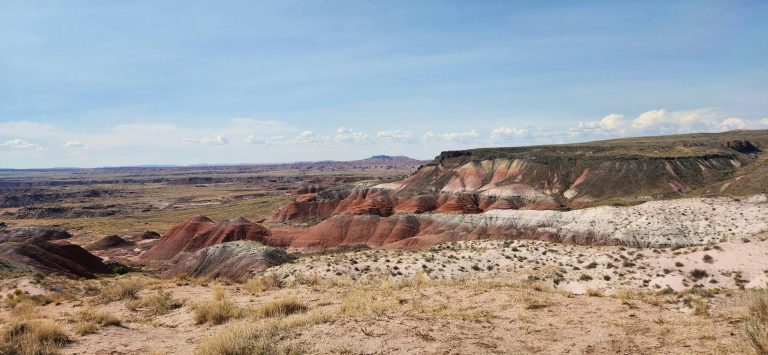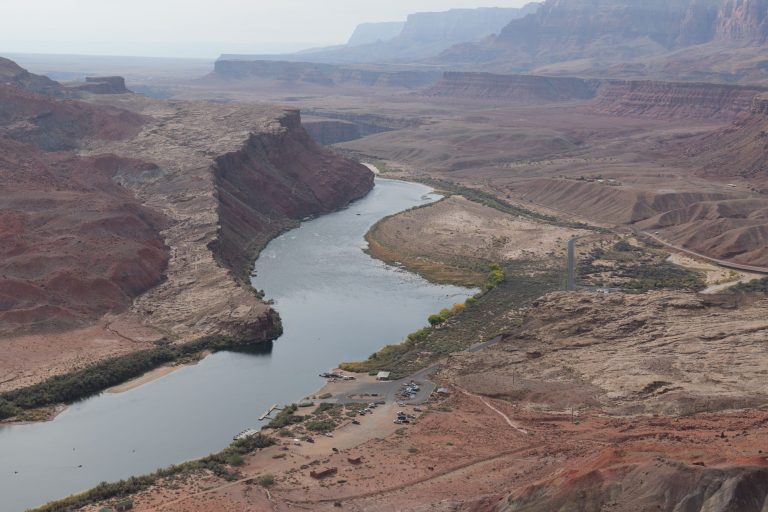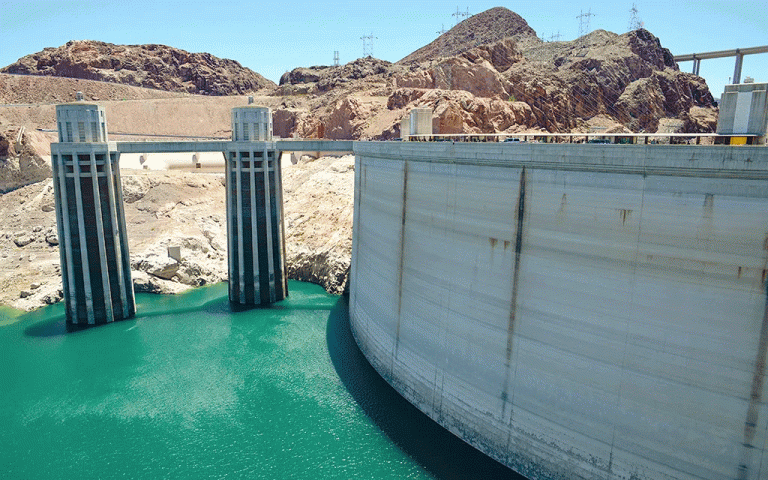
The first article in this series on June 4, described a groundwater basin that has withdrawn roughly twice as much water as it received every year for decades, with a 2024 gap between supply and demand of approximately 81,774 acre-feet. The Arizona Department of Water Resources built its projections for the Little Colorado River Plateau Basin around five scenarios extending to 2075, and none of those scenarios includes water demand from gigawatt-scale industrial development, because no such development existed when the assessment was prepared. Two proposals now moving through local approval processes, one in Winslow and one near Holbrook, would introduce exactly that category of use.
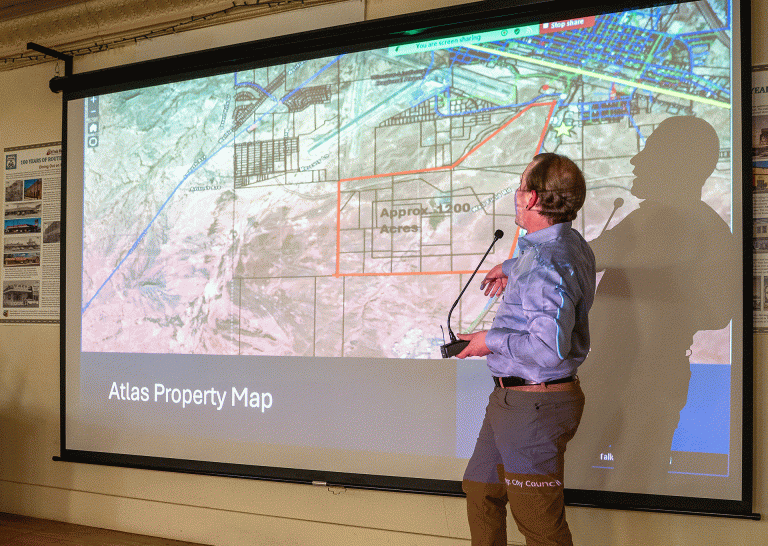
The Winslow project is the Winslow Commerce and Industrial Park, a Planned Area Development led by Atlas Global Development Group LLC. The PAD an initial zoning area of approximately 1,471 acres located south of the BNSF rail line, west of AZ-87, north of the Arizona State Prison Complex and east of the Winslow airport. There is also a potential expansion of the total project site to more than 3,700 acres, with a buildout the developer estimates at three to 40 years.
Data centers appear in the PAD as permitted use in both the Commerce Park and Industrial land use categories, subject to three conditions attached as footnotes to the permitted use table. The first requires a Utility Demand Study, defined in the document as a preliminary water and wastewater demand and generation report, before any site plan can be approved. If that study finds that any use would require more than 20% of the City of Winslow’s current water supply, the PAD states that one of two things shall occur: the city shall require a Conditional Use Permit for the data center under or the Master Developer may install water infrastructure and/or purchase water rights to meet the forecast demand. The second condition requires a noise study before site plan approval. The third states that data centers may not be constructed on the approximately 1,200 acres originally purchased from the City of Winslow, which limits to an area that largely sits just south of the Southside neighborhood.
Detailed figures are deferred to later stages: Final PAD submittals must include demand and capacity analyses for water supply and sewage Infrastructure Master Plans for water and sewer must be approved before building permits can be issued. Those later approvals are largely administrative rather than legislative. The development agreement approved alongside the rezoning contains its own water provision, described at the December 2024 Winslow Council meeting as requiring additional studies and council approval. If any phase is projected to consume more than 20% of the city’s current water supply capacity the PAD states that where its standards conflict with the city’s, the PAD standard shall apply. The PAD also permits hydrogen production and distribution in the Industrial category, a use that consumes water as a feedstock. Atlas Global head Dan Lupien said at a public meeting in December 2023 that if any resident’s well water was affected by the development, he would assume the cost of drilling the well deeper, a statement that does not appear in the PAD or any binding document the Tribune has identified.
A separate Winslow project has sometimes been conflated with the Atlas development. Global Logistics Development Partners is pursuing a lease of approximately 311 acres of city land north of Interstate 40 near the Second Mesa exit, focused on logistics and distribution as part of an I-40 trade corridor that also includes sites in Kingman and near Albuquerque. City staff told the council in April that any data center proposal on either project’s land would return to the city council or Navajo County for case-by-case approval identified energy capacity as a constraint on development south of Winslow. Atlas is pursuing the Red Sands energy project south of the prison, which could generate about 60 megawatts of solar power with 40 megawatts of battery storage.
The Holbrook-area proposal is larger and earlier in the approval process. Gordon Baier, chief executive of Go Solar Energy, has described a project he calls Gigawatt.Land on Marcou Mesa, roughly six miles northwest of Holbrook and seven miles north of Joseph City, primarily on privately owned and leased land. The initial phase would cover more than 5,000 acres and combine roughly 1.5 gigawatts of on-site generation with an equal amount of storage, exchanging up to 500 megawatts with the Arizona Public Service grid, alongside a proposed 345-kilovolt transmission line to Winslow and Flagstaff. Baier has said that data centers would anchor the industrial side with server waste heat possibly being directed to chemical processing including fertilizer production, that the development would support around 500 permanent jobs and that he is working with Atlas Global’s Dan Lupien to share infrastructure between the two projects.
On water, Baier has said the project would use a closed-loop geothermal cooling system in which water circulates through an underground heat exchanger and returns, which he says would eliminate evaporative loss. That description is the only water information in the public record for the project and no engineering documentation, demand estimate or identified source for this part of the project has been filed with the county. Closed-loop systems avoid the continuous evaporative consumption of conventional cooling towers, though they still require water for initial fill and periodic replacement and fertilizer production generally requires both water and hydrogen as inputs. The site sits in the portion of the basin where, as described in the first article of this series, groundwater is most influenced by the buried salt deposit south and east of Holbrook.
County Manager Bryan Layton said developments like Baier’s must go through a development agreement with the county, a document negotiated with the developer and made legally binding after a public approval process. Layton said such an agreement can set a limit on the number of gallons of water a project may use and can restrict its energy consumption, terms the county can legally enforce if they are broken. He also said that at this time no data center has submitted paperwork to Navajo County.
How much water either project would use depends almost entirely on design choices that neither has disclosed in any reviewable form. Independent estimates place the water use of a single data center anywhere from 50,000 to 5 million gallons per day, because cooling technologies differ so widely and there is no exact scale for the data centers being proposed. Evaporative and water-cooled systems consume less electricity but more water, while air-cooled and closed-loop systems consume little water on site but require more power, which shifts water demand to whatever generates that electricity. Thermal power plants consume substantial water for their own cooling while solar and wind consume very little, so a data center’s total footprint depends on both its cooling design and its power source.
For comparison, a proposed Tucson data center complex known as Project Blue was estimated in city documents at about 870 acre-feet per year at full buildout of its primary site under its original design. After the Tucson City Council rejected the project and refused it city water, the developer redesigned it around closed-loop air cooling and its state well permits now cap withdrawals at 96.5 acre-feet per year, with the company estimating actual use of 15,000 to 20,000 gallons per day, or roughly 17 to 22 acre-feet annually, with water needed mainly for the initial loop fill and domestic uses. One acre-foot is approximately 325,851 gallons, enough to supply roughly two average Arizona households for a year.
At the high end, a very large data center campus using evaporative cooling can consume around 5 million gallons per day, or roughly 5,600 acre-feet per year, and two such facilities would together draw about 11,000 acre-feet annually, which would add roughly 14 percent to the basin’s existing deficit of 81,774 acre-feet and exceed half of what all agriculture in the basin used in 2024. At the low end, a closed-loop design like the one adopted for the redesigned Tucson project would use tens of acre-feet per year per facility, an amount smaller than a single irrigated field and negligible against the basin’s water budget.
The regulatory backdrop is thinner here than in the urban parts of the state. Though the Winslow development agreement and PAD footnotes function as a local version of such a framework. Most bills introduced at the Legislature this session to limit data center water use did not advance and a per-gallon water fee proposed by Gov. Katie Hobbs has not been enacted. The 2024 Northern Arizona Indian Water Rights Settlement Agreement, which would resolve the water claims of the Navajo Nation, the Hopi Tribe and the San Juan Southern Paiute Tribe once authorized by Congress, remains unauthorized and the relationship between new industrial water permits and the eventual terms of that settlement is not formally defined.
What the public record contains at this point can be stated plainly. In Winslow, the record includes an adopted preliminary zoning framework, a development agreement, a 20% water threshold with two possible compliance paths and a requirement that water studies be completed before site plans are approved, but no completed water study, no demand figure and no named end user. Near Holbrook, the record includes a described project concept, a stated cooling approach, a proposed transmission line and a developer timeline, but no filed water documentation, no permit approvals and no board vote. The decisions that will determine how much water these projects draw will be made phase by phase in site plan reviews, utility demand studies, infrastructure master plans and city and county hearings, against a water budget that the state’s own assessment shows has been in deficit for as long as records have been kept.