Last week, Winslow City Council and staff outlined how two large-scale development projects differ in structure, location and oversight, while clarifying how potential uses such as data centers fit within the city’s land use framework.
Economic Development Director Jack Fitchett outlined a development effort involving Global Logistics Development Partners, or GLD. The GLD project centers on approximately 311 acres the company plans to lease from the city north of Interstate 40 near the Second Mesa exit, with a focus on logistics, distribution and commercial support services rather than heavy industrial use. Fitchett said Winslow is one of three locations being developed as part of a broader I-40 trade corridor, alongside sites in Kingman and near Albuquerque, intended to support the movement of goods from the ports of Long Beach and Los Angeles inland. “Their main focus is not so much industrial as it is our logistics partner,” he said, explaining that the project is designed to capture existing freight traffic along Interstate 40 and create local economic activity tied to that flow.
Unlike the Atlas Global development, which is centered south of town and involves a large-scale industrial park, the GLD project is expected to include distribution centers, truck mobility services and smaller-scale manufacturing operations, along with supporting commercial uses such as hotels, restaurants and related amenities.
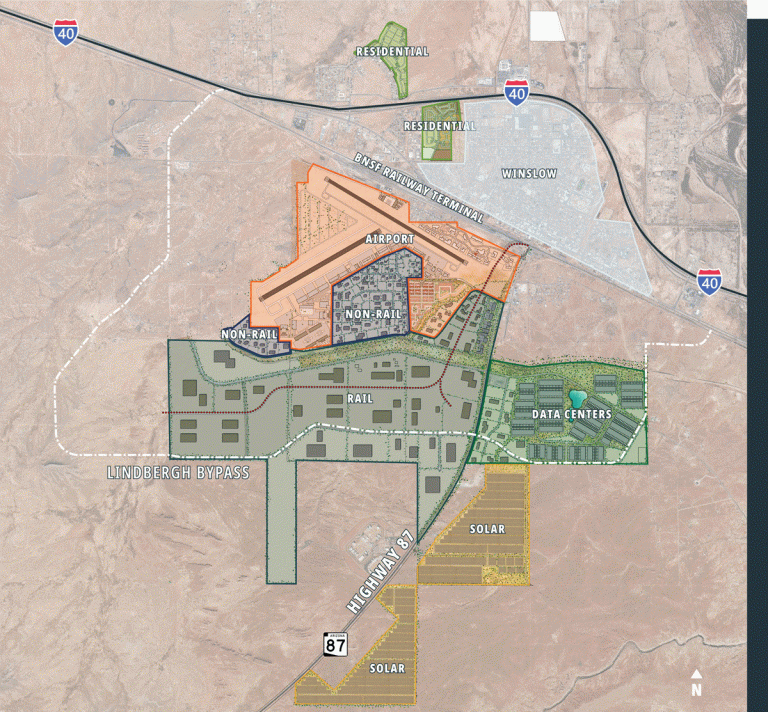
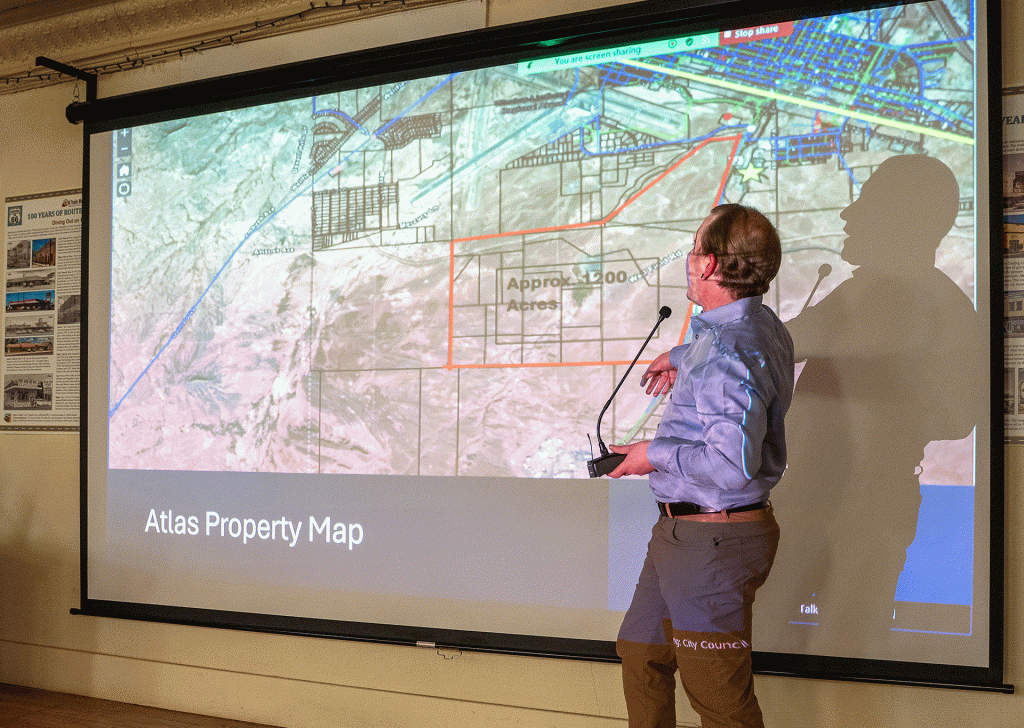
Fitchett said the city’s agreement with Atlas Global Development, which includes roughly 1,170 acres currently being financed by the developer, already contains restrictions addressing one of the central concerns raised by residents.
“That was one of our provisions that we put into the plan,” Fitchett told council. “It says specifically in the PAD, or planned area development, that data centers cannot be constructed on the 1,170 acres that the city sold to Atlas.”
However, the PAD also includes about 300 acres within city jurisdiction that are not city-owned. That land has been identified by Atlas for potential data center use and largely sits directly south of the Southside neighborhood.
Fitchett said Atlas also holds options on approximately 2,000 additional acres south of Winslow in unincorporated Navajo County. Those parcels are not subject to the same restrictions.
“If it’s not within the city limits, it’s not governed by the same standards,” he said, noting development on that land would fall under county jurisdiction and development agreement unless annexed into the city.
That distinction became central to the council’s discussion. While the city can prohibit data centers on the land it sold and zoned, it cannot extend those restrictions to property outside city limits, even if it is controlled by Atlas or tied to the broader project.
Fitchett said annexation would be the primary way to bring additional land under city oversight but cautioned it is not a simple solution. Any annexation request would require the developer to meet city development standards and receive council approval.
“If Atlas wants to be annexed into the city, they’ll be working with us to make sure that whatever development they want to put there meets our code and our standards,” he said.
He added that annexation cannot be applied retroactively. Projects developed under county authority would not automatically be subject to the same PAD restrictions after being brought into the city.
Fitchett also speculated that broad bans on specific types of development could have unintended consequences, pointing to past instances in Arizona where state lawmakers limited local control in response to municipal restrictions.
“When cities do an outright ban on one specific type of development, what has happened more often than not is the state comes back and preempts us entirely,” he said. “And now you have no ability to regulate it at all.” Implying that if the community doesn’t comply the state may force these developments to happen without an agreement at all. However there have been no specific actions by the state or legislature that would suggest interest in forcing communities to allow data centers.
The discussion also highlighted infrastructure limitations, particularly energy capacity, as a major constraint on development south of Winslow. Fitchett said large-scale industrial users require significant power, which will influence what projects can move forward.
To address that, Atlas is pursuing the proposed Red Sands energy project south of the prison, which could generate about 60 megawatts of solar power and 40 megawatts of battery storage. While not described specifically as a data center project, the scale reflects the type of demand associated with high-energy industrial uses.
Fitchett said any future decisions about how that land is used will ultimately come down to separate approvals tied to each parcel, whether through annexation, zoning changes or county review. That means proposals such as data centers would not move forward automatically but would instead return to either the Winslow City Council or Navajo County officials for case-by-case consideration as development plans are submitted. He also clarified that at this point in time no specific plans for data centers have been discussed with the city.