When Mike Hawkins was growing up in Winslow, and he saw someone unfairly picking on someone else, he’d step in, recalls WHS classmate and friend Jeri Meikle Nowakowsaki, a retired educator and university president. “He was outspoken. Had views and expressed them. He had a sense of what’s right and fair.”
In high school he played football and baseball, was selected for National Honor Society as a senior who, according to Nowakowsaki, “was a leader, very active, popular, and always with the cute cheerleader girls.”
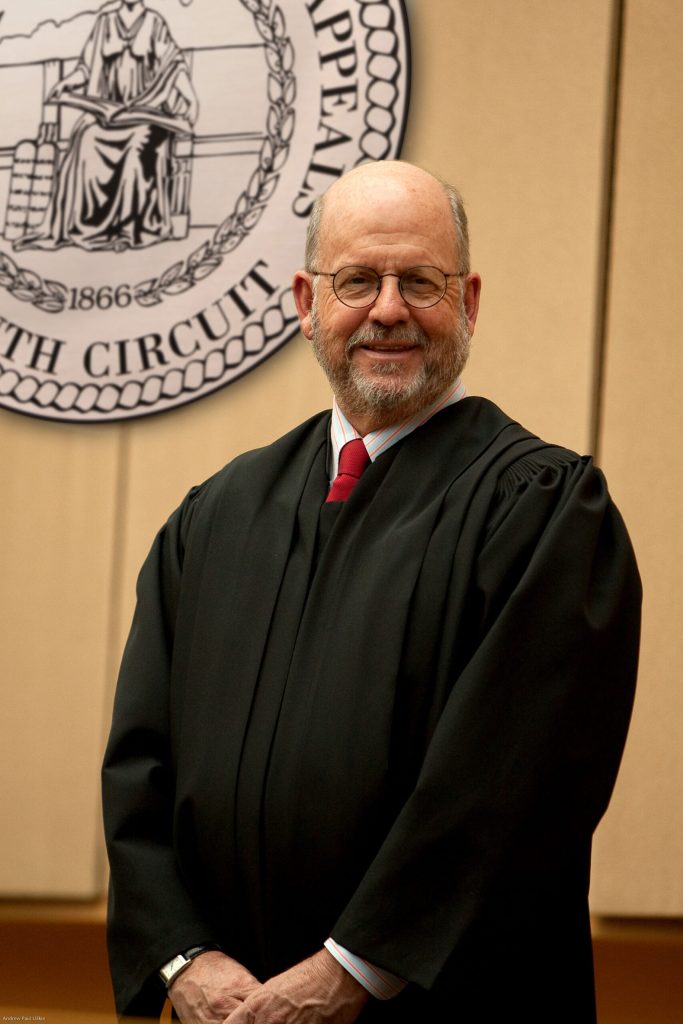
Today, as a judge on the U.S. Ninth Circuit Court of Appeals since 1994, Hawkins is often called upon to hear high profile cases, like President Trump’s challenges to birthright citizenship and citizen challenges to administration efforts to terminate Temporary Protective Status for immigrants from countries experiencing natural disasters.
Born in Winslow in 1945, and member of the class of 1963, Hawkins earned his B.A. (1967) and law degree (1970) from Arizona State University, later completing a master’s degree in law at the University of Virginia (1998). He served in the U.S. Marine Corps from 1970 to 1973, ending his career there as a Special Courts-Martial Military Judge, then entered private law practice, before serving as U.S. Attorney for Arizona (1977–80).
Back in private practice until 1994, he played a key role in the 1987 Navajo political strife as a special prosecutor for the Navajo Nation over controversy surrounding the Big Boquillas Ranch purchase under the Peter MacDonald administration. “When the allegations were raised, I retained former U.S. Attorney Michael Hawkins to review the ranch purchase transactions for any improper acts,” recalls Michael Upshaw, then the tribe’s attorney general in the Spring 1990 Arizona State University Law Forum Journal. As the U.S. attorney, Hawkin’s office prosecuted MacDonald resulting in an acquittal.
Hawkins told the Navajo Tribal Council (as reported by High Country News, Aug. 1, 1988) that “there was no evidence of impropriety on the part of tribal officials,” though he was “unable to question the owners of the intermediary firm.”
His path also ran through politics. While attending a state convention meeting in Globe, some of the delegates realized they needed someone from a small town to serve as a delegate, recalled Upshaw.
Jake Baker, a sixth grade teacher from Winslow told the group: “One of the people here is from a small town,” and pointed at Hawkins. He was selected. Then as a young delegate to the 1974 Democratic convention he happened to sit next to then-Pima County Attorney Dennis DeConcini’s mother. In speaking with Hawkins, he stated, “We talked and got really close,” he said. “Some time passed (after the convention) and Dennis (DeConcini) showed up at my office. He walked in and said ‘my mother says I need to see you. I need help with my campaign.” Hawkins joined, rose to serve as campaign chairman for DeConcini’s 1976 senate victory.
Having won a senate seat, it was time for the new senator to assemble an office staff. “I didn’t have any interest in becoming part of his Washington, D.C. staff,” he said. “But I was interested
in being U.S. attorney for Arizona,” noted Hawkins. Sen. DeConcini asked Hawkins and he accepted the post. Then almost 14 years later, as DeConcini was retiring from the Senate, he asked if Hawkins wanted to be a federal judge. Hawkins said “yes,” and was nominated by President Clinton, and confirmed unanimously by the U.S. Senate in September 1994. Today Hawkins serves as a Senior Judge on the U.S. Court of Appeals for the Ninth Circuit—the federal appellate court just below the Supreme Court that reviews cases from nine western states and Pacific territories and resolves appeals from federal trial courts, the last step before the U.S. Supreme Court.
Recently, Hawkins has been part of Ninth Circuit panel’s handling challenges to President Trump’s attempt to limit birthright citizenship. In July 2025, a Ninth Circuit panel kept a block on the executive order, finding it likely violates the 14th Amendment and that the states suing needed relief broad enough to work in practice—even after the Supreme Court’s June 27 decision narrowed the use of nationwide injunctions.
“As a classmate and friend, it has been inspiring to watch Mike rise to such an important position in our country, where decisions are made that affect all of us as Americans,” said Nowakowsaki. “It provides evidence that a kid from Winslow can make a big difference—as he and others truly have.”
Hawkins credits home and particularly his wife Phyllis for his compass. In his February 2025 book, Big Bug Creek: Stories of Growing Arizona, about a pioneer family’s Arizona roots and his own years in Winslow, he reflects on standout teachers who also mentored future luminaries like the late U.S. Attorney General Richard Kleindienst and former U.S. Ambassador William P. Mahoney. “I would say the teachers at Winslow have a lot to do with our success, as well as a supportive community. Those are the two things that had a big impact on me,” Hawkins said. He adds that, around the fifth grade he decided he wanted to be a lawyer. But he “had no idea, while living in Winslow, what my future might be like.” His memories include close Navajo friendships. “On my fifth grade basketball team, I was the only starter who was not Navajo”—and he remembers a Navajo student who would run the long miles back toward Oraibi.
The ties endure. Hawkins and his wife of 60 years Phyllis (also a WHS grad) return to Winslow from time to time. “We stay at the La Posada and walk around, checking out places we used to live. We’re anxious to get back, to check out the remodel of the Root Beer Stand where Phyllis used to work.”
In 1979, he spoke to the graduating class at Winslow High School. His message to
students: “Find a job you love and you’ll never work a day in your life.”
And the writing continues: alongside “Big Bug Creek,” he’s working on another collection, “Small World and Other Stories.” “I hope to get it out by the end of the year,” he said.