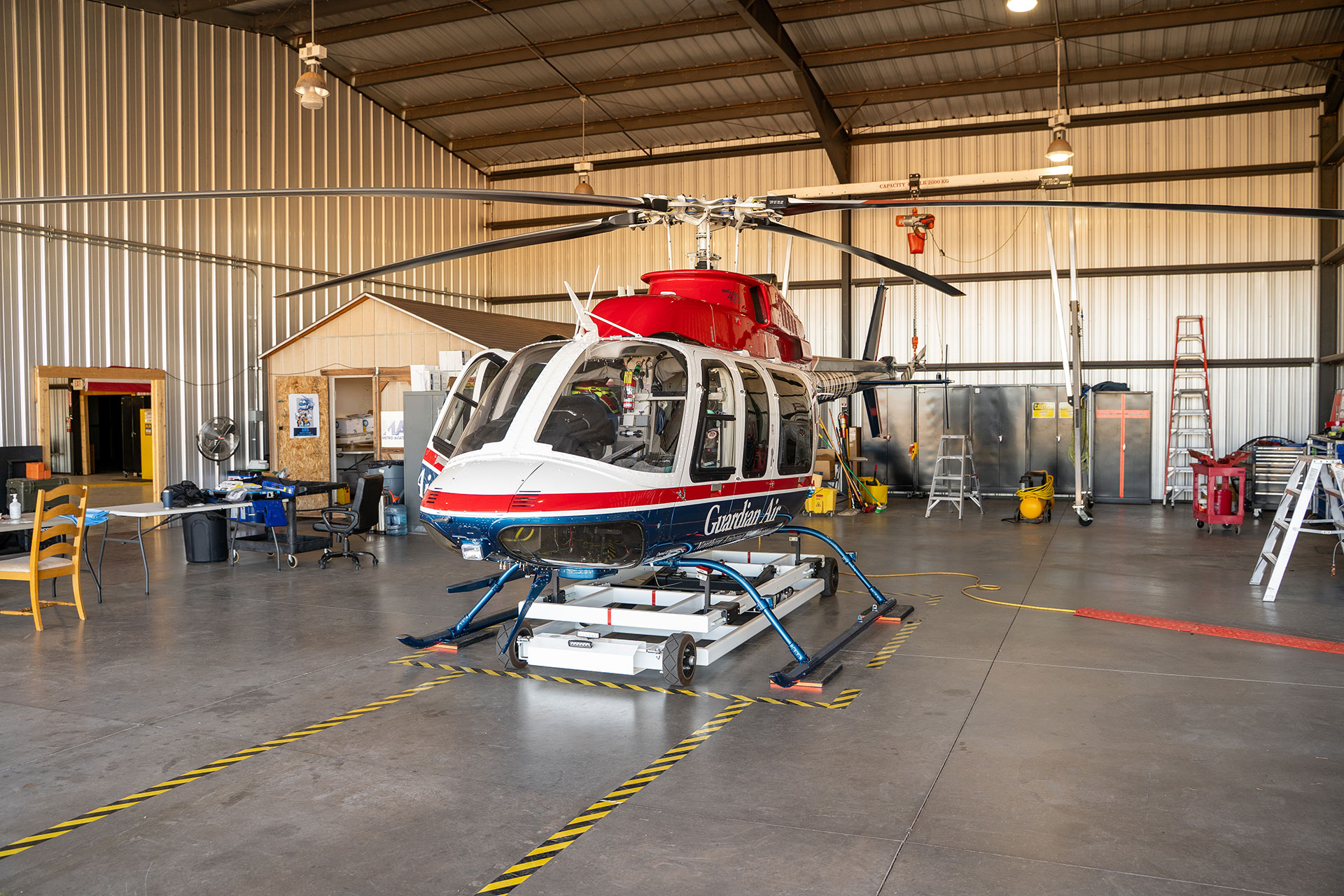
The call doesn’t come to Winslow first. It comes to a room in Flagstaff, where Guardian Air’s communication center picks up the phone from an emergency department, a rural clinic or an ambulance crew somewhere across northern Arizona and starts writing down the things that matter. Not the patient’s name and not yet the diagnosis. What the comm center needs immediately is where the patient is, where they might be going and how much they weigh, because that last one determines whether a helicopter can come at all. Then the center passes it to the base as a weather check and the clock starts.
From that moment, Guardian’s crews aim to be off the ground in roughly 10 minutes. It sounds fast until you hear what’s packed inside it and the complexity of the situation begins to sink in.
The pilot gets the weight and the destination and almost nothing else, then begins doing math that won’t stop until the aircraft is back on the pad. How much fuel is on board, how much the flight will burn, how much has to remain at the far end, because Guardian’s standard is to arrive with 30 minutes still in reserve, which means knowing the entire shape of the flight before committing to the first minute of it. At the same time the pilot is reading weather in three places, since a Bell 407 cannot fly through a thunderstorm and the question isn’t only whether the sky is clear over Winslow. It’s whether it’s clear between here and Chinle, whether it’s clear over Chinle and whether the cell sitting 40 miles east will have drifted into the return path by the time they’re loaded and pointed at Flagstaff.
“The pilots are meteorologists and mathematicians,” said Tony Carrozzino, chief flight paramedic and business development manager for Guardian Air Transport. “They’re constantly doing math. They have to figure out these weights, figure out the fuel level, figure out distance, factor in wind.” None of it starts from scratch, since the pilot coming on shift has already walked the aircraft and already has a sense of what the day’s temperatures will allow. If it’s an early afternoon in July, the answer to some missions is simply no.
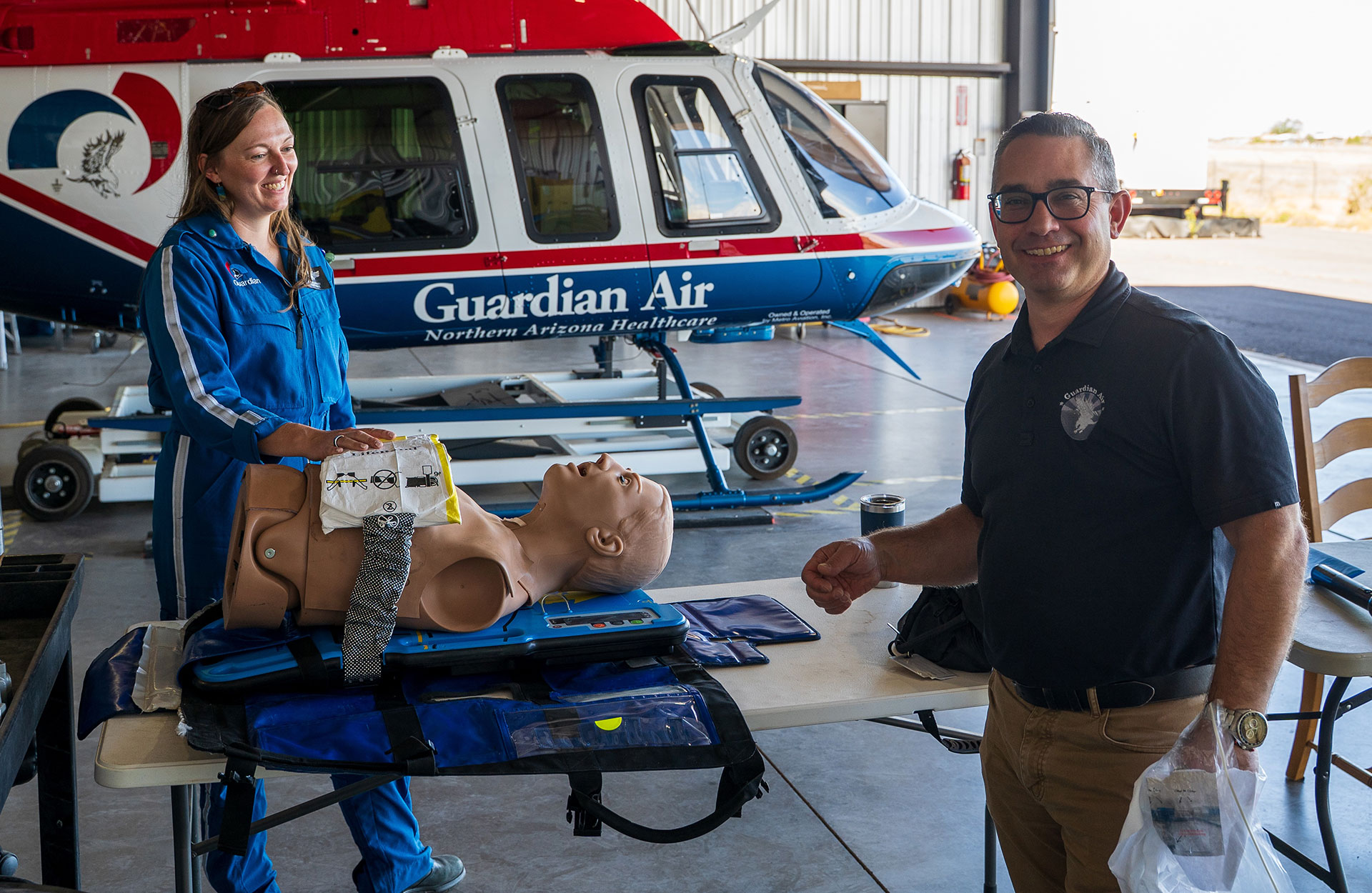
While the pilot runs numbers, the clinicians triage their own equipment rather than the patient, because a helicopter has a hard weight limit and every pound of patient is a pound of something else that comes off the aircraft. The mechanical CPR device that performs chest compressions automatically in flight is a superb piece of equipment and also a heavy one, so it’s among the first things left in the hangar when margins get thin. If the crew thinks it’s flying toward a cardiac patient, the device goes aboard and sometimes onto the patient before takeoff, sitting there unused with a button waiting to be pushed. If they’re flying toward a hiker with a broken femur, it stays home and somebody decides which comes or goes in about the time it takes to walk to the pad.
Here’s the strange part: they make that decision without knowing who they’re flying to get and that’s deliberate. “That is why we don’t know what the patient is before we get the weather check,” Carrozzino said. “Is it safe? Is it legal? Is it prudent? Yes or no?” The reasoning is uncomfortable and completely sound, because a crew that knows there’s a 4-year-old waiting at the other end will find reasons to launch into weather it has no business launching into. The industry learned that over decades at a cost it hasn’t finished paying, so the aviation decision gets made blind, on physics alone and only afterward does anyone find out what the mission actually is.
Guardian runs two helicopters out of Winslow and the hangar at the airport is much of the reason they’re here. The second aircraft used to be based at Hopi Health Care Center, closer to a community that badly needs it, but the logistics kept fraying. Pilots work seven days in a row on 12-hour shifts and finding pilots willing to live on the reservation for that rotation became the bottleneck, while the mechanic would drive two hours out only to watch the aircraft lift off on a call that kept it gone for four to seven hours.
The aircraft moved to Winslow in December of 2024 and the math that justified it is the same math that governs everything else here. It is a 12-minute flight from Winslow back to Hopi Health Care Center, and over an hour by road. “Having a base that was on the reservation was really important to us,” Carrozzino said, “but we can actually service the community better by being here.” The hangar shelters both aircraft from sun and weather, the crews share tooling, parts and a full-time mechanic Scott Parker, and the two helicopters take turns going wherever the calls fall.
What’s coming is anywhere from one to six calls a shift and the clinical crews work 48 hours at a stretch. Jordan Sweeney, a flight nurse and a base coordinator at Winslow, has a plain description of how a person survives that. “It’s a marathon, not a sprint,” she said. “You come to work and when you’re tired you take a little bit of rest, catch a little bit of sleep. Ultimately it’s two days at a time and if you’re tired for two days, then you go home and get caught up.” Sweeney commutes from Flagstaff and sleeps in crew quarters between calls and others drive in from Prescott, Cottonwood and points much farther south, because long shifts buy long stretches off.
The clearest argument for any of this is a stopwatch. Chinle to Flagstaff takes Guardian roughly an hour by air and about three hours by ground and the North Rim of the Grand Canyon is five hours of driving against 15 minutes of flying. But the time savings are only half the case and arguably the less important half, because what lands with the helicopter is critical care that wasn’t there a minute earlier. “We’re bringing that ICU, that ER, to the patient,” Sweeney said. “We’re initiating that level of care instead of that three-hour drive before they start having that care initiated.”
The clinics they fly to on the Navajo Nation do extraordinary work with very little, which is the context for what Guardian carries in the door. The emergency physician at a small facility may be the only physician in the building that night and a facility may hold two units of blood total for the entire hospital. Guardian’s crews carry blood products, plasma and packed red cells, which they began about two years before and which Carrozzino calls the most important addition the program has made in recent memory.
They can perform rapid sequence intubation, sedating and paralyzing a patient to open an airway rather than only intubating someone already too far gone to resist and they can evacuate air or blood collecting around a lung. That last one matters more in a helicopter than almost anywhere else, since trapped gas expands as you climb and a chest injury that looks stable on the ground can get worse simply by going up.
There’s a third benefit that almost nobody outside EMS thinks about and it may have the widest reach of all. When a rural ambulance drives a patient to Flagstaff or Phoenix, that ambulance is gone for six hours, or 12 and some communities have exactly two of them. “They might only have a couple of ambulances and if they take them out of service to take somebody to Flagstaff, they’re gone,” Sweeney said. “So that’s six to 12 hours, that that ambulance isn’t able to service the community for regular 911 calls.” Flying the patient keeps the ambulance in town, which means the flight sometimes isn’t really about how sick the patient is. It’s about what the community will need at two in the morning.
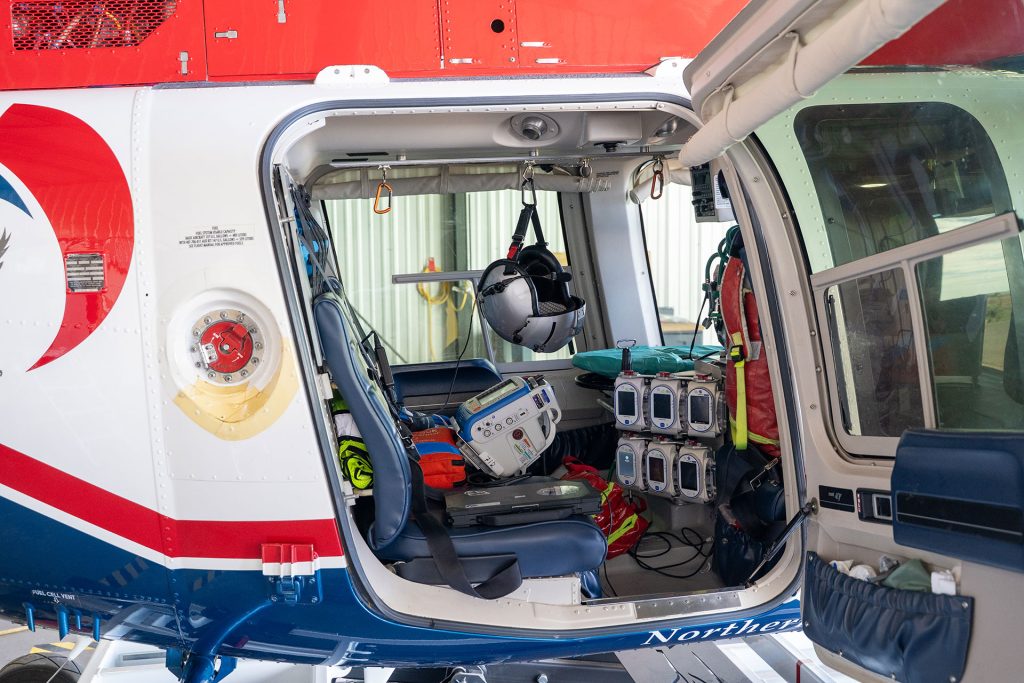
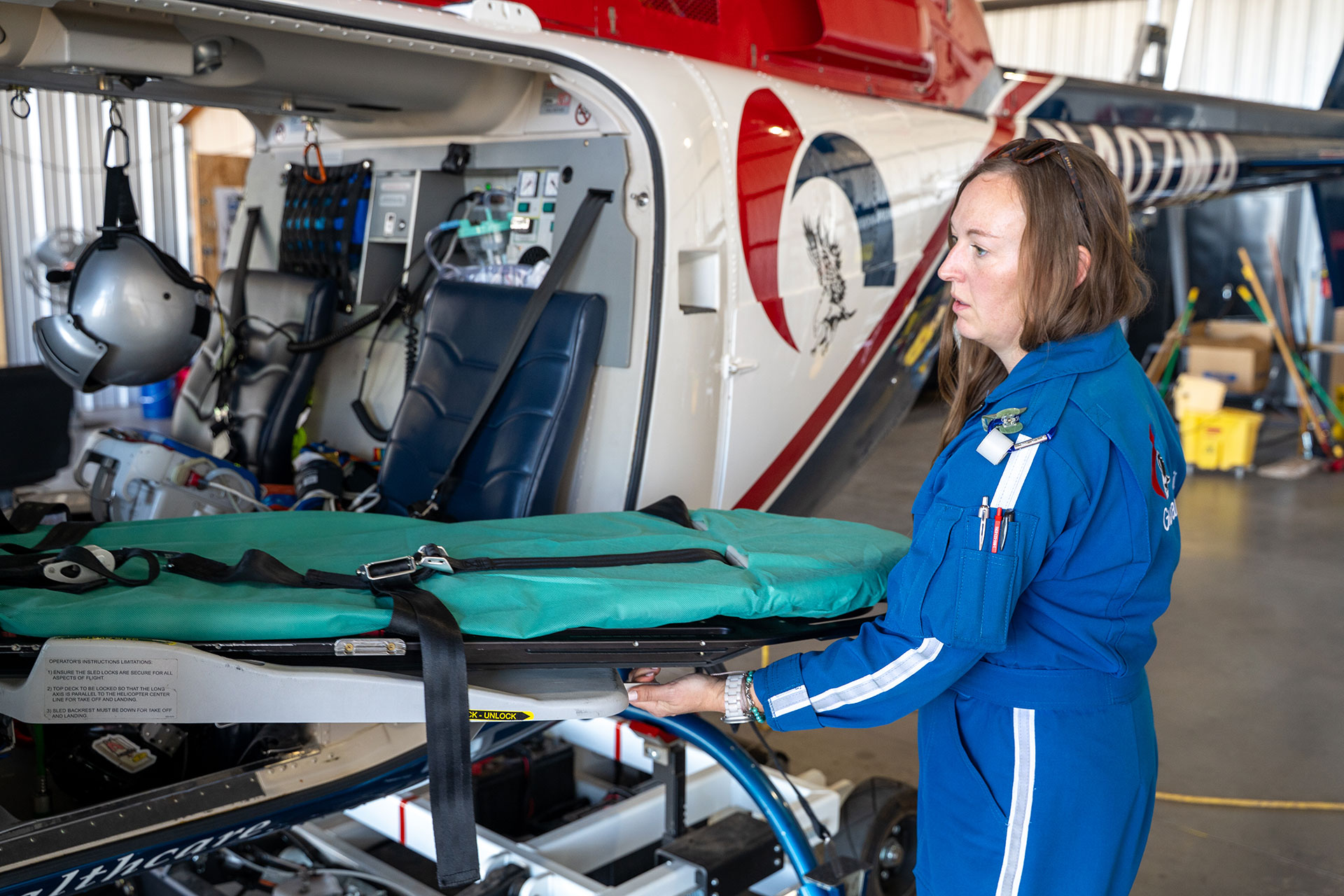
The aircraft doing all this is smaller than people picture. Guardian’s Bell 407s are, in the words of the people who work inside them, smaller than a Volkswagen Beetle, with a single pilot up front because the patient occupies the space where a copilot would sit. That leaves a nurse, a paramedic and a patient in back, an arrangement the crews joke about in the bleakest available terms: four people in there and sometimes one of them is trying to die. Everything aboard has been chosen and there’s one of most things and the patient’s feet point toward the pilot so that one clinician sits in precisely the right position to manage an airway in flight if it comes to that.
What makes this program unusual isn’t the medicine, it’s the map. A crew in Phoenix might fly seven minutes from one hospital to another because a patient needs something highly specialized, and the pilot can top off the tank and not think about fuel again. Guardian may fly two hours to reach a single patient and then another stretch to get them somewhere that can help, which is why the fuel reserve and the weight math never stop. Carrozzino, who came from Ohio for this job, says the distances are part of the appeal, since he wanted to be responsible for a patient for an hour or more rather than 15 minutes across a city.
The desert compounds it. Temperatures swing 40-50 degrees between afternoon and night here, and hot, thin air robs a helicopter of lift at exactly the hours the calls tend to come. Pilots arrive from Louisiana or Texas having never flown anywhere that wasn’t at sea level, then must learn terrain, density altitude and a service area with very few places to stop. Carrozzino calls it one of the most demanding flight programs in the country and the volume backs him up, since Guardian’s pilots can log more night-vision hours in a month than some programs put on a whole base in a year.
Getting hired to do this is hard and it’s hard on purpose. Guardian pairs a flight nurse with a flight paramedic, both trained to the same level of care and differing mainly in what state licensure allows each to do. Nurses arrive with years of critical care behind them and paramedics need a minimum of three years in a genuinely busy system, a qualifier Carrozzino stressed harder than the number itself, because three years running one call a week is not three years. After a competitive application process comes roughly five months of onboarding before anyone flies for real. “It’s not on-the-job learning,” he said. “It’s very structured in how we break that out.”
The training never lets up either. Every clinician completes 100 hours of education a year and performs an intubation on live human tissue every six months, going into an operating room if it hasn’t happened in the field. Once a year the entire organization shuts down for a safety day, taking itself out of service statewide so everyone can be in the same room and Guardian knows exactly what that costs in a region where there isn’t always another aircraft to fill the gap.
Pilots face their own gauntlet of more than 2,000 hours as pilot in command, full instrument ratings and substantial turbine time, which Carrozzino called the crème de la crème of helicopter jobs.
That makes the current situation a little galling, because Guardian is short, with three or four open pilot positions at Winslow amounting to a full night-shift rotation. Metro Aviation, the vendor that employs the pilots, is flying float pilots in from around the country to backfill, so flights aren’t being cancelled, they’re just costing more.
The safety culture behind all of this was built on a body count and the people in this hangar will tell you so without being asked twice. Carrozzino spent his earlier career as a firefighter, where the calculus ran differently. “We used to risk a lot to save a lot,” he said. “If we had a child in a burning building, we would risk a lot to try to save them. It changes for us in this aspect, that we have three people that are inside the aircraft and we’re not pushing those limits.” Then, more bluntly: “Our industry has killed a lot of people. We’ve learned a lot of things through blood.”
Some of what the industry learned is now hardware. Pilots once got evaluated twice a year by a check airman sitting beside them asking for maneuvers and now they train in full-motion simulators that can set a fire in the cockpit or drop the aircraft into an uncontrolled spin. Flying accidentally into cloud used to be close to a death sentence, with the aircraft hitting the ground inside about 30 seconds and everyone aboard dying and that statistic has changed outright because of those simulators, Carrozzino said. Night vision goggles tell a similar story, since nobody wore them when Guardian first based an aircraft here and everyone wears them now.
The thing the crews most want the public to understand has nothing to do with aircraft at all. It’s about the hospital down the road. “We’re taking patients from LCMC not because they’re not getting good care, but because it’s a community hospital and it’s limited in resources,” Carrozzino said. Little Colorado can’t sustain a cardiac catheterization lab, not for any lack of will but for lack of volume, because interventional cardiologists need to be doing 10 cases a day to maintain a practice and those cases aren’t in a city of 9,500. “It’s really important to highlight the care that is here and that we’re an extension of that,” he said. “We’re not coming to save people from LCMC.” If LCMC weren’t in Winslow, the nearest emergency room would be an hour away for residents of Winslow, not to mention all the other cities that rely on LCMC, and the crews were emphatic that this community is beyond fortunate to have that hospital.
Guardian Air turned 41 this August, having started flying on Aug. 1, 1985, and it’s the oldest hospital-based nonprofit air medical program in Arizona, which means it’s locally owned, locally accountable and not subsidized by anybody. It is owned by Northern Arizona Healthcare, the parent company that runs Flagstaff Medical Center and they operate it as a service for the people of northern Arizona.
Asked what the program looks like in 10 years, Carrozzino didn’t talk about helicopters. “The biggest risk we have right now is this whole transformation of healthcare,” he said. “We don’t know what’s going to happen nationally at the federal level. We don’t know what’s going to happen at the state level. If 75% of our payers are government payers and they want to find ways to not pay at all, this system can’t continue.”
Demand, meanwhile, keeps climbing, with Guardian expecting more than 4,000 patient transports company-wide this year, which would be a record. The reasons aren’t encouraging, since there are fewer EMS professionals than there used to be and hospitals are shedding service lines, so patients travel farther for the same care while the helicopters absorb the difference. Carrozzino watched a version of this in Ohio, where rising malpractice costs for obstetricians created what he called an OB desert, with hours of driving between one labor and delivery unit and the next. “We are definitely seeing where patients are having to go further to get that care,” he said, before summing it up: “Population growth doesn’t stop because of malpractice insurance.”
Ask the crews for war stories and you’ll get a polite decline. “I never want to share the trauma that we’ve experienced,” Carrozzino said, explaining that everyone wants to know the worst thing they’ve ever seen and that plenty of people in this line of work carry PTSD from a standard day at the office. Sweeney even says she forgets a lot of what happens, which is a defense mechanism the brain sometimes does after trauma. What they offered instead were two moments.
Sweeney flew a child not long ago, sick with a respiratory illness, whose mother couldn’t come along on the flight, there’s no room. The boy was frightened and working hard to be brave about it, so the crew handed over stickers and a stuffed animal and made him an honorary member of the flight crew for the duration. Somewhere over the high desert, halfway to Flagstaff, the pilot glanced back and found him sound asleep after having fully intended to see every last sight along the way. He woke up on the helipad at Flagstaff Medical with no clue where he was. “Those are the things I remember,” she said.
Carrozzino’s was harder. He tries to impress on new crews that sooner or later they’ll pick up a patient who may not survive the flight and that the person standing in the parking lot may be a wife of 45 years who has never spent a night apart from her husband. He tells them that sometimes stopping for three minutes to let them talk before the doors close is better medical care than getting the fastest time to the hospital. “There’s a real human aspect of what we do and sometimes we get very used to it, because we see it on a daily basis,” he said. “We’re being called on someone’s worst day and it’s easy for us to normalize all of that. People always remember how we make them feel and we may not even remember that it happened.”
Ten minutes to wheels up and that math turns out to be the easy part. The hardest problems are the calculations that happen above the ground, at 150 mph, with a stranger’s life as the variable to solve.