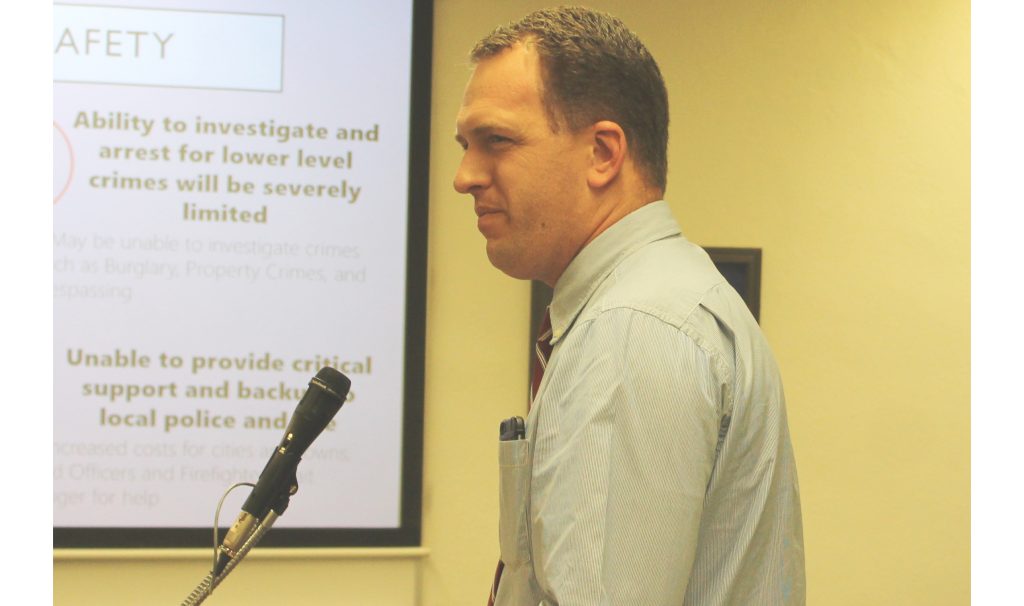
Concerns from double-dipping to cutting back on jail services were mixed with questions as to whether Proposition 419, the Jail District tax, would become like the toll roads in the Midwest, were voiced at the Snowflake Council meeting on Sept. 4.
Members from Navajo County staff, including County Manager Glenn Kephart, Assistant Manager Bryan Layton and Sergeant David Clouse gave an updated presentation to the council regarding the ongoing efforts to inform the citizens regarding Proposition 419, which would raise sales tax county-wide by one-third of a cent and will be on the November ballot.
“We began this discussion as a result of the declining coal production and we want people to understand what this is about,” said Kephart. Since 2008 the county has lost $11 million in sales tax. Another $200,000 was lost in property tax from the Cholla Power Plant unit closure. Add to those losses the 254 percent rise in retirement costs and a 40 percent increase in health care, which caused the county reduce staff by 16 percent. Last year was the first time services were cut with the closure of the Juvenile Detention Center and the cutting of the County Attorney’s Child Support program.
With a big push to streamline services and reduce costs, Kephart noted that this last year was a pretty good economic year for the county. But with the closing of the Navajo Generating Station by 2019, the county will lose an additional $1.6 million in sales tax revenues from the Kayenta Mine, as well as the property tax. Coupled with the Cholla Power Plant scheduled for closure by 2025, the county will be facing an estimated annual shortfall of $2.5 million.
In an effort to be proactive, the Navajo County Board of Supervisors approved the Jail District Tax on July 10. On Aug. 14 a public hearing was held with no opposition and now the Jail District tax, formally known as Proposition 419, will be on the November ballot.
The tax can only be used for the daily operations of the jail, which cost Navajo County approximately $5 million each year. Without the tax, the county is facing the dire possibility of reducing staff by 20-25 percent, a reduction that would impact the Sheriff’s Office as well.
On the flip side, should Proposition 419 pass, the cities and towns in the county would no longer be required to pay jail fees and the $425,000 that was paid in this year, will be another resource the municipalities can have at their disposal.
“It seems like the county is double-dipping on its citizens through this tax,” said Councilman Cory Johnson, as he went on to explain that people associate the Sheriff’s Office with Heber-Overgaard to the west and past the Country Store out east. “Have you looked at raising the property taxes on those areas, especially since Heber-Overgaard does not have a police department,” asked Johnson.
Kephart responded, “The maximum levy we could implement countywide would be a two percent raise and that would only generate an additional $130,000 for county operations.”
Councilwoman Allison Perkins asked how the jail could be reduced stating, “I struggle to see more money go to jails.”
Clouse responded, “The Sheriff is mandated by the state to provide a jail. Closing the jail is not an option.” He added that the Sheriff does make the inmates pay for their meals, their toilet paper and other services. “The Sheriff even gets pizza for $4 and sells it to the inmates for $10 to raise money for the GED program.”
Clouse acknowledged that the biggest headache in the county was the jail, “but we are mandated by law to have it.” He went on to share the reality of jail is that so many of the inmates are not healthy and even though an inmate is charged $15 every time they seek medical services, it doesn’t stop situations like the inmate that was picked up on a $300 warrant and ended up with an aneurysm which cost the County more than $30,000 for the transport to Phoenix.
Councilman Byron Lewis asked if there was an escape clause in Proposition 419. To which Kephart replied, “It is set for a 20-year period and can never be raised above the third of a cent.” Kephart also noted, “There are statutory procedures in place for dissolving special taxing districts. Voter approval would not be required to dissolve the district if the need arose. Also, the Board of Supervisors can adjust the rate lower than the proposed one-third of a cent in the future, but according to state statute the tax cannot be increased above the one-third of a cent.”