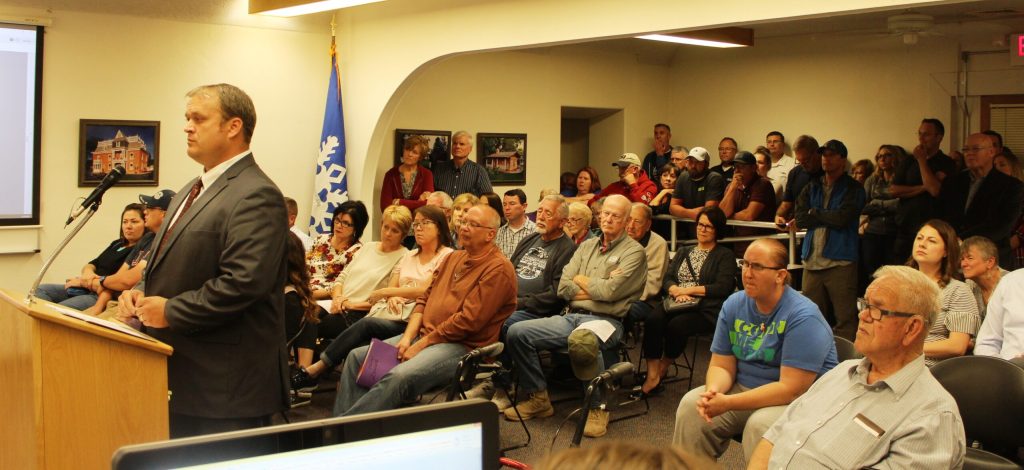
It was standing room only at the Snowflake Town Council meeting on Oct. 2, as residents came out in force to defeat the rezoning request submitted by Abacaxi, LLC. Amid clapping and cheers, mixed with a few jeers from the audience, the rezoning request that would have allowed multi-family housing and commercial development on the west side of Snowflake was denied by the council in a 5-0 vote with Councilmen Cory Johnson and Hunter Lewis recused because of their membership in Abacaxi.
On Sept. 11, the Snowflake Planning and Zoning Commission had held a public hearing for the rezoning of 15.57 acres adjacent to Putter’s Paradise with approximately 500 feet along Highway 277 from R-10 single residential to multi-family, and 21.18 acres along Highway 277 south of the Snowflake Industrial Park from R-10 to general commercial. There was no request to rezone the remaining 37.47 acres of the original 74-acre parcel, which is currently zoned R-10. The commission approved the request with 4-0 vote.
With the approval of the commission, Joseph Holland, a real estate attorney in Snowflake and one of the four members of Abacaxi, which include Cory Johnson, Justin Woodside and Hunter Lewis, brought the rezoning request before the council for a final vote.
Before the discussion began Mayor Lynn Johnson addressed the audience, “In the spirit of community, this is not going to turn into an argument fest. We, the council, understand that there are strong feelings on both sides of the issues. We understand the ramifications of what is going on here.”
Holland told the council that 23 lots within the acreage would remain with the original zoning, which is for single-family residents. “I think a lot of people are under the perception that we are seeking to build multi-family homes on all of it and that is not true.”
By zoning the parcel next to Putter’s Paradise as multi-family, Holland said they are hoping to create a residential buffer between Putter’s and future housing on the remaining lots.
Holland also noted that the commercial zoning is good for a box store. “The growth of the community is going west and this commercial zoning is natural growth to what the town needs. If the town ever hopes to attract a big box store, whether it be a Home Depot, Lowes or Costco, the only place it can be done is here, as further west lacks the necessary infrastructure.”
In reference to the town codes which require that notice be given within 300 feet of an affected property, Holland said that there is at least 1,000 feet or more between the zoning requests and existing property. “The distance between the land and the homes is nearly a quarter of a mile. It is not reality to say this will affect our property.”
Councilman Byron Lewis noted that the reason for the rezoning is to increase the saleability of the land. His question to Holland was, “Why can’t you develop that land?”
To which Holland replied, “We don’t have a million dollars on hand to develop it. We (Snowflake) have a need for multiple family housing and businesses. We don’t have enough affordable housing.”
However, Holland did say that the Abacaxi does plan to develop the residential homes in the remaining 37 acres. “We are planning on building out some beautiful homes. They will be premier lots, the apple of the town.”
At Mayor Johnson’s request, the community members were limited to two speakers to represent their concerns. The two chosen were Frank Pinnell and Chris Flake.
Pinnell said, “We understand progress and we see the positives of that, but we didn’t buy into this area for it to become multi-family or commercial and we don’t think it is the right thing to do.” Pinnell broached the concerns that high-end apartments could become low income or Section 8 (government subsidized housing) housing in the future. “Our property values have been going up, but we believe this will lower our property values.”
As one of the closest homes near the land slated for rezoning, Flake said that the decision to buy their home was based on the zoning. “This is not the time or place to rezone for multi-family or commercial.”
Flake used the Fairway Manor Apartments as an example of the impact of multi-family housing on a community. “Everyone in the community was promised that they were building upscale apartments, and then they were turned into Section 8 and low income housing.”
Flake further noted that according to the police calls to that area, there had been an increase of calls after the apartments were built. “I have had multiple people tell me of items stolen from their garage, a car stolen, mail stolen, toys stolen that were later recovered in the apartments,” shared Flake. “I have a friend who sold a house a couple of years ago and he had a $20,000 loss based on the location of his home and those apartments. Everyone feels that multi-family housing will decrease our home values.”
Continuing, Flake said that he saw the distance of the Fairway Manor Apartments from the town amenities, another part of the problem. “They are far away from schools, stores, employment, parks. I see people walking up and down the road all the time. We are not trying to discriminate against people that don’t have money for nice houses or the poor; there are just better places in town that are closer to the amenities.”
Councilwoman Allison Perkins said, “We can argue about property values and crime, but I look at the fact: Would I want to live next to a multi-family area? I feel people bought into the residential area for a reason.”
Mayor Johnson noted, “We have no determination on what could be in the future. You could be in the nicest house in the nicest neighborhood and in 20 years it can be the worst house in the worst neighborhood, but we have no control over that.”
Vice Mayor Kerry Ballard asked if the police chief could give some insight on the criminal aspects that were shared.
Chief of Police Larry Scarber answered the question, stating that the crime in that area is no worse and no better than any other areas. “We have no crime free areas and no crime ridden areas. I would love to have our criminals move out of this community but that is for another day.”
At the end of the presentation Mayor Johnson said, “As a council we have a huge responsibility to our community. We have a company that wants to develop economically, and we have a group of people that are saying not my neighborhood. I believe that it takes time and study to develop things. Not one person on this council takes this lightly, we are all human and we all want the best thing for Snowflake. Mr. Holland and his group don’t want to make this area trashy or a bad place. They have a vested interest here.”
In a surprising move, when Mayor Johnson asked for a motion to approve the rezoning, the council remained silent.
Town Attorney Robert Hall advised the council, “You can have a motion, or you can allow it to die with no motion. This is a political issue not one precluded into the future.”
Mayor Johnson then asked if there was a motion to disapprove the rezoning. Lewis immediately made the motion to disapprove, which was seconded by Perkins. The vote ended 5-0 to disapprove the rezoning.