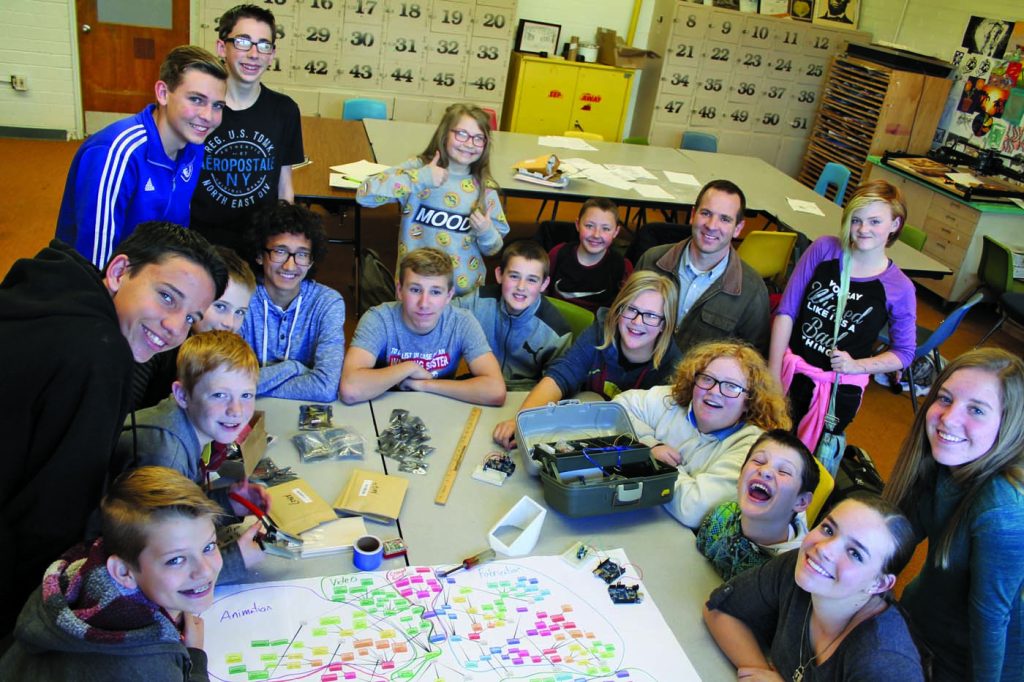
A group of Snowflake Junior High School students have a lot to be excited about. As the state winners of the Samsung Solve For Tomorrow competition, students in Michael Eilertsen’s class have been awarded $25,000 in technology for their idea for an invention that can save lives. The students were also provided a Samsung camcorder and laptop to chronicle their progress in the next phase of the contest, where they will compete with 51 other state finalists.
Eilertsen’s class decided on a concept that creates a low-cost solution for decreasing collisions with wildlife, a common problem in rural areas. As Eilertsen wrote in his initial submission, “America’s deadliest animal doesn’t have big teeth, sharp claws or venomous fangs. Surprisingly, deer and large wildlife cause over 10,000 injuries in accidents and about 200 deaths each year. In many cases two seconds can make the difference between life and death, avoiding an accident and the loss of precious wildlife.
“Although animal detection and highway crossing systems are not new, they are extremely costly and lack the ability to address a widespread need.”
He further explained that the students plan to creatively combine Arduinos, a popular, open source micro-controller, and other components to construct and install a functioning detection system for under $30 per unit. The units will be placed 30 feet apart along the road at known elk crossing locations. The low cost allows widespread implementation.
According to Eilertsen, the 10” tall units are designed so that an animal approaching the road is detected with an infrared motion sensor, triggering a solar-powered motion light that blinks. This, in turn, triggers wireless sensors in the nearby devices to begin flashing in a programmed pattern radiating from the original device that detected the animal to let drivers know there is wildlife in the vicinity.
The students will have to dedicate some of their precious after-school hours as they begin work on their prototype and video, which must be submitted by Feb. 15. It will be available for online voting at Samsung.com/solve.
Ten national finalists will be selected. Each will receive $50,000 in technology, have their videos posted for online voting and have the opportunity to present their project at a national event. Ultimately, three winners will be selected to receive $150,000 in technology and an additional prize will be awarded to the online winners.
Samsung started the contest to challenge students to show how Science, Technology, Engineering, Art and Math (STEAM) can help the local community, and to raise interest in those subjects among students.