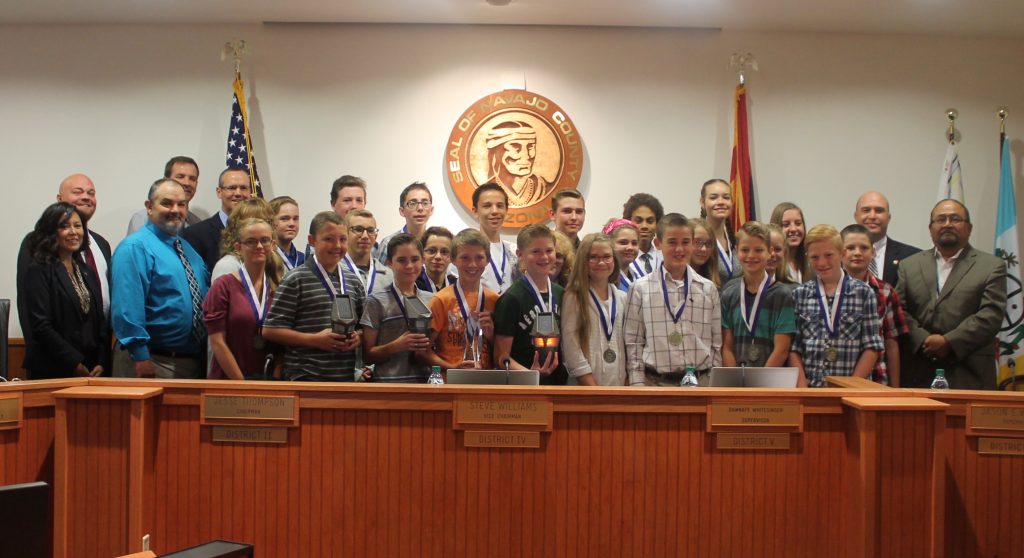
Students at Snowflake Junior High School were honored by members of the Navajo County Board of Supervisors May 9 for winning the national Samsung Solve for Tomorrow competition. Their submission was a low-cost wildlife detection system that will warn drivers when large animals like elk and deer approach the road.
In presenting the students to the board, District III Supervisor Jason Whiting first acknowledged the efforts of teacher Michael Eilersten. “We have a teacher that is a very selfless man, a very talented man, that was willing to help these youth come together and their leadership come together with something that’s such a great idea,” praised Whiting.
Eilersten told the board that the project first began with the students determining a problem in the community and then how to fix it. “It’s a competition that empowers youth. It makes them feel like they can make a difference, that they can change something,” said Eilersten.
The students first had to list their project, then make a detailed lesson plan on how to execute the plan. Once they won on the state level, they were then asked to prove their idea beyond paper for the national competition. According to their teacher, it took about three months of dedicated effort after school, during which time Eilertsen said he never heard a complaint. “I never assigned anyone to do this. They came in because they wanted to help and contribute,” he said.
The students presented their project in Washington, D.C., where they were not only selected as one of the top three winners, but also as a community choice winner, which was determined by the number of votes received for their project online. “This is thanks to our town, our region, our county, everyone just kind of pulled behind us,” said Eilersten.
The effort not only earned $170,000 in technology for SJHS, but an additional $20,000 because of the online voting results. In addition, Samsung donated $20,000 in equipment to the Phoenix Herpetological Society to help support wildlife and science education programs as the selected charity of choice by the students.
District V Supervisr Dawnafe Whitesinger, who has a background in education, stated, “When we talk about education, we talk about students like you; students who not only find a problem and find a solution, but you begin to figure out there’s a great deal of teamwork, process and analysis that goes into something like this. Very impressive.”
The hope is that the system, which costs approximately $40 to make, will be utilized to preserve life and property. Collisions with large animals cause more than 150 deaths per year and countless auto accidents. A video on the project is posted online at www.samsung.com/solve.