This week’s Holbrook Depot Art Series audience will witness a mix of tribal and contemporary influences presented by Holbrook artists Richard Gorman and Jacob Warner, and Petrified Forest National Park artist-in-residence Sue King.
Gorman says he got his start as a portrait artist and wood carver in his youth. “I went into the Army and served a tour in Germany, and was inspired by the Bavarian cuckoo clock carvers there. It reminded me of the Kachina carvers where I grew up on the Hopi reservation,” he related.
Gorman notes that, while his artistic leanings oriented him toward carving from that phase of his life, he wouldn’t begin crafting his own wood creations until much later.
“At that point, I had been painting already. When I was around nine or ten years old, I was mainly just drawing. It was the norm in that area of the reservation back then, everyone was gifted artistically. But not knowing that, I thought it was just normal.
“But when I moved to Holbrook in the sixth grade, we had to draw Christmas greeting cards in school for our families, and it was then that kids started to gather around me and say ‘Wow, look at what he drew’, and I was wondering what was going on,” Gorman recalled.
Although he continued his artistry throughout his teens, Gorman says he lost academic focus during his later high school years, applying to art schools but missing out on entry due to full enrollment. He decided a change of environment was needed for him to mature emotionally and “to stay out of trouble,” which ultimately led to his military stint.
“I didn’t make a very good soldier,” Gorman jokes, but he notes that the journey “changed everything,” expanding his cultural perspective through exposure to the Impressionistic, Modern and Arabian artistic influences of Amsterdam, Holland, South Asia and the Middle East, which he began to incorporate with the traditional Hopi styles of painting and sculpture he knew.
Gorman’s works continue to garner critical acclaim, and have even caught the eye of the occasional notable celebrity.
“I almost sold one of my paintings to James Earl Jones. I was invited by a retailer who was selling my art to attend an event in Phoenix, and while I had stepped away for lunch, he expressed an interest in the painting. All I could think was ‘I just missed meeting Darth Vader.’”
Pueblo artist Jacob Warner, who also works in paint and wood, says the encouragement of the relatives who raised him spurred his desire to begin painting as a child.
“I can remember my aunt bought me a watercolor paint set. To get inspired more, I used to watch the painter Bob Ross on Channel Five every Saturday and Sunday. He would work with oil paint, and I didn’t know there were different types of media you could work with. I only knew of pencils and watercolors back then.”
Warner’s other aunts were potters, from whom he learned as a boy not only the creativity of the Southwest Indian craft, but also the discipline, dedication and tenacity to sell his art.
“At the Old Laguna Pueblo Church in New Mexico, my aunt was teaching me something, although I didn’t know it at the time. She would arrange her pottery in baskets and send me to sell it to the visitors,” experiences he now realizes prepared him for life as a career artist.
On his woodwork, Warner says he initially shaped and finished his sculptures in the Hopi style and was later encouraged by other Hopi crafters to channel and pay homage to his Pueblo roots, which is reflected in the detail of his works today.
Contemporary textile artist and Ohio-native Sue King says she enjoys melding her creativity with a love of history, the outdoors and the beauty and textural quality of fabric.
“About thirty years ago I began making quilts that relied on traditional patterns and color ways, but became bored with the repetitive nature of the endeavor.
“My textile art calls forth the ghost into the room, searching for a way to connect our present condition with the human experience of those who came before,” she says.
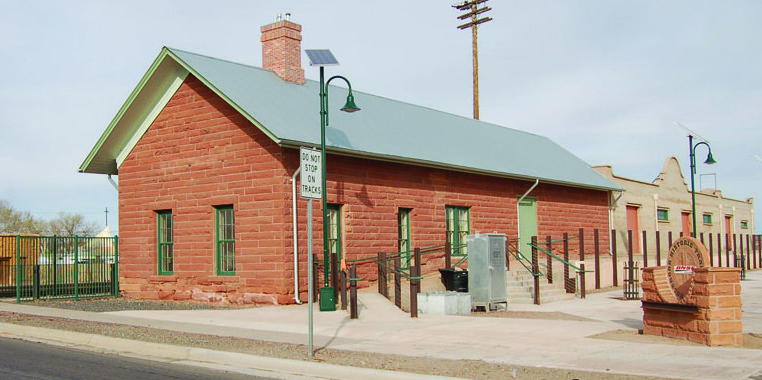
The free art event will host from 5 to 8 p.m. at the Historic Holbrook Train Depot, located south of the railroad tracks on Navajo Blvd.