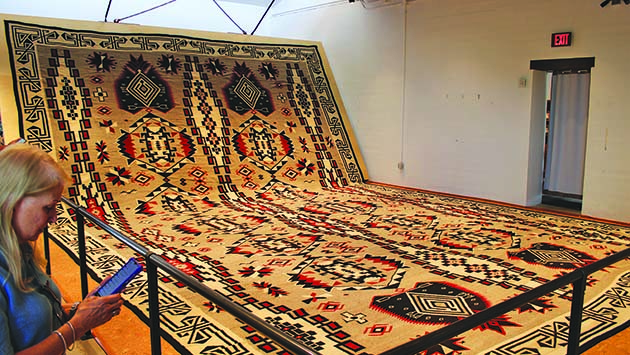
In a momentous event that took place last Saturday, the Affeldt Mion Museum (AMM) unveiled the highly anticipated Hubbell-Joe Rug exhibit to the public. The exhibit, hosted within the meticulously renovated confines of the Mary Colter 1930 depot, stood as a tribute to the remarkable collaboration, cultural heritage and artistic excellence of the Navajo people.
The Hubbell-Joe Rug, formerly known as the Hubbell Rug, now proudly recognizes the dual efforts of Lorenzo Hubbell Jr. and Julia Joe, an accomplished weaver from Greasewood. This exhibit was a testament to the harmonious fusion of Hubbell’s visionary concept and financial backing, and Joe’s exceptional weaving skill, guided by her Kin ł ichii’nii (Red House) Clan. During the construction of the rug, Hubbell paid the living expenses of all the weavers as well as allowed them whatever they needed from the trading post to aid in the making of the rug.
Named as the “Hubbell-Joe Rug,” the exhibit embodied the profound synergy of two distinct forces that birthed an exceptional masterpiece. This acknowledgment signified the artistry that flowed from the combined vision of Hubbell and the creative prowess of Joe, supported by her family and community. The exhibit showcased not just the rug itself, but also a wealth of historical images and interpretive materials, weaving a narrative that chronicled the rug’s fascinating journey through time.
The journey of the Hubbell-Joe Rug began during the challenging era of the Great Depression when Hubbell conceived an audacious idea to attract visitors to his trading post in Winslow. This ambitious notion led to the commissioning of Joe, an esteemed weaver, to bring the concept to life. The result, which couldn’t be called anything less than a masterpiece, not only bore testament to its immense size but also to the precision of its technique, symmetry of color, and intricacy of design.
To accomplish the creation of a weaving of such grandeur, Joe’s husband, Sam, ingeniously fashioned a custom metal pipe loom and an accompanying building to house it. The community rallied, shearing hundreds of Navajo Churro sheep to procure the wool needed for the endeavor. Joe, alongside her daughter Lillie and numerous members of the community, spent nearly three years weaving the rug from dawn till midnight. By 1937, after five years of unwavering dedication, the monumental rug measuring 21-feet, 4-inch by 32-feet, 7-inch was completed, showcasing a universe-themed design. The pattern represents the night sky, including stars, planets and the Milky Way galaxy. Lori Law, the exhibits curator, said that when diving into documents it was believed that the rug took about three years to construct but upon further investigation it was found that it took three years to complete after two years of sheering to get the required amount of wool for a total of five years in totality.
Over the decades, the rug embarked on a journey that saw it gracing museums and exhibitions across the United States, elevating it to the status of a cherished artifact. It even made an appearance at the World’s Fair. However, its course took an unexpected turn when businessman Kyle Bales acquired the Winslow Trading Post, including the prized rug, following Hubbell’s financial downfall. Despite its storied travels, the rug eventually found itself in storage for over 40 years.
The return of the rug to Winslow was an endeavor championed by Allan Affeldt and Tina Mion, who recognized its historical significance. Acquiring the trading post, they ensured that the rug once again found a home. A couple weeks before the opening of the exhibit, a touching blessing ceremony was held, attended by members of Julia Joe’s family, including Emma Joe, who had played a pivotal role in carding the wool eighty years prior.
The unveiling of the Hubbell-Joe Rug exhibit was a poignant affair, resonating deeply with the descendants of Joe and the Kin ł ichii’nii Clan. Family members gathered for an exclusive viewing, offering blessings and connecting with the legacy of their ancestors through the rug’s intricate patterns.
Sammy Lee, Joe’s grandson, expressed his appreciation for the exhibit’s presentation, acknowledging, “You’ve done a good job. It’s laying on a real nice floor. Comfortable. It’s laying there resting. Let it rest on a nice comfortable form.”
The exhibit’s realization was the culmination of detailed planning and meticulous execution by the AMM team, in collaboration with the City of Winslow and other stakeholders. The inventive presentation of the rug, featuring a custom-designed platform and a tiltable wall, provided visitors with an immersive experience that allowed them to explore the rug’s intricate details while ensuring its preservation. The wall on which it lays is fitted with the soft side of Velcro to add just enough friction to keep the rug in place without putting it in any danger of damage.
The exhibit not only celebrated the partnership between Hubbell and Joe but also served as a testament to the enduring legacy of Navajo weaving traditions and the unbreakable connections that bind generations of artists and communities. The rug’s elaborate patterns, the dedication of the weavers, and the unity of purpose that birthed it continue to serve as a wellspring of inspiration for the preservation of cultural heritage and artistic expression.
With the exhibit having opened its doors to the public on Sept. 2, visitors are now invited to engage with the history, artistry, and cultural significance that the Hubbell-Joe Rug embodies. The exhibit ensures that the narrative of Joe, her family, and the Kin ł ichii’nii Clan will endure, bridging the past with the present for all those fortunate enough to experience it.
For more information on the rug, visit the museum or ammwsa.com.