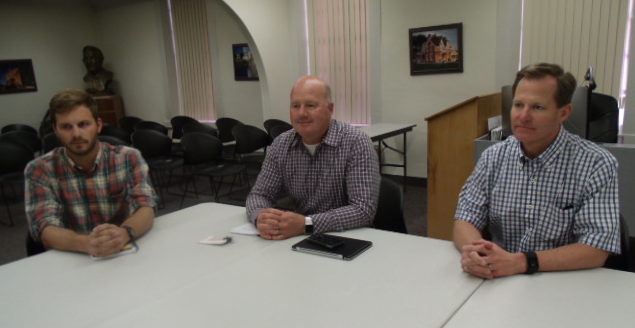
Copperstate Farms is purchasing the greenhouse facility in Snowflake for use as a state-of-the-art high-tech marijuana grow facility.
“Right off we’ll be hiring over 136 people at roughly double the wage scale of the last people,” said Fife Symington IV of Copperstate Farms, noting that employees will have full benefits.
“My plan is to put about five acres into production, a little over 10 percent of the existing facility, and to grow high quality medicine at a good price,” he said.
“I enjoy being in the community and getting to know the community…,” said Douglas Cole, senior vice president of Highground Public Affairs Consultants, who was in Snowflake May 19 for the announcement.
A study by Elliott D. Pollack & Company shows that the agribusiness has the potential to create 1,227 jobs when it is at full capacity of 40 acres, and will generate more than $41.8 million in wages and more than $217.9 million in economic output annually. The five-acre production annual wages will total $4.9 million.
Symington noted that he got started in the greenhouse/vegetable industry 20 years ago in Mexico, and has more than 850 covered acres. He started a distribution service approximately 10 years ago.
“A little over a year ago I decided to take a look at the marijuana industry in Arizona,” said Symington noting that it had been in the news a lot, and he had been spending a week or 10 days each month in Mexico. He began doing research, and realized that most of the production facilities in the state are warehouse facilities that use artificial light and cooling to maintain the temperature.
“I realized that there was a need for what I had learned,” he said, and started developing his own greenhouse in the state. At the same time, NatureSweet pulled out and shut down the Snowflake facility.
Symington was aware of what Eurofresh went through with two bankruptcies, because basically tomatoes that sold for $15 in winter are now selling for $10.
When Symington heard the greenhouse was vacant and he looked into purchasing it. On April 19, he signed paperwork to purchase the greenhouse, contingent on getting a special use permit.
Should he receive the proper permitting, he would grow medical marijuana beginning with five acres of the existing facility, and would grow high quality medicine at a good price.
In November 2010, voters approved Proposition 203, which allows the use of medical marijuana as an alternative pain treatment for a number of debilitating medical conditions. The law permitted medical marijuana cultivation facilities, but there were rules adopted to govern the cultivation operations.
“What’s nice about it (the greenhouse facility) is it meets all the provisions of the voter passed initiative of Proposition 203,” said Cole. It meets the setbacks that require the facility to be so far from a school, religious facility, housing and public library. “It meets and exceeds all those requirements, so it’s the perfect site,” he said.
Cole went on to say that the weather here is perfect for growing this type of product. “The altitude and days of sunshine are perfect for running a year round facility,” he said.
In order to be completely transparent, Cole met with Snowflake Town Manager Brian Richards, Mayor Tom Poscharsky and members of the town council. He also met with District III Navajo County Supervisor Jason Whiting and Assistant County Manager Paul Watson. They are meeting with neighbors to give them information and make this transparent. He has met Police Chief Larry Scarber briefly, and will make sure that any suggestions he has are incorporated, explained Symington.
“That’s how we’ll continue to operate, in a transparent fashion,” said Symington.
He further noted that they have been very clear with town and county officials that they are starting with five acres and growing to 10 acres, “because growing beyond that would need a voter initiative to pass.” He emphasized that this is a grow facility, not a distribution facility.
Cole explained that the Copperstate Farms facility would have a tremendous economic impact on the town. He said that the fiscal impact study estimates that this will increase 159 jobs in the initial phase of operations, which equates to nearly $5.7 million in wages and more than $29.6 million in annual economic output, and has the potential to create 1,227 jobs in the region at full capacity, which would generate more than $41.8 million in wages and more than $217.9 million in economic output annually.
Tax revenues were estimated at $42,100 for Navajo County from the initial five acres of cultivation. It is estimated that the Town of Snowflake would generate $21,418 in new revenues, and the school district and other districts would see an estimated $162,400 increase in annual revenue.
Copperstate Farms will employ 136 people with wages of $4.9 million, and generate an economic impact of $26.7 million. If they were at the full 40-acre capacity it is anticipated it would generate 1,227 jobs.
They are scheduled to go before the Snowflake Planning and Zoning Commission on June 21, and the town council on June 28. If the special use permit is approved, Copperstate is scheduled to open July 19 and start production in December.
Cole said that they will be retrofitting the facility at a cost of approximately $3 million, with Robbie Stone as the project manager. Other maintenance needs done on the facility, so the goal is to open 90 days after the closing of the sale.
They explained that all employees at the property will go through thorough state and federal background checks. It is expected that they will employee 25 crop workers and two mid-level managers per production acre, who will receive extensive training, and the company will go to great lengths to retain employees with good pay, benefits and a positive work environment.
“We’ll start accepting job applications on July 18. We’ll be launching a website around the first of July called Copperstatefarms.com, so be looking for that website to go live after July 1 and we’ll have specific job applications online that you can fill out online,” said Cole.
Symington and Cole were both born and raised in Arizona.
“This is our state,” said Cole.
“We’re going to make this work,” said Symington.
“It’s your community, and I know why you like living up here,” said Cole. “People are proud of their community and we want to be part of that.”