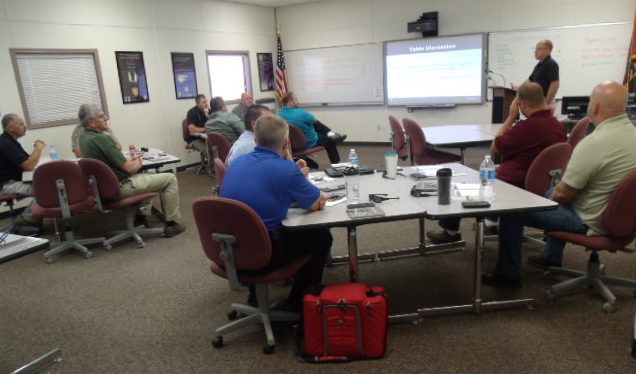
Blue Courage, a national program that teaches law enforcement how to build stress resilience and optimize performance, is taught by Snowflake-Taylor Police Lt. Bobbie Martin at the Northern Arizona Training Center (NATC) in Taylor.
The two-day workshop is not just for law enforcement officers, but for military service members, firefighters, emergency medical services and 911 call-center personnel, and other first responders.
Martin noted that three to four years into the job he struggled with his career and why he got into police work. He took this course and it was the turning point in his career. After his experience, he had a great desire to share it with fellow officers, so when he had the opportunity, he attended an Arizona Police Officers Training (AZPOST) Blue Courage to qualify to instruct the course.
Blue Courage “is a way of being, a philosophy that inspires one to embody the noblest of character and unquestioned devotion,” according to the program website.
Lt. Martin explained that often police officers are trained to deal with the practical side of the job, spending several hundred hours learning to be proficient in the use of the physical tools of the trade such as the car and baton. A giant gap is left in the area of how to deal with stressors and their effect on officers.
Martin feels Blue Courage fills a significant need, because the academy teaches ethics, but this course is about re-centering and why officers get into law enforcement. It helps them become aware of situations, and improve reaction time and decision making, especially when they are under pressure. It helps them find an emotional balance.
“No one is compelled to use the profession of a police officer, but having chosen it is obligated to perform its duties and live up to the high standards of its requirements,” said President Calvin Coolidge.
Martin noted that there is a time to reconsider why they got into law enforcement, what they want to accomplish and what it means to be a police officer.
The course covers topics such as police culture, respect, resilience, health and wellness.
As part of the course, there is a chapter entitled Psychological-The Immortal Cop. That means that every time a police officer interacts with someone, the officer leaves something in their lives, Martin explained. “Every contact you make will leave an impression for good or bad; hopefully, my impression is going to be a positive one,” said the lieutenant.
The workshop uses the book Nobility of Policing-Guardians of Democracy. The forward written by Stephen R. Covey states, “It has always been my firm belief that policing is one of the most noble professions. The actions of any police officer, in an instant, can impact an individual for life, and even a community for generations. Given this realization, every police officer must be centered on what is important. Service, justice and fundamental fairness–these are the foundational principles in which every police action must be grounded.”
A chapter entitled Nobility in Policing “is police ethics that reminds us what we learned at the academy, and a renewal of what brought us into policing,” said Snowflake-Taylor Police Chief Larry Scarber.
He noted that each officer is given a Learning Journal in which they jot down their thoughts.
“I would like to get everybody through the 16-hour class,” said Chief Scarber, who would like to hold the class several times a year.
Officers from the Snowflake-Taylor, Show Low and Pinetop-Lakeside police departments, as well as the Arizona Department of Public Service, attended recent classes.