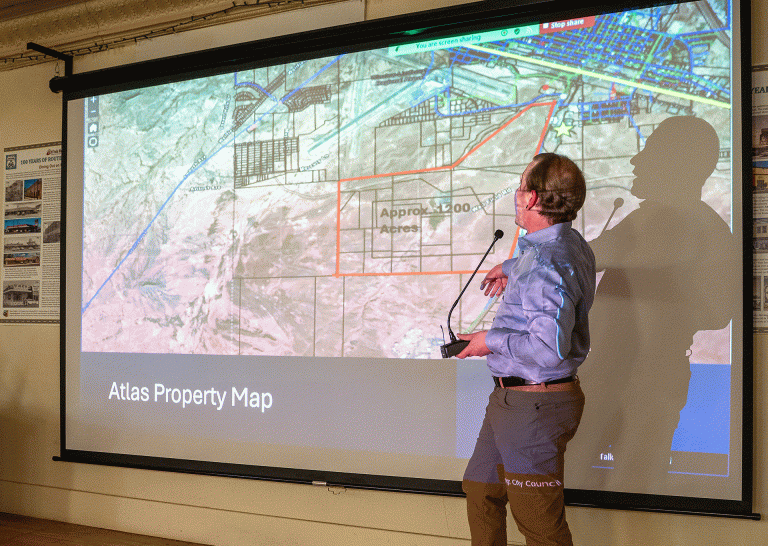
Last week the Winslow City Council heard an update on the I-40 TradePort project, with Atlas Global Development outlining delays in development to justify what will likely be their seventh contract extension with the city later this month.
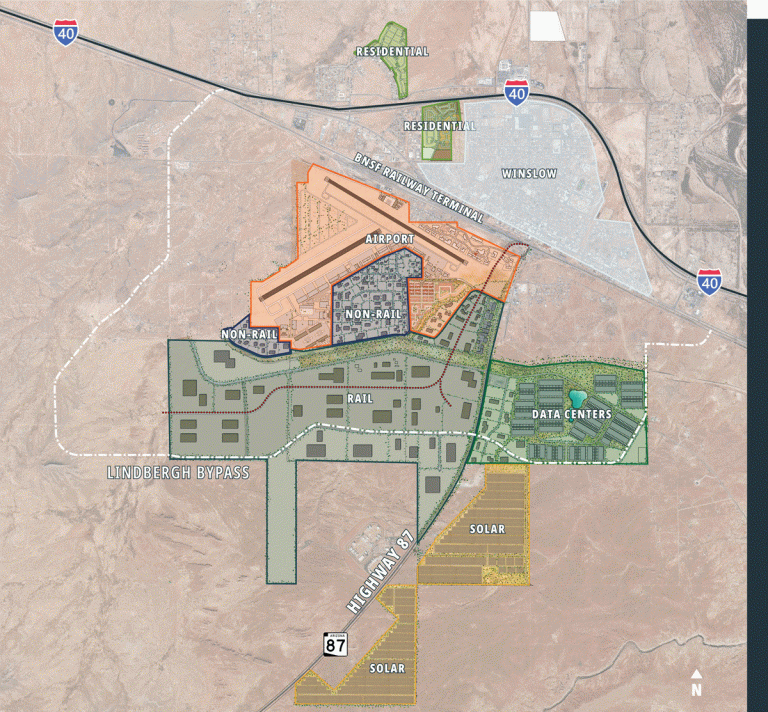
Dan Lupien, Managing Director of Atlas Global Development said Atlas has spent much of the past year working “mostly on our energy solution” in coordination with Arizona Public Service (APS). Central to that effort is the proposed Red Sands Solar project which is as a 100-megawatt renewable energy facility on roughly 500 acres on the east side of Highway 87 across from the Winslow State Prison. The project combines 60 megawatts of solar generation and 40 megawatts of battery storage.
Lupien said Atlas is awaiting a facility study from APS that will determine what substation upgrades are required to connect the project to the grid. He said the team is “very close to getting through that final hurdle with APS.”
He described Winslow as “transmission constrained,” explaining that the city is currently tied into the electrical grid through 69-kilovolt transmission lines connected to the former Cholla Power Plant, which provide limited capacity. Those constraints, he said, became clear during a BNSF certification process and resulted in Atlas learning that at the current moment APS could deliver 1 megawatt of power to the site with current infrastructure. “We have work to do before we can build the infrastructure needed to accommodate those users,” Lupien said.
Rather than exporting new power generation elsewhere, “We’re trying to make it right here for our users in the I-40 TradePort,” he said, contrasting that approach with renewable projects whose output “is heading to other places.”
Atlas Global’s website touts that the area could generate “over 2 gigawatts of renewable energy,” which is the equivalent of the energy consumption of roughly 1.6 million homes. He said the Red Sands project could be shovel ready as soon as March or April.
Long-term solutions, however, remain costly and time-consuming. Lupien said transmission and substation upgrades capable of creating roughly 250 megawatts of additional capacity could take five to seven years and cost more than $170 million. Because of that timeline, Atlas is pursuing what he described as short-term “bridge solutions,” including natural gas, solar and battery projects.
Atlas Global’s energy strategy shifted last year after a large-scale solar proposal on Hopi land collapsed late in the process. Atlas had spent roughly two years pursuing a large ground lease for roughly 20,000 acres for solar and said the project had advanced to the point of securing a letter of intent and receiving approvals from the Hopi Tribal Council. Lupien said the deal unraveled near the end of negotiations, forcing Atlas to abandon the project and reassess its long-term power plans. Lupien said the change required Atlas to “pivot” in August and accelerate efforts to develop alternative generation closer to Winslow, while still planning for longer-term regional energy solutions tied.
Among those alternatives, Lupien outlined discussions around a potential biomass co-generation facility that would use forest waste as fuel. He said Atlas has been working with a biomass consortium that includes the U.S. Forest Service in Coconino County and Restoration Forest Products in Bellemont. Atlas, he said, has identified potential co-generation plants in the 30-to-50-megawatt range.
Lupien said the approach could address both power needs and forest management concerns. “It helps with the fire danger, which protects our watershed,” he said. Lupien also said the Bellemont mill is currently operating at 40% capacity because it lacks sufficient options to remove waste material, making it motivated to ship biomass for energy production. He said Atlas met earlier that day regarding the biomass concept and is actively pursuing multiple sources of local power generation to address Winslow’s energy constraints.
Looking ahead, Lupien said Atlas believes it can begin scaling power delivery in 2027 and 2028, followed by the arrival of a large natural gas pipeline from the Permian Basin in 2029. He said the pipeline could create almost unlimited potential for power generation in Winslow and surrounding communities. However, this change would signal a backtracking of carbon neutral claims that have been at the forefront of the public conversation regarding the project.
Despite the energy challenges, Lupien emphasized that the TradePort itself is otherwise positioned to move forward. He pointed to existing assets including rail spurs, the Winslow–Lindbergh Regional Airport and Interstate 40, describing Winslow as offering a “multimodal opportunity.” Atlas, he said, has resolved zoning issues, finalized development agreements, secured PAD approvals and assembled 32 properties. “We’re into it now for over $10 million and continuing to spend every month,” Lupien said. Power, he added, remains “the last issue that we’re really trying to solve for.”
Lupien said Atlas plans to release a two-year power ramp-up strategy in the near future, calling it a “very creative structure” that could serve as a case study for other rural communities facing similar challenges. He stressed that Winslow’s situation is not unique. “This is all over the state, all over the country.” Atlas, he said, continues to work to attract manufacturers and generate new tax revenue, describing the TradePort as a regional project that could create jobs in the region.
At one of its meetings this month the council will vote on whether to give Atlas Global Development its seventh contract extension to purchase 1,094 acres south of the airport due to the closing deadline being set for the end of February.