The Winslow City Council on Feb. 24, unanimously approved a significant restructuring of its agreement with Atlas Global Development. City Manager David Coolidge, who has led negotiations on the deal and presented the item to the council, said, “As you’re well aware, we’ve been working on this agreement for several years now,” noting that “the last extension was through the end of February.” He explained that while the purchase price remains unchanged, the payment structure has shifted significantly. “The only difference being that this will be a term, a per month basis payment versus a lump sum payment. Really, that’s the only difference between this and the prior purchase and sale agreement.” He added the revised arrangement would give the city the ability to close on this property while simultaneously closing on the Brimhall property as well.
The Brimhall property is right in the northeast corner where I-40 and state Highway 87 meet. This property is currently being eyed as a logistics hub being worked on by GLD Partners, which is a different project than the one being pursued by Atlas Global near the city airport. The property funding is bound by the closure of the deal with Atlas Global, and this has put the city in a situation in which it cannot develop the hub property while Atlas Global continues to ask for extensions after not securing a deal with the Hopi Tribe for land to be used for energy development, most notably solar. The city’s fix to this is to enter into this agreement with Atlas Global where it can start to make payments on the property, and that will fulfill the requirements for the funding received for the hub project.
Under the new terms, the city is entering into a secured promissory note with Atlas Global Development, a structure that functions similarly to a loan. The principal amount is just over $1 million but rather than collecting that sum at closing, the city will receive 36 monthly payments of $31,408. Payments are not required to begin for the development group that has already completed the private sale of hundreds of acres around the city until Sept. 1, with a final payment due Sept. 1, 2029. Over the full term of the agreement, the total repayment will be just over $1.1 million, $83,000 more than the principal amount.
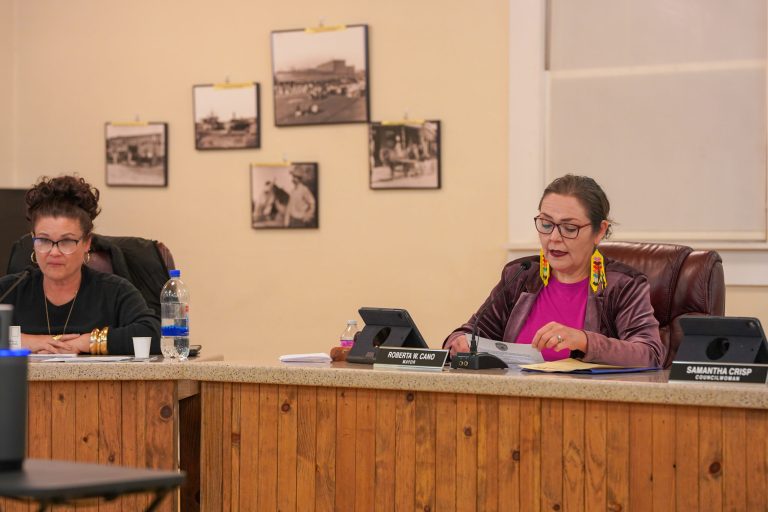
After Coolidge concluded his remarks, Mayor Roberta Cano asked whether council members had any questions. None were raised, and it passed unanimously by voice vote.
Earlier in the meeting, councilmembers announced that the Mother Road Farmers Market has been temporarily suspended while organizers work to establish a 501(c)(3) nonprofit structure.
Two bazaars had been planned by the market and then canceled but then rescheduled to instead benefit Alice’s Place. One was held last Saturday and the next is from 10 a.m. to 2 p.m. on Saturday, March 14, at the Winslow Chamber of Commerce, located at 523 W. Second St.
Call to the public was dominated by residents urging the council to take a harder look at, or outright block potential data center development in the area. Speakers expanded the scope of concern beyond the water usage and environmental issues that have been raised at previous meetings, introducing health and noise-related arguments into the discussion.
Chez Sells told the council he recently encountered a video about data center impacts and then realized Winslow has “multiple maps with data centers so close to the epicenter of Winslow.” Sells said he forwarded councilmembers a YouTube video discussing “infrasound, noise pollution from data centers,” explaining that while he had previously heard about water use and environmental concerns locally, “I personally never heard of health concerns.”
Summarizing the video’s claims, Sells said the presenter described measuring impacts “up to half a mile away” and stated that “infrasound … could travel up to a mile away from the center.” He called the information “chilling” given where data centers have been proposed, warning that “the infrasound would make tourism really difficult.” Sells said he wanted the information on record and offered to share the video publicly if residents were discussing the issue elsewhere.
Raymond Lucero said similar concerns are being raised across the country, citing what he described as a wave of data center projects in Texas. Lucero argued that transparency is often a casualty of such development, claiming that in some cases, “Citizens on the council level, county level and state level have signed nondisclosure agreements that limit public information about projects.”
He said unresolved questions include how water is treated after it has been used and what the quality of recycled water would be for the public. Lucero also pointed to reports of a large data center land deal near Page, questioning potential downstream impacts to communities along the Colorado River system, noting, “A lot of that water is going to end up in Phoenix.” He urged the council and the public to seek more information.
Ann Schmidt took the most direct stance, asking the council to adopt a formal prohibition before any projects advance further. “Before any contracts are finalized, the council should declare a prohibition on any data centers being built on city land, any property that would be annexed to the city, leased out by the city or otherwise under city jurisdiction,” Schmidt said. “There are really a lot of people in this town who do not want data centers.” She asked the council to respond publicly with its position on the issue.
In other business, the council:
* Approved an agreement with Winslow Hot Shots for use of city-owned baseball fields at no cost.
* Approved repealing a previous ordinance authorizing the sale of certain real property located at 21 N. Williamson Ave., to Mary Alice Hayes because of the cancellation of escrow.
*Approved a grant application in conjunction with the State of Arizona for the United States Department of Transportation’s Rural Public Transportation Program to support the city’s transit program.
* Approved setting the following budget priorities going into budget season as: high performance governance, safe community; sustainable and thriving economy, active and healthy quality of life, attractive and livable community, and proactive infrastructure improvement.