B y Toni Gibbons
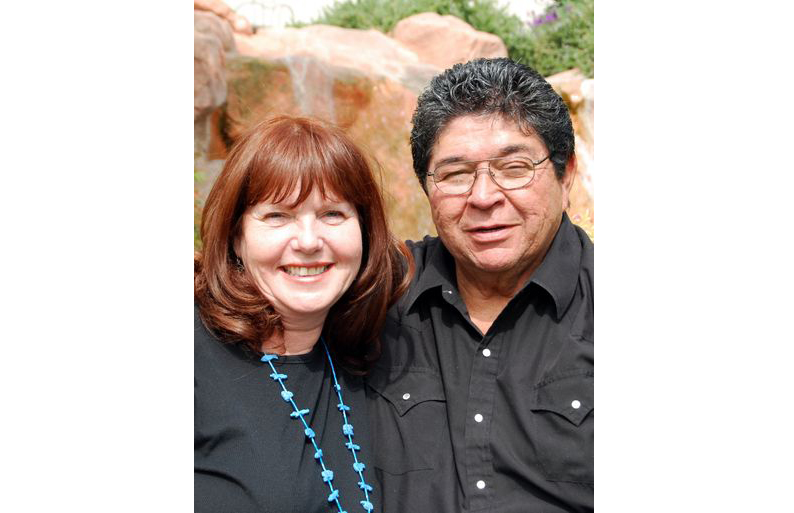
“When I was little, living in foster homes and orphanages I always dreamed of someday having my own program to work with kids,” said Ron Hatch, president and co-founder of Eagledancer Youth and Family Services (EYFS) in Snowflake.
In 2009, those dreams came true when Ron and Charla Hatch moved to Snowflake and started EYFS, a state-licensed, child-welfare agency to specifically help the children of Native American families. Today, the Hatch’s continue to bring hope and new life to the Native American children from the Navajo Nation as well as the Hopi and White Mountain Apache tribes.
While Ron and Charla are still involved with the kids, the daily operations of EYFS now lay in the hands of their children, Taylor Hatch, executive director; April Peterson, licensed therapist; and Heather Boone, youth care coordinator.
Married in 1970, Ron and Charla carried the passion of family deeply into their hearts as they welcomed nine daughters and six sons into their lives, but realizing the capacity to love can be endless, they also began working with foster kids.
“In the last 40 years, we have had over 250 foster kids living in our home and more than 1,000 kids go through our programs,” shared Ron.
Perhaps the most unusual aspect of the Hatch family story is Ron Hatch. Born of the Miwok tribe located in the Sacramento Valley, Calif., and born to alcoholic parents, Ron remembers the first five years of his life were spent homeless.
“We lived homeless on a little reservation in California,” began Ron. “From age five to 14 I was in and out of foster homes and orphanages. Some of the homes weren’t very good. I got beat, locked in closets, told I would never be worth anything. When I was 12, my dad was killed in a street fight in California. He lay dying on the sidewalk for nearly two hours while people just walked over him.”
The cumulative effect of everything Ron had experienced left him angry, frustrated and distrustful. “I was afraid of a lot of things; afraid of the police because they would come out to the reservation and take our people away. When I was 14, I was sentenced to six years of juvenile lock up for fighting and stealing.”
Facing a bleak future, Ron clearly remembers the day when a new door opened. “I had been told that I would be at reform school until I was 21. That day I was sitting in my cell when my probation officer came and said he had found a home for me.”
Like many angry, hurting kids in the system, Ron said he decided to go to the family. “I wanted to get even with some kids in the neighborhood who had beaten me up when I was younger, shared Ron. “I planned on staying just long enough to get even but later I decided to stay because there was something different about this family. They were kind and took good care of me. It didn’t matter what I said or did to them, they still loved me and kept me.”
The family was members of the Church of the Latter-day Saints and through their love and faith, Ron had a chance to experience the impact of a good family with good parents.
“They taught me a different way of life. They taught me a new way of getting along and caring,” said Ron. “From them I learned about forgiveness, love and kindness. I always wanted to give back, because someone helped me get my life straightened out.”
Within two years, Ron had joined the LDS Church. By the time he was 18, he went on a mission to Canada. Upon his return, he met “a lovely young lady” who later became his wife.
“We both came from different families, mine was devastating, filled with abuse, neglect and hunger,” said Ron. “Charla came from a loving, caring family. We went together for two years. She was 18 and I was 23 when we got married.”
According to Ron, after completing some college courses he worked at a number of different jobs before he landed a position serving as the Indian Education Director to 55,000 students in the Mount Diablo School District in California. In 1977, Ron left that position to become home parents with Charla on a boys’ ranch at Spanish Fork Canyon in northern Utah where they cared for their own growing family and 12 delinquent boys. From there they moved to Cedar City, Utah, and started a group home working with the same company that ran the boys’ ranch.
By 1985, the Hatch’s stepped out on their own becoming founders of Raindancer Youth Services (RYS), a program that worked with native and non-native children.
“My oldest brother was in prison and had a tattoo of a rain dancer on his arm. He always encouraged me to do the right thing and stay away from drugs and alcohol,” shared Ron. “I wanted to make him a part of it in some way.”
According to Native American beliefs the rain dancer is brought in when Mother Earth is parched. The dancers bring the rain, which brings new life and growth. “The kids that come into our program are so dried up and having a hard time. It’s our goal to bring them back to new life,” continued Ron. “We teach them how to overcome their anger, fear and frustration.”
For more than 20 years, until 2008, RYS operated out of St. George, Utah, with eight branch offices in New Mexico. In addition to the foster care, which included infants to 18 year olds, the Hatch’s established a successful residential treatment center that was licensed by the state and had hospital accreditation for kids from 12 to 18 who had more severe behavior problems or addictions. “We even had our own private school that my wife insisted on naming the Ronald N. Hatch Academy,” noted Ron.
In 2008, through a tragic series of events, RYS was shut down. “I hired a good friend to be our new chief financial officer (CFO),” said Ron. “We had programs in New Mexico that included eight offices, a director and everything. This CFO and my director in New Mexico set everything up to steal Raindancer from us. By the time I learned of everything, they had already done so much damage that we had to close down and start over.”
From the 200 kids in the RYS program, Ron said they were able to keep 20. Already familiar with the White Mountain area, the Hatch’s moved to Snowflake and began rebuilding.
Three of their children, Taylor, Heather and April are now working at EYFS. Taylor, who has a master’s degree in social work from the University of Southern California, came on board, bringing his wife, Crystal, to manage the bookkeeping. Heather, who had worked with her parents in prior years, came back, as did April.
April said her passion had always been to do social work. This past May she became a licensed master social worker after completing an internship at Primary Children’s Hospital in Salt Lake City. She now works full-time with EYFS.
“If our kids wanted to work in the business, we wanted them to do that. We never pressured them,” said Ron. “Fortunately for us Taylor got his master’s degree and his wife, Crystal, has a bachelor’s degree in accounting. We pretty much turned the business over to them.”
Before the takeover that destroyed RYS, Taylor had been working with a youth facility in Utah that had approached the Hatch’s with an offer of $3 million to buy RYS. Ron said, “My wife and I prayed about the offer and then decided we didn’t want to do that, we wanted to continue working with the kids.”
EYFS works with approximately 12 local foster families and 25 to 30 youth. “Snowflake and the White Mountains have been good communities to work with,” said Taylor.
“For a lot of our kids, it is the first time they have had academic success,” Taylor continued. “It is the first time they have been able to play school sports, go to a dance or be in a school play. Being in dysfunctional families, the kids have not always had these opportunities and it helps to build their confidence and self-esteem. We work to bridge the cultural gaps, while helping them to retain their Native American culture. Many of the kids are ashamed of their culture because all they see is the alcoholism, the violence and the drugs. We want to build a sense of identity in their culture,” he added.
“The Navajo Nation puts our success rate at about 70-75 percent,” said Ron. “For some of these kids just being alive is a success. A lot goes on to have families of their own and break the cycles of violence, abuse and addiction. If we can help these kids become adults and raise their kids differently, then we have succeeded.
“I tell the kids my story and then I tell them, I can match you hate for hate, pain for pain, hurt for hurt and discrimination for discrimination. I ask them what is your excuse; stop blaming everyone else, stand on your own two feet and be accountable for who you are,” explained Ron. To which Taylor added, “Dad not only changed his life, but also the lives of his kids and grandkids.”
Ron concluded by sharing, “One of my favorite sayings is, ‘blessed are those who dream dreams and then are willing to pay the price to make them come true.’ I have paid the price and my dreams have come true. I love teaching and working with youth. I love giving them opportunities so that if they will pay the price of hard work and not give up, they can make their own dreams come true.”