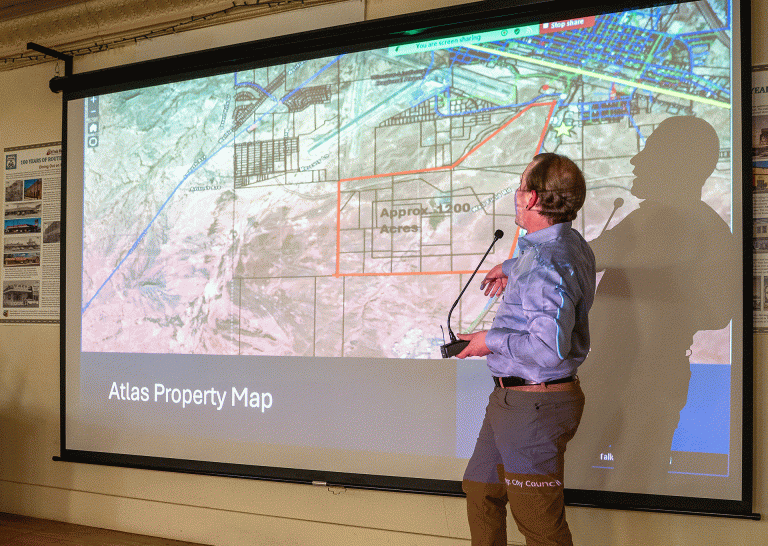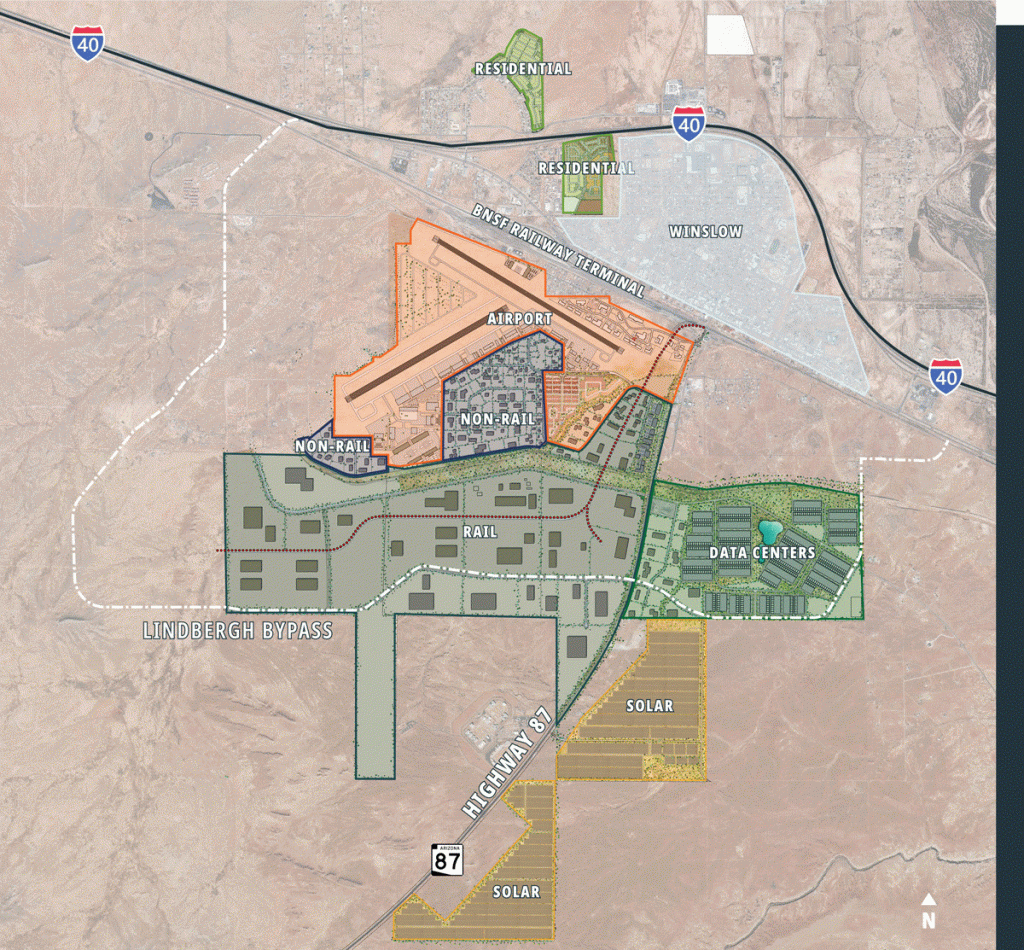
Concern and confusion over large-scale industrial development dominated Tuesday night’s Winslow City Council meeting, where residents voiced fears about water use, power capacity and transparency while city officials insisted no data center project has been proposed for the community. Several speakers during the call to the public focused on the I-40 TradePort, recently renamed RedSands Tradeport, and Atlas Global development, warning the city could be taking on risks without fully understanding the long-term impacts. Monica Gose told the council the project was being presented as an economic opportunity but argued the underlying realities did not support that claim. “We are being told that the I-40 TradePort is the future of our economy, but the objective documented facts show that this project is a house of cards,” Gose said. “We are being asked to hand over our land to a 4,000-acre mega site that requires up to 1,000 megawatts of power. But our legacy grid can currently deliver exactly one megawatt to that site.” She pointed to the gap between current infrastructure and what would be required to support large-scale industrial uses, saying upgrades could take years and cost tens of millions of dollars. She also raised concerns about water consumption tied to potential data center development, telling the council, “A single 100-megawatt data center will suck up 2 million liters of water from our aquifer every single day… the equivalent of 6,500 households.” Gose also challenged job projections tied to similar developments, arguing that employment figures often fall short of expectations. “We are told to risk our survival for the promise of up to 10,000 jobs, but those numbers are completely unverified,” she said, pointing to other data center projects that produced far fewer permanent positions than advertised. However, those figures of large job prospects are often tied to the industrial and commerce park which, they expect to house factories and other industrial uses contributing largely to that high job number. Raymond Lucero also addressed the council, focusing on a solar project planned near the prison. “The solar farm that’s going to be coming in across from the prison is going to be temporary employment,” Lucero said. “It will not include most citizens of Winslow… the only permanent employment might be 20 people.” He also raised concerns about long-term environmental impacts, warning that materials from such facilities may not be fully removed after decommissioning. “We’ve got issues and we need to look into this stuff,” he said. City Manager David Coolidge responded with a detailed explanation of the city’s current position, repeatedly emphasizing that the project many residents feared does not exist in any concrete form. “The city has, to this date, yet to ever be approached by a data center,” Coolidge said. “We are not currently working with a data center.” He added that even Atlas Global, the developer frequently mentioned in connection with the project, is not currently working with a data center either, despite conceptual marketing materials that include them. “They have a conceptual market strategy that does show data centers, but they have not been approached by a data center either,” he said. Coolidge outlined the regulatory hurdles any such project would face if it were ever proposed, including zoning restrictions, conditional use permits, public hearings and multiple impact studies. He said any proposal with significant water demand would trigger additional requirements, including infrastructure investment or the purchase of water rights. “If the utility demand study finds that any use will require greater than 20% of the city of Winslow’s current water supply,” he said, “then… the developer may install water infrastructure and or purchase water rights to meet the forecast demand.” He also noted that data centers are explicitly prohibited on portions of land already sold by the city and said a broader zoning rewrite is underway that will address them more directly in the future. At the same time, Coolidge cautioned that local control may not be the final authority on the issue. He said state lawmakers are considering legislation that could limit the ability of cities and counties to regulate data center development and other related infrastructure. “Oftentimes, they are items that take away our local control and are decided at the state level,” he said, urging residents to follow developments at the Legislature as closely as they follow local meetings. Despite the explanation, at least one resident said the city’s communication had lagged behind public concern. Ann Schmidt told the council she had asked about data centers months earlier and never received a response.“ I think the city could avoid this by more proactively responding to our questions,” Schmidt said. “It could have prevented a lot of bad feelings.” The discussion highlighted a growing disconnect between public perception and the current status of development proposals, with rumors and online discussion filling gaps where official information had not been clearly communicated. The meeting also included a warning from Fire Chief Michael Duran, who said the region is already experiencing dangerous wildfire conditions. He described confusion earlier in the day over whether a burn ban was in place, ultimately prompting the department to respond to a fire due to weather conditions alone. “With the winds, excess temperatures, the lack of rain… you should not burn,” Duran said, explaining the guidance from emergency management. He noted that Winslow Fire has responded to four incidents in the past three weeks and emphasized that the combination of wind and dry conditions is already creating a high-risk environment. Duran added that the department is now formally aligned with the Forest Service, giving it greater access to resources during fire season. Outside of the development debate, residents also raised concerns about everyday issues affecting quality of life in the city. Laura Lashomb told the council she has heard consistent concerns from across the community about speeding and code enforcement. “The first is the untethered speeding in town… residents are worried about the safety of their neighborhoods,” Lashomb said, adding that inconsistent enforcement of weed abatement is affecting property values and community pride. She also said some residents are hesitant to speak publicly. “I personally worry about ramifications of speaking out about these issues,” she said, urging the council to ensure people feel safe raising concerns. Lashomb did not elaborate on who she was referencing or what type ramifications. Alice Kinkman addressed the council regarding animal control, particularly the handling of cats. She said residents are being left to deal with abandoned or stray animals themselves and alleged the city is not consistently providing services. “Animal control has stopped taking cats,” Kinkman said, describing how she recently transported several animals out of town herself because no local option was available. The council also approved a proclamation recognizing March as Women’s History Month, citing the contributions of women in the community and across the country. Mayor Birdie Cano read the proclamation aloud, referencing this year’s theme focused on leadership and long-term sustainability. No representatives were present to accept it, and the city said copies would be sent to local organizations. In other business, the council: * Approved a cooperative purchase agreement with VSS International street maintenance and rehabilitation at a cost of $411,120. * Approved splitting a city-owned parcel located at 3000 East Highway 66 to separate out the part that has a wireless communications tower, * Approved waiving vendor fees for the fifth annual Winslow Arts Festival to be held April 26, and waiving fees for the transfer station for City Cleanup Day on April 18.