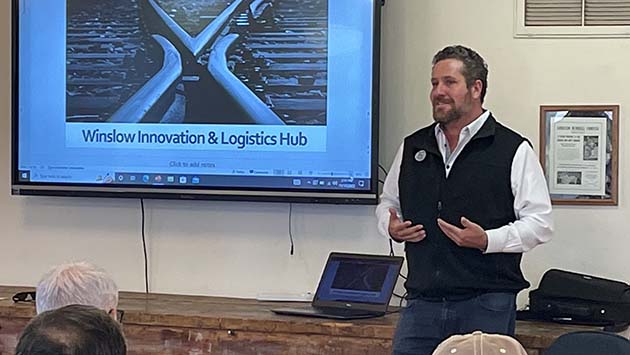
A public meeting was held last week hosted by Daniel Lupien with Palmer Development Group and Danny Wasson with Wasson Commercial who have come together for the joint venture Atlas Global Development Group, with the intention of bringing industry and housing to Winslow.
The meeting was one of several being held by the group to provide information and also receive information from the public regarding an upcoming development that will have a definitive impact on the residents of that community.
Not long ago another group, World Homes Initiative presented much the same way to residents, but what that presentation lacked in a definitive history of development was in start contrast to that of the partners involved in Atlas Global. According to Lupien, the World Homes Initiative plan was unable to garner enough investment funding, an issue that may not be the case for Atlas Global.
Lupien noted that he is a 25-year market veteran and industry expert who has bought, sold, developed and leased more than $6 billion of commercial real estate throughout his career. He began his career in 1998 and has constructed over five million square feet of commercial development for Triple Five Development Company. Then, in 2003 he was recruited by Kimco Realty, one of the nation’s largest publicly traded real estate investment trusts and served in the roll of Director and then Senior Director of Real Estate. Lupien stated that over a span of 15 years, he has helped to expand the western region from roughly three million square feet in 2003 to over 26 million square feet in 2016 through multiple acquisitions and millions of feet in development.
Lupien is now focused on creating his own projects through his personal investment firm Palmer Development. With a $200 million development pipeline primarily in the Western United States, Palmer Development is poised to rank as one of the top development firms in the Southwest.
Wasson is president and founder of Wasson Commercial Contracting, a firm established in 2009. Since inception, his company has constructed and developed over 400 projects in Arizona.
A third partner in this venture is James Rinzler, the owner of Dominion Management, an umbrella organization for the Rinzler Family real estate business, which has been investing in real estate for over 60 years. Through DMC, the Rinzler family currently owns approximately $500 million in assets.
When addressing those at the public meeting, Lupien explained that supply chains and global logistics patterns are changing, which puts market opportunities front and center in Winslow for a major investment in infrastructure. Market demands now include large industrial manufacturing clusters along what he called “the I-40 Innovation and Logistics Corridor.”
“This town has been overlooked by developers in Arizona but we are attracted to the unseen value, unrealized value and potential in these communities. I’ve got a lot of institutional real estate and institutional investment background. Why is that important? Because we are going to be raising some big, big money for projects. I’ve done that before and I understand how that works,” stated Lupien.
One of the attractions that led Lupien and his partners to Winslow is the BNSF railway. “It’s the busiest stretch of rail in the country, about $39 billion each day coming through here, just on the rail. We estimate another $5 to $10 billion a day on (Interstate) 40.”
He explained that many manufacturers are moving back to the US, known as the “re-shoring of manufacturing” or the “on-shoring of manufacturing.”
Lupien added, “Not many places want these manufacturers because ‘manufacturing’ is just a term we haven’t used in this country for 30 years. We off-shored it overseas because of cheap labor, well now there’s automation. Automation makes labor costs a lower variable. With the automated supply chains, a lot of manufacturers are looking to come back to the US. We have all the natural resources here, we have all the commodities here and we also have the consumer market here. So why are we shipping everything 8,000 miles away and then bringing it back here?”
Lupien explained that there are still many jobs associated with an automated supply chain. “People are needed to fix, run and program machines. There are transportation jobs and people who deal with buyers and customers, orders and processors. We like Winslow because it has the confluence of three modes of transportation here that come together, which makes Winslow very unique from our perspective. Not only do you have the I-40 but you have the rail and you also have the Lindbergh Airport, which if you extend that runway, we can start flying cargo here in the US. It’s called ‘high velocity cargo,’ that’s a new term but a lot of retailers like Costco, Walmart, Amazon – there’s certain things that they just don’t want to wait 12 weeks to ship over here and wait in line at the port of LA in Long Beach.”
He expressed the hope of developing an inland port in Winslow and flying international cargo directly to Winslow where it would then be put on rail cars or on the interstate to be sent out.
The project includes 1,200 acres of industrial development and also a residential component, which would alleviate the immense housing shortage in the region. The land involved includes parcels south of Winslow and both east and west of Highway 87. It includes the extension of rail spurs, the expansion of the Lindbergh Regional Airport, and the creation of thousands of square feet of industrial space and housing.
For the housing component, the development would not be traditional construction but prefabricated models, with four small show models that should be complete in the next week north of Transcon Lane. Lupien explained, “What used to take six months can now be put together in just four days and they’re affordable.”
Wasson addressed the housing development stating, “We have a lot of land tied up north of Mike’s Pike right now and we have 310 acres over off the (Highway) 87, on the north side of the 87, east of the concrete plant over there.” He noted that there were housing developers that were already involved and that additional land was going to be added to that. It is expected that escrow will close on all properties by March. The housing plan includes pre-fabricated family homes with a cost under $200,000.
Regarding the concern of what should be addressed first, industry or workforce, Lupien said they will address both at the same time. “We’re also going to define the workforce. It’s not just going to be the 9,000 people inside the community here but also the people up in the Navajo and Hopi reservations and the people in Holbrook and in Joseph City, and maybe even Flagstaff and further south into Snowflake.”
He pointed to the development that has taken place in Pinal County between Phoenix and Tucson as an example. “I think Winslow has some of the same qualities, if not better qualities than Casa Grande and Coolidge. I think we can do it better; I think we have a better story to tell and we have better infrastructure.” Lupien referenced industries such as Proctor & Gamble, Tractor Supply, and electric vehicle manufacturers Nikola and Lucid Motors, each who have built facilities in Coolidge.
The endeavor planned for Winslow will include private and public partnerships to qualify for more grant funding including the funding in the $1 trillion Infrastructure Bill. Lupien explained that this is critical in order to compete with other global companies that are being subsidized. “For us to re-shore manufacturing, it’s not going to happen just on the back of private capital markets. There’s a lot of grant money out there that we want to apply for and it has to be given to somebody, be given to some area, be given to some town. So, we’re going to research all the grants and see what we qualify for and apply.”
Lupien made it clear that the community’s response to the plan presented will determine the scope and scale of the investment being made. “We will build several hundred affordable homes in Winslow because we know that’s what’s needed right now, irrespective of anything else,” stated Lupien.
Regarding utility infrastructure, Lupien pointed out that Winslow sits on the largest aquafer in the state. He stated housing would barely make a dent in that and if the area’s industry is as a transport hub, very little water would be associated with that. If large manufacturers choose to come to the community, the city and the people that live there would be able to make the decision as to whether or not the city could accommodate those operations. Regarding sewage, it was noted that the city sewage system is currently at 50% capacity, but, if necessary, a new wastewater treatment plant would be created.
The timeline presented by Lupien includes a market analysis, which is already complete as well as due diligence. Next on the list is a cost analysis within 90 days, entitlement within 180 days, construction is 14-24 months out for Phase 1 and 2, then 36 to 60 months for Phase 3 and 4. Marketing would be in 24 months, leasing and sales in 24 months and then ongoing management. The estimated cost for the entire endeavor is estimated over $273 million.
More public meetings will be scheduled in the near future but as of press time those dates were not available. They will be posted in the paper and on The Tribune Facebook page as they become available.