Atlas Global Development has recently conducted three presentations in Winslow, including a city council meeting and two public meetings, one in the morning and one in the evening. These events focused on discussing the project’s scope and potential outcomes for Winslow.
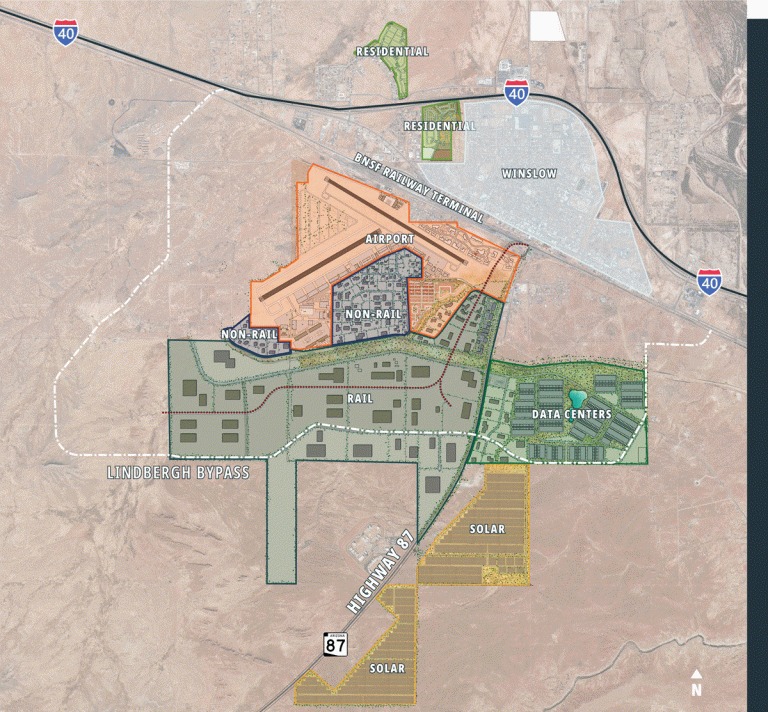
The success of this project hinges on access to housing for workers to be able to move into town for the project and the surrounding areas currently lack sufficient housing to support a workforce for the Atlas Global project. According to Dan Lupien, one of the partners at Atlas Global Development, the first phase will start near Southside on the east side of Highway 87 and will involve light industrial work. This phase won’t require many workers and will need lower levels of water, energy and workforce. The first phase will also most likely include the Winslow’s Lindbergh Regional Airport because most of the necessary infrastructure is already in place.
Lupien is looking to bring in flight schools and industries involved with the maintenance of popular aircraft to meet industry demands. In previous versions of this plan there was expansion of the airport’s runways but he made it clear this is no longer the direction they are going and will send the bigger cargo planes that need a longer runway to Kingman.
Lupien also expressed his pride in securing a nearly $1 million grant for the planning portion of this project that will aid in much of the studies that will be required during that portion of the project such as water, traffic, noise, geological and environmental studies.
Lupien predicts that when the third and fourth phases of the project are completed, there could be as many as 8,000 new jobs that he expects to materialize in about three to four years. The introduction of such a large industry will significantly impact various sectors in a town of 9,000 residents. Retail and consumer services, educational services, healthcare, transportation and logistics, hospitality and tourism, legal, and financial services will all see growth. Local government and public services such as waste management, water supply, and public safety will need to expand to serve a larger community. There will be a continuous need for infrastructure maintenance and development, including roads, schools and utilities.
With these jobs coming in four years or less, according to Lupien, every industry around Winslow will unanimously have to adapt to the unprecedented demand. The extent of the plan’s effect on the Winslow population is not yet clear, but if Lupien is correct, the town could triple in size by the end of the decade.
Lupien is uncertain about the exact number of jobs the project will create and currently has no specific companies on board. However, he expects four letters of intent (LOIs) to be signed in the coming months, which would begin moving these companies to Winslow.
“I expect to have four leases by the end of the first quarter of 2024,” Lupien remarked. He anticipates one company dealing with waste management, ensuring the project puts “nothing in the landfills” and could even remove material from the landfills or accept waste from other cities to be processed in Winslow.
Additionally, he plans for two of the LOIs to be for modular home manufacturing, aiming to build affordable housing and supply homes to much of northern Arizona. His plan is to have the two 500-home subdivisions he plans on building in Winslow to be built from modular homes produced in town to keep prices as low as possible.
The last LOI is expected to be for a biomass company that would utilize forest thinning to manufacture products or create energy, focusing on branches under 6-inches in diameter.
Energy is another major concern for the project. Winslow currently has only a fraction of the power needed for the Atlas Global mega site. Lupien noted that Arizona Public Service has many energy upgrades in the queue, and necessary upgrades to the energy infrastructure are unlikely to happen within his timeframe.
His plan involves generating all necessary power locally, utilizing Winslow’s abundant sunshine and wind. This includes a hydrogen creation plant to power semi-trucks, aligning with California’s future ban on diesel trucks. Lupien stated several times that starting in 2024 California would ban the sale of all diesel trucks however that strict deadlines for this ban would initially affect drayage trucks, that transport goods from ports to their final destinations, with other diesel trucks facing looser restrictions and timelines.
The plan for hydrogen conversion would require a lot of water. Water can be separated into hydrogen and oxygen which can be used to power hydrogen vehicles, which when burned gives off water vapor as a byproduct instead of carbon dioxide like the burning of other fuels. This is much cleaner but there were several citizens concerned with the amount of water being used for a project like this and asked Lupien how it would affect people’s wells in the area.
Speaking about manufacturing in general, Lupien said that the factories he is seeing proposed would be able to recycle its water at a rate around 90% with modern technologies, however this cannot be the case for a hydrogen manufacturing plant. His answer to this was that if residents have to re-dig their wells deeper to be able to get water then, “This means our plan is working and we should be the one to do that [re-dig the wells].” Lupien did assure the audience that they are working with water engineers with sophisticated computer modeling that will show how taking water from one area will affect all the wells tapped into the West Virginia-sized aquifer.
Moving forward, Atlas Global expects to have the first site plan ready for the city’s review in January. Lupien expressed willingness to hold another public meeting at that time to discuss the plan, though no meeting is currently scheduled. This project represents a significant turning point for Winslow, with potential for economic growth and new opportunities, but also challenges that require comprehensive planning and community involvement.