Eighteen hundred pounds of pinto beans found their way to the Wings of Faith (WOF) Ministry warehouse at the Holbrook Airport in May. Added to the beans were truck loads of tomatoes, cleaning supplies and water barrels. Behind the scenes, workers from WOF, Operation 29:11 and the Native American Emergency Relief (NAER), came to help with the massive distribution that goes to more than 50 churches and organizations throughout the tribal areas of Arizona and New Mexico, including groups in Holbrook.
On a local level, Bob Seymour, a retired pastor from the First Baptist Church in Snowflake, and Eric Luhmann, who serves as Holbrook’s Facility Manager with WOF, are continuously working to keep the donations flowing in and the warehouse open so the goods can easily flow out to those in greatest need.
Luhmann said that it was God who built the building, debt-free through a lot of hard work as well as donations and the generosity of the City of Holbrook. “The city asks that we cover the insurance,” noted Luhmann. “God fills it and we empty it.”
Kristy Scott with NAER, a branch of the World Emergency Relief organization, said that much of what they bring to the tribes goes to the elderly members. “They have been forgotten,” said Scott. “We bring them firewood, food boxes, blankets, cleaning supplies, as well as our hearts and our time.”
But it is Operation 29:11, co-founded by Randy and Pat Williams and Robert Ratzlaff in 2010 as an outreach of ICS Strategic Partners that is starting a new movement promising to bring greater resources and hope to the tribes. “Our big push is to help establish community gardens on the tribal lands,” said Williams, and not just any community garden concept, but one that takes into consideration the limitations of water and resources.
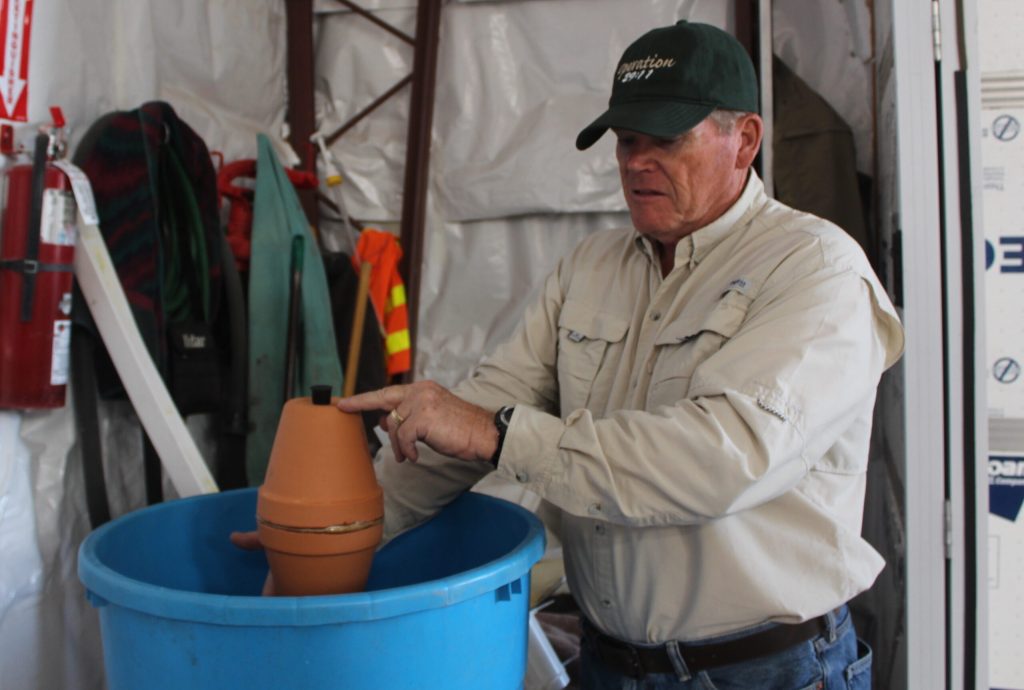
From the ancient irrigation method of olla gardening to using buckets and barrels to create a wicking bed garden, Williams said he is committed to finding a way to help the indigenous tribes of the Southwest find a way to grow fresh vegetables throughout the year, using items that are easily and cheaply attained.
Living in Southern California, Williams said he has recently been able to get involved with the Sherman Indian Boarding School in Riverside where more than 70 tribes are represented by the youth that attend the school. Within the concepts being considered are container gardens, meat and egg chickens, livestock, medicinal gardens and classes in nutrition and food preparation.
Williams feels strongly that if people can learn how to grow food in the harsh environments that so many tribes encounter, then a better world can open up for everyone.
Through coordinated efforts, Scott was able to obtain 55 gallon plastic barrels and gutters that will be used to create rain collection systems on the church buildings on the reservation. By creating gardens in containers using methods like wicking and olla pots, the water loss through evaporation is minimized, literally making every drop count on lands where water is often a premium.
An example is olla gardening, which creates irrigation systems through the use of clay pots that can easily cost $25 or more for one pot. While the concept was excellent, the cost of the pots had Williams stumped as to how it could become affordable until he came up with a way to glue basic clay pots together, saving a significant amount of money. “We are just working with concepts; concepts that can be modified to fit whatever need there is,” said Williams.
While the warehouse is opened two or three times a week to keep supplies flowing, the next big distribution is being planned for October of this year.
The biggest heartbreak for Seymour, who has been doing this for a number of years, is the lack of involvement by the young people of the communities, “Not too many young people get involved anymore,” shared Seymour, adding, “I had no idea that I would be doing this for this long.”
For more information on the organizations and how to donate or get involved, visit: www.narelief.org, www.operation2911.org and www.flywithwings.org.