Atlas Global Development, the company behind Winslow’s potential tradeport, is seeking a zoning change for their Planned Area of Development (PAD). Currently, the land in question is zoned for industrial use. A PAD is a type of zoning that allows developers more flexibility in designing their properties, often combining different types of zoning. For this project, the land use will include both industrial and light industrial zones, which imposes additional restrictions on its use. PAD basically allows for developers who are creating large developments with large impacts to sit down with council and provide additional rules to better help the development’s effects on citizens.
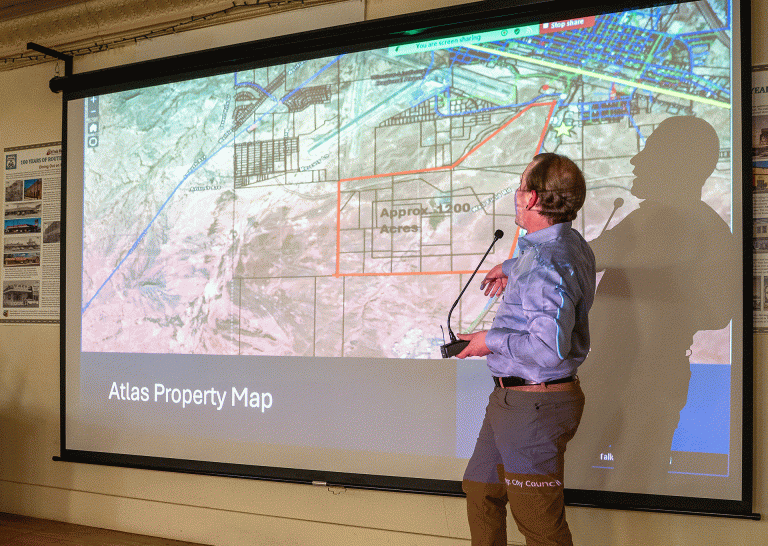
This version of the PAD covers 1,449 acres of land, located west of Highway 87, south of Coopertown, and north of the Winslow’s prison complex. Winslow Planning and Zoning Officer Jason Sanks mentioned that Atlas Global plans to add more property to this PAD, including land near Southside. When that addition occurs, it will be subject to the same rules as previously passed versions of the PAD.
Within the PAD, there are design guidelines for various aspects such as lighting, design, drainage, and traffic. These guidelines are proposed by the developer, likely after extensive discussions with the city. Once the preliminary PAD is approved, the developer is bound by those guidelines and can proceed to the more detailed phases of planning.
Many of the guidelines the city requested were inspired by conversations with residents, particularly from Southside and Coopertown, who will be most affected by the project. These guidelines were also shaped by the city’s recently adopted general plan.
Sanks emphasized how discussions with residents highlighted the need to prohibit industrial use north of the levee. That area will be designated for a commerce park, focusing on indoor businesses. If manufacturing takes place there, Sanks noted that it must be indoors, and any loading docks must face away from residential areas to minimize disruptions. Sanks told the audience at the planning and zoning meeting, “Our current code does not require this; we’re making this required of them. It’s that they’re agreeing to this if we’re going to support their zoning case. That they can’t have the nuisance uses of 18-wheelers backing up the loading docks and facing residents. It looks terrible, it doesn’t look well, and they’ve agreed to that.”
Winslow is also developing the Lindbergh Parkway, which would eliminate the need for traffic to enter Winslow when traveling between I-40 and Highway 87. Winslow Economic Director Jack Fitchett said that the city is currently pursuing grants to fund this bypass. This is crucial for the plan’s feasibility, as the preliminary traffic study shows that the development could bring an additional 32,000 to 61,000 vehicles per day through from I-40 to Highway 87. Sanks explained that the PAD requires that if Winslow cannot complete the Lindbergh Parkway, Atlas Global must revise their PAD and take on the responsibility of developing it themselves.
Dan Lupien, one of the principals of Atlas Global, also spoke at the planning and zoning meeting. He explained that although the project was initially nearly 4,000 acres, they scaled it down to 1,449 acres to grow more gradually and ensure community support. Lupien emphasized that PAD zoning imposes stricter regulations than standard zoning, a point Sanks reiterated by highlighting the numerous restrictions they had negotiated.
The final PAD plans, which may take a few years to develop, will need to closely align with the preliminary plan. These plans will include detailed site layouts, grading and drainage strategies, building designs, and landscaping and lighting plans. Additionally, updated traffic impact and utility demand studies will assess the project’s effect on local infrastructure and resources. These steps ensure that the final PAD complies with both the city’s expectations and the community’s concerns, preventing any unexpected changes from being introduced in the later stages.
Sanks recommended that the zoning change from industrial to PAD be approved by the council, although he noted that it likely won’t be on the council’s agenda until October, and he’s unsure of the exact date. He assured the audience that “there will be many, many more public hearings” regarding the Atlas Global project.