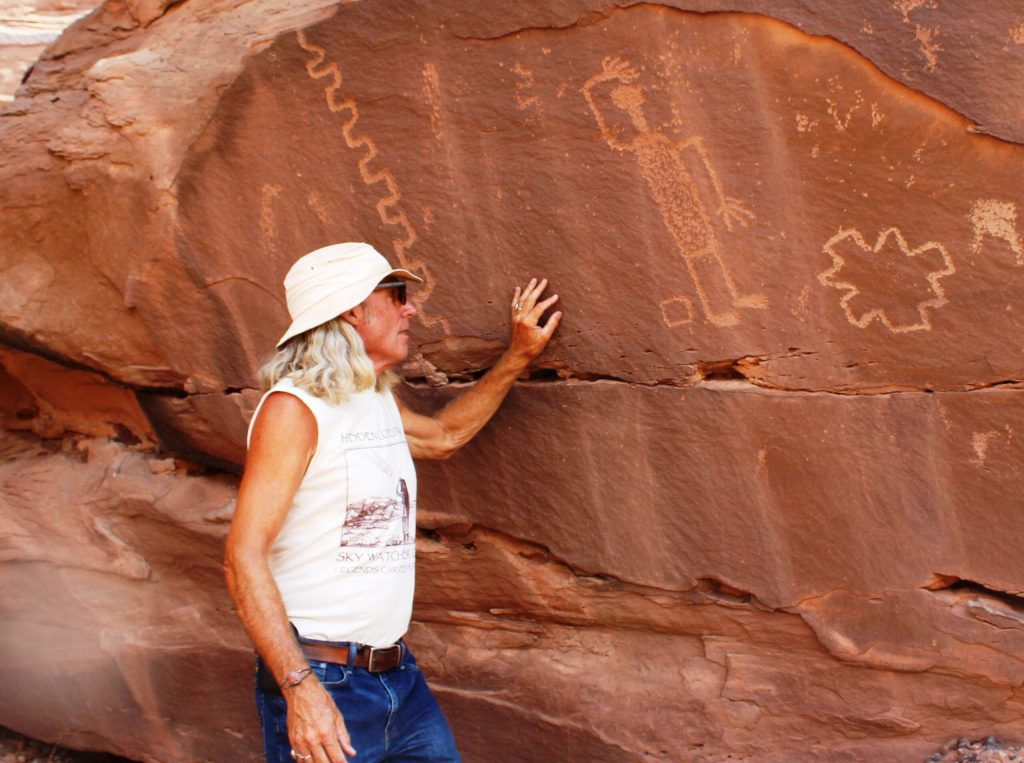
HOLBROOK –“’Hisatsinom’, it’s the Hopi word for ancient people,” said Mike O’Dell, tour guide for the Hidden Cove Petroglyph Park, as he stood at the base of the small mesa located about five miles northwest of Holbrook. True to the ancient culture, that one word spoken with passion, echoing slightly off the cliffs, embodied the beauty and starkness of the desert world. For the next two hours, O’Dell was no longer a long-time city employee who helps to maintain the golf course; he was a guide, teacher and passionate student of the ancient world located in the park. The petroglyphs, which are not easily seen from the base, are both unique and common, spanning thousands of years from the Pueblo Two and Three periods as well as some that might go as far back as the Archaic and Basketmaker eras. “The Archaic period can go back thousands of years into the B.C. time frame, while the Basketmaker starts from the beginning of the A.D. time frame,” O’Dell shared from his research. But perhaps the greatest part of the experience is walking the pathway that has been traveled for thousands of years to stand on the ledges and view closely the pictures and stories left by those who traveled this way so long ago, then to turn and look out across the vista, seeing a landscape that goes on for miles. As Valerie Martin, a visitor from France wrote after a second visit to the park with her friends, “In his own inspired way, between relevant comments and silent observation, Mike O’Dell made us dream about the life of native people in the area a long time ago.” The Hidden Cove Petroglyph Park adjoins the Hidden Cove Golf Course, a nine-hole course, built by Holbrook in 1974 in the shadow of a mesa located north of Interstate 40 at Exit 283. While the city purchased some of the land for the course local ranchers, Charlie and Mollie Jennings, donated a portion. By the mid-1980s, water laws changed and Holbrook was required to reclaim their wastewater, causing the city to search for a piece of land that would allow them to build the necessary containment ponds. The Zuck Ranch, located near the golf course, became available and the purchase was completed without the citizens of Holbrook ever realizing that included in all the ranch land and rocks was a gem of immeasurable worth. “Some of us would go out after work and explore the area,” said O’Dell, who found the petroglyphs and became a quiet guardian of the area. Armed with books like “Tapamveni: The Rock Art Gallery of the Petrified Forest,” O’Dell began to study and research the rock art. Over the years, O’Dell became the tour guide sharing the experiences as often as possible. The day he guided Petrified Forest Superintendent Cliff Spencer and his family through the maze of rock art in 2009, was the day the vision of the park changed. “Cliff really got what we have here and he told the city that they had something,” shared O’Dell. A 23-year veteran with the National Parks Service (NPS) before he became superintendent, Spencer was able to get Joe Winfield, who worked with NPS out of Tucson, involved at the park. Also involved was a representative of the Hopi Tribe. While the Navajo and Zuni tribes were invited as well, there were no representatives sent. “Joe loved the fact that the historic site was so close to the prehistoric site and would come from Tucson to hold public meetings and helped us get an NPS grant for nearly $100,000 to create paths and sustainability in the area,” said O’Dell.