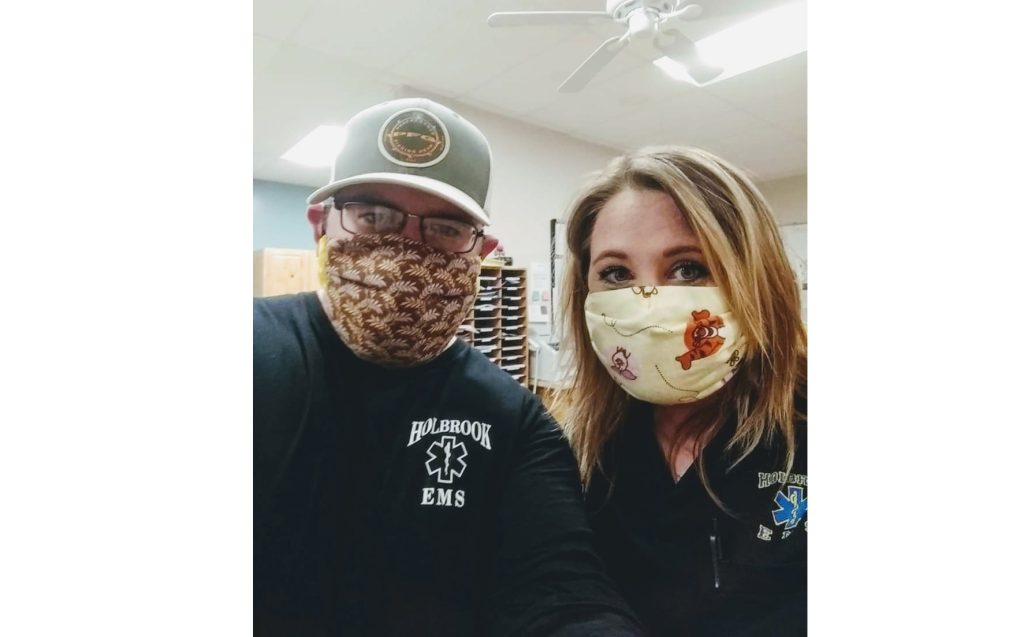
 By China Cassidy Since COVID-19 hit the United States, there have been multiple reports from medical professionals who are on the front lines of battling this global pandemic and who are sharing their experiences from hospitals all over. Holbrook EMT of 12 years, Becky Slade provided insight into what it is like for first responders during a pandemic when each call finds them somewhere different and the extra precautions they are taking to try and reduce exposure. Unlike hospitals where they have some control over their environment and are able to enforce their policies and regulations before allowing anyone to enter the facilities, the first responders don’t always know what circumstances await them at each call. Slade said that while dispatch does do a questionnaire for each call to help them prepare, there are many other precautions they must take to ensure their safety as well as that of the patients. Slade explained, “Dispatch will ask certain questions if people call in for an ambulance and they’ll come over the radio and tell us whether the questions lead them to expect they have COVID. So, we can kind of start prepping at that point. Or if they have tested positive or have a fever or that kind of stuff, we’ll automatically get in full PPE (Personal Protective Equipment) and respond to the call.” Though most of the precautions taken are already common practice, they are taking extra to minimize the possibility of infecting someone who does not have COVID. “We change the plastic out after every patient that is COVID positive. We also have an ozone machine that we run after those patients. So, we’ll hang those up in the ambulance and let that kill all the bacteria and anything that’s in the ambulance.” Slade explained that aside from her normal routine, she has had to be extra diligent to ensure that she is doing everything she can to minimize exposure to her family after her 48-hour shifts, including never taking her work clothes home. After sleeping overnight at the EMS station, Slade takes precautions to ensure there’s no possible exposure to her family when she goes home. “It’s definitely worse. I have a routine where my son will stay at my parents sometimes, so instead of just going to pick him up, I’ll drive home, completely take off my pajamas, even before I go into my house really, and they’ll immediately go in the wash. Then I’ll go and shower before I do anything else. Then, once I’m ready and all cleaned up, I’ll go pick up my son.” Because there are so many people who do not agree that masks provide protection, Slade was asked if that has any effect on the day to day stresses of not knowing whether she or other first responders will be exposed to someone who will not wear a mask. Slade explained, “It’s hit or miss here for people arguing over it. Typically, we just tell them they have to wear a mask. In the ER (emergency room) they make them, its mandatory. Everyone has to and that’s for the safety of them and other health care providers so they don’t get it from the ER, and if they have it, they’re not giving it to the staff. So, it’s just a blanket policy that everyone has to wear a mask, on every call, including the patient.” Slade also noted that the number of calls they have been receiving from COVID positive patients or those with symptoms such as respiratory difficulties have increased. “Calls have seemed to pick up quite a bit actually with everything. We’ve still been getting our normal calls but it seems like all the others picked up kind of.” Spending 48 hours a week together, the crew at Holbrook EMS has formed what Slade called somewhat of a family dynamic. She said the stipulations they have to follow due to COVID and the busy shifts have taken their toll. “Everyone’s pretty stressed and tired. We’ve actually been wearing masks and stuff at the station. We’re kind of like family here and we’ve kind of been keeping to ourselves more, so it’s not that comradery really like it used to be.” Regarding the popular debate about whether masks are actually beneficial, Slade offered, ““I would say to err on the side of caution and just do your best to reduce the risks of infecting others. And if that is to wear a mask, I would do it. If it kept someone else from suffering that way, I mean, even one person from suffering that way, then it was worth it to wear a mask. So I personally wear masks and take precautions when I go home. Knowing I’m a healthcare provider, I do come in contact with patients positive for COVID. I don’t want to risk giving it to someone else.” When asked if those who are experiencing symptoms or think they might have COVID should call EMS, Slade said they should contact their primary care provider for testing. “It’s always just the recommendation for people, if their having symptoms, not necessarily severe symptoms, just to be safe, and go ahead and quarantine.”