

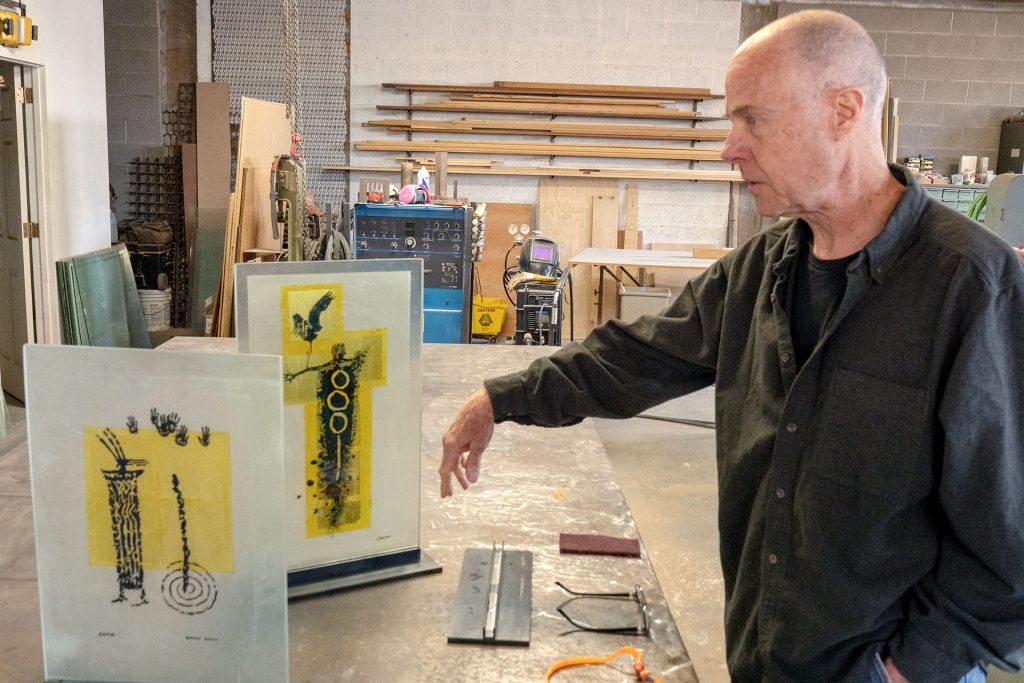
When John Suttman fires up his 1400 degree kiln this time of year the room is cold. In winter, he turns the heat on only enough to keep the pipes from freezing. Everything else is left to the temperature of the room. When the kiln is running, the heat is sealed inside it, intense and contained, while the rest of the space remains unchanged. A contrast that may be unintentional but echoes through his work.
Suttman has spent a sculpting career working in materials that resist control, shaping steel into forms that appear lighter, softer or familiar enough to be mistaken for something else. Metal becomes wood. Structural elements appear playful. Objects built for use quietly perform while disguising the effort and force behind them. The tension between what a material is and what it appears to be runs through his work at the La Posada Hotel. From the Turquoise Room Bar to the recreated Wishing Well on the South Lawn and the large train gate near the hotel’s rail stop, his work is part of how people move through the property, often without noticing where architecture ends and sculpture begins.
For much of his career, metal was the primary material through which Suttman explored those ideas. His attraction to difficult, unforgiving materials began early. His father worked as a technical artist for laboratories in New Mexico, including Los Alamos National Laboratory, producing precise functional drawings, while his uncle was a sculptor. Between those influences, Suttman grew up around both disciplined problem-solving and creative experimentation. This was the seed that grew and eventually began to bare fruit from a young age. He earned a Bachelor of Fine Arts in sculpture from the University of New Mexico, working in multiple mediums before beginning a successful career designing and fabricating high-end fashion jewelry. That work sharpened his technical skills and attention to detail, eventually merging with an interest in furniture and metal fabrication.
Furniture became a proving ground. Early designs were relatively conventional, but Suttman treated each piece as a challenge, pushing design parameters further with every iteration. Humor and whimsy emerged along the way, though not as primary goals. Deconstruction and reinterpretation of traditional forms drove the work, alongside cultural and social commentary. Cabinets appear ready to tip, chairs seem poised to move and surfaces that look like wood reveal themselves as steel finished with layered patinas and paint. His non-furniture sculpture, he has said, leans more toward mystery and discovery, inviting closer inspection.
That way of thinking carried naturally into his work at La Posada, where art is inseparable from use. Over the years, his collaboration with hotel owner Allan Affeldt allowed that approach to take hold. Suttman has said Affeldt frequently brought him creative challenges rather than fixed instructions, giving him room to respond to the building and its history. Many of the hotel’s metal elements began as detailed sketches, shaped as much by the space they inhabit as by the artist’s hand. La Posada was a place for Suttman to rest his head on the drive from his home in Ventura, California to his hometown of Albuquerque and La Posada began to be the driving force behind moving to Winslow.
Suttman’s work appears beyond Winslow as well, including a gate created in 1994 for the west sculpture garden at the Albuquerque Museum. That gate combines solid overlapping metal with windowed sections filled with grids, spirals and rhythmic lines, reinforcing his long-standing interest in blending structure with movement and pattern.
In recent years, however, his attention has been shifting. Suttman has become increasingly focused on glass, describing a process that involves painting glass with glaze used for coloring ceramics and fires it between layers of glass at 1400 degrees. Using silk screens, he prints detailed imagery onto the surface, building depth through repeated firings. He said that many of his recent works have some kind of glass aspect to them although that is not true for his earlier work. While the process remains technically demanding, it places different physical demands on the body than large-scale ironwork. His glass pieces were recently shown in Santa Fe and he described himself as currently between projects, using the pause to look for what comes next.
That period of reflection mirrors the way he has shaped his life in Winslow. For over a decade Suttman has been transforming his home and studio, a former commercial building he and his partner, Joan Harden, purchased in 2012. One of the most significant changes was the creation of a central atrium. By removing a large section of the roof, Suttman and his crew formed an open garden at the center of the building. Living spaces and offices all face inward toward the atrium, where light, shadows, plants and sculptures interact throughout the day. The project took longer than expected and remains unfinished in places but the result is a fully functional live-work space shaped by the same integration of art and daily use found in his work at La Posada.
Suttman has said that while he once imagined undertaking a project like his Winslow home in Ventura, building codes and real estate costs made it impractical. Winslow offered something different: space, fewer barriers and a slower pace that allowed him to focus.
Even as his attention turns toward glass and painting, that same tension remains intact. Whether working in steel or glass, Suttman continues to push materials toward something they are not, asking iron to behave like wood and structure to pass as ornament. At La Posada, visitors pass through gates that look lighter than they are, gather near objects that conceal their material and move through spaces shaped by forces they rarely notice.
Like the cold workshop built around a sealed source of heat, the work holds its extremes without resolving them. The material does its job, the illusion remains intact, and the contrast is only revealed to those who stop long enough to look.



