and Linda Kor
With economic development improving throughout Navajo County, the City of Holbrook is reporting that opportunities have also been received at the city. According to City Manager Ted Soltis, the city has also sought to connect business interests with available commercial property in the community. But for many years, even decades, the city has also been marred by several large, blighted buildings that have not been held to the city’s own code.
These abandoned and neglected buildings have led to criminal activity, with most serving as shelter for transients. In two of those instances, those occupancies have led to arson with one structure, the Knights Inn, completely destroyed over a year ago. The other and most recent, the Golden Inn, sustained fire damage to the office space last month. A third hotel, the Magnuson Hotel, which burned down one week after the Knights Inn, generated substantial revenue from travelers and was occupied when transients in an abandoned trailer adjacent to the hotel set a fire that spread to the hotel causing complete devastation.
This year the necessary action was taken by the city to remove the debris and clear the lots of the burned buildings. But the outcome of those fires has been costly to the city, as the abatement cost of the Knights Inn reached nearly $60,000 and according to city officials will likely never be recouped. In addition, the time that lapsed until the removal of those buildings served as a visual detriment to development in those areas
Regarding the remaining blighted buildings, Economic Development Director and Code Enforcement Officer Jason Foutz says he has made an effort to collect information from the owners of vacant properties as to their intent or availability of the property for sale in order to connect the owners with potential buyers.
“I’ve sent out letters, as far as from the economic development perspective, asking what are your plans for the property? Are you planning on selling? Are you planning to lease? Do you have requirements of what you will or won’t allow? Just in a vein of trying to help. So when I get those phone calls, which I do from people wanting places, I know what is available.” The effort had little impact as Foutz estimated that he sent 20 notices and received responses from just two.
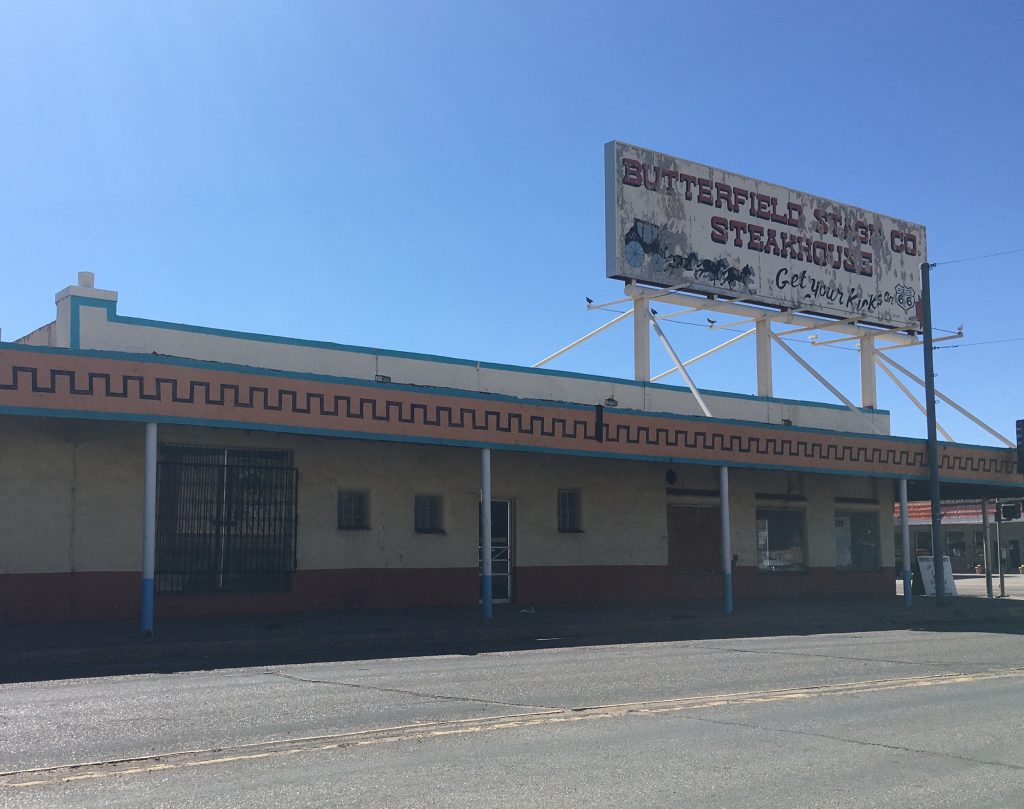
When properties begin to deteriorate the city sends letters to the owners that are able to be located, notifying them of the violations and the possible action that could be taken if those violations are not corrected. While Foutz said most people take action by the second notice on residential and some commercial buildings, none of the city codes have been enforced on the most egregious of offenders, which include multiple properties on Hopi Drive that for more than two decades have fallen further and further into ruin. These large structures dominate the city’s most famous main street as one of the few vestiges of the original Route 66 that continues to draw thousands of travelers through the community each year.
Those buildings include the old bus depot, located on the southeast corner of Hopi Drive and Navajo Blvd. and the old muffler shop in the 700 block of Hopi Drive across from Safeway, both owned by Dusan Pesut of Page. Another is a large block building in the 900 block of Hopi Drive owned by Blaine Farr of Flagstaff. Then there is the Star Inn, which is currently under ownership transfer due to taxes being paid by an investment broker. While this appears to be good news, the structure would still need to be abated before the land will be useable, which will be very costly.
Many people have offered to purchase and restore the buildings owned by Pesut and Farr but have been turned away by the owners or, in the case of Pesut’s muffler shop which is little more than a shell of a building in need of extensive restoration, is currently on the market for the exorbitant price of $399,999.
When asked what he felt was the city’s role in addressing these severely blighted and neglected buildings Foutz replied, “It’s a double-edged sword. We do have ordinances in place. We try to enforce those ordinances but people are allowed to do whatever they want with their properties, it’s called property rights. But they need to keep them safe. The problem we have is that we have some property owners, some of them non-resident owners, that don’t care. I don’t know how good our track record is with those non-residents when it comes to commercial properties but with some of the commercial properties it’s rather difficult.”
The city code, which is available on the city’s website at ci.holbrook.az.us under Planning and Zoning, is very clear on how to address blight in the community and each violation issued to property owners include a copy of that city code. Section 3-1-7 defines blighted buildings as those that have unsightly conditions, including, but not limited to, the accumulation of debris or garbage; buildings or structures characterized by holes, rot, collapse, crumbling or rusting and any other similar condition of disrepair, dilapidation or deterioration.
In the case of the buildings owned by Pesut, no effort has been made to address the appearance, with doors missing, windows broken and debris filling the rooms.
The code also requires that buildings in such condition must have a sign conspicuously posted on the building stating the owner’s name, address and phone number. None of the blighted buildings in the city have such signage posted.
Also according to section 3-1-7, the owner is responsible for securing the building. While the Farr building is boarded up for the most part, the disrepair is apparent. But even the boarded building is not acceptable for long.
According to codes, within the first 90 days that a building is vacant or abandoned all of the doors, windows and other openings the building may be secured with plywood panels. After the 90 days, the owner is responsible for restoring the building to an occupied appearance, with all doors, windows and other openings in good repair. The owner is also responsible for installing a security fence around the building and a commercially serviced, 24-hour burglar alarm system to prevent unauthorized entry into the building. Again, this has not been addressed in either the Farr or Pesut buildings, with only a broken wire fence partially around the muffler shop.
According to code if those requirements fail to be met in the timelines provided the penalties are severe. In Section 3-1-8 of the city code it states that as a civil violation a minimum $250 fine will be assessed for each violation, for each building, each day that the violation is not corrected. If found to be a criminal violation, in addition to the minimum $250 fine per day, a minimum one year probation will be assessed as a Class One misdemeanor.
If the city has to step in and correct the violation, the city can then petition the court to recover the expenses and attorney’s fees.
With the city code very clear on how to move forward, Foutz was asked why the city does not proceed according to code to address the more severe problems in the community. In reply he stated, “I don’t know. It just hasn’t been done. I don’t have an answer what got us to this point. All I can say is the current administration is trying to work with property owners.”
When asked to define specifically what it meant to work with the owners Foutz clarified by stating, “Trying to motivate them to get things done and not have a heavy hand because a heavy hand does not always have a good result.”
When dealing with new violations it’s understandable to address property owners in a manner of assistance, looking for ways to help the owner to get the building up to code and to allow time for property owners who are involved in continuous improvement. But when asked how property owners that have a decades-long record of ignoring the city’s request for improvement and undoubtedly know of the repercussions of doing so, Foutz noted, “But the new administration doesn’t know that.”
When asked if he thought enforcing the ordinances would make a difference he stated, “It’s tough to say if it would work. I don’t think there’s a magic bullet.”
In the case of Pesut, he has received six notices of violations this year alone by Foutz, detailing the necessary repairs in addition to a copy of the city code, one so thick that one had to be sent in a manila envelope. Despite those notifications there has been no improvements made to the property by Pesut and no repercussions handed down by the city. Attempts to obtain a response by Pesut regarding his properties were not received as of press time.
Ofelia Lange, who currently owns three businesses between Holbrook and Sun Valley and will be opening a restaurant on Hopi Drive in Holbrook in 2020, was asked if the appearance of the neglected and deteriorated buildings affect her business and what she felt should be done to resolve the issue. According to Lange, city administration, residents and property owners are all responsible for the lack of care apparent in Holbrook’s appearance.
Lange suggested that the city hire someone dedicated to code enforcement and begin holding property owners accountable for not following the clear policies set in the city code. “I know we have a code, but it doesn’t get enforced,” said Lange.
Lange pointed out the older abandoned buildings as the biggest deterrents, whose owners have allowed the structures to deteriorate but are also so far overpriced, they’re not affordable. Especially, when considering what it will cost for people like Lange who may wish to purchase the properties.
“If they’re not going to take care of it then let me have it for a reasonable price and I’ll fix it up,” said Lange. Lange believes that the buildings such as the old bus depot across from her Holbrook Mercantile shop are a significant part of the historic appeal of Holbrook and should at the very least be preserved both structurally and superficially if the owners insist on keeping the properties.
Because the intersection where Hopi Drive and Navajo Blvd. meet is one of the only 90 degree turns on Route 66, Lange fears that buildings like the old muffler shop across from Safeway and the Star Inn will put-off any potential business brought by the historic highway. Lange stressed, “We need to preserve that turn.” Adding that property owners will take advantage of a lenient administration if given the opportunity.
Using the newly assigned no-parking zone in front of the Wells Fargo Bank on Navajo Blvd. as an example, Lange pointed out that it is blatantly ignored by many due to lack of enforcement. Saying that following through with consequences is needed to make change, “Give them a ticket, fine them every day. We need consistency,” she said.
She noted that above all the community and city administration need to begin working together to take care of their town. The business owner said that as much as it is the city’s responsibility to see that there are consequences for violators, it is as equally important for property owners to take an initiative.
Lange said that the buildings on the main streets are just a portion of the eyesores that can be seen around the town. She stated that renters take advantage of the leniency of the property owners who are not requiring their tenants to maintain the properties.
According to Lange, if both city administration and landowners were to adopt and enforce the policies, it would make it difficult for renters to move from one residence to the next repeating their offenses. “Feelings might get hurt but they will start to listen,” said Lange.
Having invested so much in Holbrook, it’s safe to say that Lange wants Holbrook to flourish to its fullest potential. As far as what she thinks will make the difference, she believes that members of the community have lost sight of the importance of community togetherness. She said that while there are many things needing to be addressed it starts with everyone supporting and respecting each other and seeing what needs to be done to ensure that their town is being taken care of. She added that there seems to be more competition and resistance in the community of Holbrook rather than support.
A native of Mexico, Lange shared what the community she grew up in was like. “I grew up in a small town in Mexico. The town was all cobblestone. Everyday everyone cleaned the streets. If somebody didn’t help, oh believe me, they would hear it. Nobody wanted to be the part of the street that was dirty. Everybody wanted the cleanest house. We don’t have that here.”