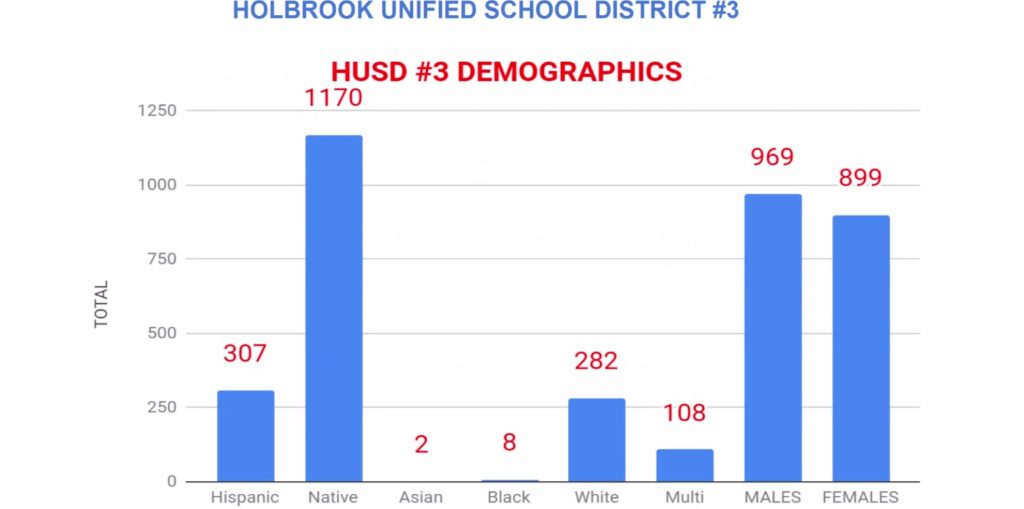
By Talaina Kor During the Holbrook Unified School District No. 3 Governing Board meeting last Tuesday, Feb. 9, at Indian Wells Elementary School, the board listened to a presentation from Superintendent Dr. Robert Koerperich, Indian Education Coordinator Janelle Chee, Business Manager Casey Hancock, and Parent Liaison and Indian Impact Data Representative Alfred Clark. In the presentation the group discussed district funding as well as an Indian education parent survey that was conducted. The district has a majority of students that are Native American. “At this time we have 1,350 Native American students,” stated Chee. “Holbrook Unified School District represents 15 Native American Tribes.” The Johnson O’Malley (JOM) funding used to meet the special and unique needs of Native American students equals $97,777 this year plus an additional carry-over funds of $30,776, for a grand total of $128,553. “Normally our contract ends in Junes 30, but this year they are giving us an additional six months to use our funds due to COVID,” stated Chee. Due to lack of student activity this year, the JOM committee voted to use some of their funding to help the art and music programs at the Holbrook High School and Holbrook Junior High. The Title VI funding, an additional funding source, totals $262,929. The board was also presented the results of the parent survey that is provided yearly to gain a better understanding of family access to education and needs. Casey Hancock informed the board regarding on the district’s Impact Aid, which helps make up the financial difference needed after district generated revenue through local taxes is collected. Students that qualify for Impact Aid are those that reside on Indian lands, military families, those living in low-rent housing and civilians who live and or work on federal land. “Ninety-nine percent of (the district’s) eligible students reside on the reservation,” stated Hancock. Clark noted that students attending HUSD reside throughout Arizona and New Mexico, including Navajo, Coconino, Apache and Gila counties, and 39 Native American Chapters. A demographic chart presented to the board revealed that HUSD educates 1,170 Native, 307 Hispanic, 282 White, 108 multi-racial, eight Black, and two Asian students. Native American students makes up 62 percent of the student population. It is important to note that the discrepancy in these and Chee’s numbers that were previously stated are due to the fact the Chee included multi-racial students that possess a Certificate of Indian Blood in her Native American count. Sherra Dunsmore, a second and third grade special education teacher, gave a presentation for a class she taught in relation to the Diné Institute for Navajo Nation Educators (DINE). “DINE is the first partnership through Yale National Initiative (YNI) to partner with a tribal nation,” said Dunsmore, “as well as the first to serve rural communities.” The partnership between Navajo schools, YNI and Northern Arizona University empowers teacher growth and fosters mutually beneficial cultural and content knowledge between the partners. Dunsmore taught a segment on Native law through storytelling and peacemaking to students attending Hulet Elementary. “The class was a literature unit enriched with vocabulary and cultural connection. This includes elements on fluency, comprehension, sequencing, and retell,” said Dunsmore in her presentation, “This helps students learn about and understand the value of peacemaking and how to make those connections in and out of the classroom.” Dunsmore then went on to explain the importance of peacemaking how she used it as a connection to Native law for her students. “Native law governs Native Americans and it is a huge focus of their court systems,” she stated, “peacemaking is a big part of Native law, so this became my focus.” Dunsmore also stated the importance of giving Native American students more opportunities to integrate their traditions in the classroom. “We are helping erase the liens of difference of opposing cultures and allowing them to merge,” added Dunsmore. In other business, the board: * Held a public hearing for the Indian community to provide recommendations to the district administration. There were no comments from the public. * Reviewed the Indian Policies and Procedures. * Approved first readings of the district’s retirement policies for the 2021-2022 school year and administrative procedure for post-retirement employment options. * Approved the Northland Pioneer College and HUSD dual enrollment/concurrent enrollment amendment, which includes a change in procedures for compensating dual enrollment and concurrent enrollment coursework teachers. NPC will no longer provide stipends for dual enrollment and concurrent enrollment coursework. * Approved the dual enrollment/concurrent enrollment extra duty job. The job description will recognize extra duties, qualifications and responsibilities associated with offering dual enrollment/concurrent enrollment classes at HHS in coordination and cooperation with NPC. Funding for the extra duty pay will be provided through Title I, Title II or Rural and Low Income Schools (RLIS) funding. * Authorized the Board President to sign the terms and conditions for a structural assessment due to a crack in an interior wall at Hulet Elementary School utilizing the renewal grant provided by the School Facility Board. * Approved the district administration’s request to continue in Phase III of school operations through a re-evaluation date of March 9. Phase III will allow campus learning as well as online and hybrid learning. * Approved support staff employment of student custodian/ground worker Tyshawn Begay and night custodian Delden Nez. * Approved the retirement of Barry Lambson, technology director; and the retirements of Brian Gohl, project manager, with the post retirement option to return to work, and Teri Tafoya, superintendent secretary, with the post retirement option for work for insurance. * Approved the certified employment of Kellene Anguiano and Melisa Sanchez, as emergency substitutes; and Victoria Dawson, substitute teacher. * Approved extra duty for Byron Bateman, HJHS after school tutoring and sports helper; Karen Estridge, Kate Zulaski, Lou Ann McLaws, Estefana Chavez and Julie Berry, each for HJHS after school tutoring; Christopher White, Kristin Manning and Loren Silver, each for HJHS sports help; John McDaniel, HJHS head boys basketball coach; Zane Morgan, HHS head track coach; Lelia Demuth, Brandi Butler and Paul Demuth, each as HHS assistant track coaches; Kendall Bakurza, HHS head baseball coach; Galen Knight, HHS assistant baseball coach; Delmar Johnson, HHS assistant softball coach; Jeremy Madison, HHS head golf coach; Cale Allen, HJHS seventh grade girls basketball coach; David Smith, HJHS game help. * Approved volunteers Scott Baker, HHS head softball coach; Alex Baker and Ray Patterson, each as HHS assistant softball coaches; Ryan Baldonado and Bryce Stevens, each as assistant baseball coaches. * Approved expense and revolving vouchers totaling $305,462. * Approved payroll and expense vouchers totaling nearly $1.3 million. * Approved personnel pay for Kerry Perkins, $500 for Hulet Desegregation Day; Sherra Dunsmore, $1,875 for Hulet Dine Institute professional development; Park, Indian Wells, Hulet, HJHS, and HS, $13,651 for third quarter class differential stipend. * Approved a request by HHS baseball fundraiser for team apparel. The fundraiser is expected to earn approximately $800.