

Holbrook rancher Casey Murph put the signs up before anybody asked him for anything. They’re bolted to the gate where the BLM ground ends and his deeded property begins north of Holbrook past the dry lake bed, “Private property. Keep out.” Ørsted, the Danish energy conglomerate, wouldn’t be calling him for weeks yet.
“I saw this coming a long time ago,” Murph said, wrestling the gate against a hard afternoon wind. “I put these signs up before they called me and asked me.” He’d watched it happen to people he knew, his cousins the DeSpains over in Joseph City and ranchers out toward Snowflake. He said he could stand at that gate for an hour giving names of ranchers losing land to solar and wind projects.
Ørsted’s application on file with the Arizona State Land Department covers 6,000 to 8,000 acres: the state sections Murph leases, plus private ground he holds grazing rights on. Ørsted wants an industrial solar installation on it. If the state says yes, Murph says the H-Y Cattle Company is done.
The ground is about 30% of his winter range, a figure that understates the value of it, because most of the rest is playa, miles of dry lake bed where nothing grows. The state sections climb toward the painted hills, out of a rain shadow Murph calls his particular bad luck: five to seven more inches of rain a year up top. The line where it starts is visible from the truck. One minute gravel, then grass.
He has cut his herd every year since 2017 and before that he was cutting for a previous drought. The place has never been fully stocked in his lifetime, he said. Not once. Lose the state sections and he’s at 50% of 50%. “That’s getting into an area where it’s going to cost me more money to run the operation than I can ever make off it,” he said.
The mechanism is less mysterious than the anger around it suggests and most of that anger is going to the wrong address. The Land Department carries a fiduciary mandate: maximize revenue, because the revenue goes to schools. Not a preference; a requirement. Its second priority is promoting renewable energy.
That one isn’t statute. That one comes from the ninth floor. The department reports to the governor and Gov. Katie Hobbs has issued an executive order directing it to expedite wind and solar on state land, along with a map grading state sections by their suitability for it. Murph’s section is yellow, which is the middle designation for the land’s potential for solar investment. “So the solar conglomerates, they didn’t just happen to find these lands,” he said. “The state kind of directed them toward it.”
He’s been to the Land Department three times and gotten the same answer: early stages, no decision either way, waiting on Ørsted to demonstrate legal access to the site. Legal access runs through his gate, past his signs. “If the solar company has no access, that should be an automatic rejection,” he said. “And that’s that. So a man like me can move on and have peace.”
When the state moves, it moves by auction and grazing cannot win it. Murph’s understanding is that solar leases pay $1,000 to $1,500 an acre annually, across a thousand acres, millions a year. Far more than the cattle industry could ever match at the current price of beef.
Why Navajo County and not everywhere? Navajo County Manager Bryan Layton explained that Navajo County is seeing the most solar and wind development outside of Maricopa or Pinal counties. Transmission lines, sunshine, open ground are all here but all insufficient. “There’s transmission lines and sunshine in the rest of the state,” Layton said. Two weeks ago, he said, the county found out. Assessor Mike Montandon pulled a thread and unraveled the federal subsidy stack. Thirty percent for paying prevailing wages. Ten more for buying steel and cement domestically. Twelve and a half more on a sliding scale, because the median income here is low. That’s 52.5%, the same as Pinal County. Then 10% more for building where a coal plant closed. That comes to 62.5% of construction cost, back, in cash, cash because the credits gained from these operations are transferable and Layton said major banks take them one-for-one from companies they already lend to. A project like this can be a billion dollars or more so an extra 10% in decreasing costs can save tens or hundreds of millions of dollars. “Who’s not taking that deal?” Layton said.
Not every developer behaves the same. That turns out to matter less than it should. Another outfit, still raising money, is run by Gordon Baier. Baier is the CEO of GoSolar.US, which is planning what he calls Gigawatt Land, a co-located complex of power generation, long-duration storage, industrial development and a data center on private and leased ground about six miles northwest of Holbrook. He told The Tribune in April that he spent nearly a decade evaluating some 30 sites nationwide before this one came out on top a plateau called Marcou Mesa, which is near Murph’s land. He and Murph have a handshake: no ground arrays inside Murph’s fence line, arrays up on the mesa to the north. So far Baier has kept his word, Murph said and the week that changes is the week they’re in litigation.
Baier sat down with the county in July and proposed tying his property taxes to generation rather than to the value of his panels, so his payments wouldn’t depreciate over 30 years the way every other projects do. “In order to be good neighbors,” Baier told The Tribune in February while discussing the same volunteer tax structure. The county had to tell him no. There is no mechanism. A developer, nor anyone, gets to design their own tax. Layton suggested he put the rest of the money into community groups and nonprofits that make the communities better.
Murph’s read on Baier’s decency is unsentimental: he needs investors and investors don’t like opposition. Ørsted needs nothing. Baier has also told Murph not to worry, because he believes he’s first in line for those state sections. “But I know that’s not how it works,” Murph said. “There’s no first in line. There will be an auction. And whoever can put up the most money will get it.” Which means the company that has never once called the county and has so far made no community outreach for the project, could likely be the one to win the ground under Murph’s cows.
Sixty miles east, Apache County has been having an even bigger fight against renewables than Navajo County. After months of packed rooms, its planning and zoning commission voted 6–2 on June 3 to recommend supervisors consider a temporary moratorium on renewable energy permit applications.
It’s real and it wouldn’t save Casey Murph. A permit moratorium reaches private-land projects that need a county permit. Murph’s fight is on state trust land, inside a state agency, under a governor’s directive. Layton said Ørsted has never approached Navajo County about any of it. “Those steps haven’t even started with the county,” he said. “I don’t even know what developer he’s talking to.”
Layton says the county has spent two years sharpening tools that work. Development agreements with enforceable water and energy caps, wildlife corridors, teardown bonds. None of it is in play. The county cannot say no to a lawful business and nobody has asked it to but it can put specific restrictions on them through these development agreements.
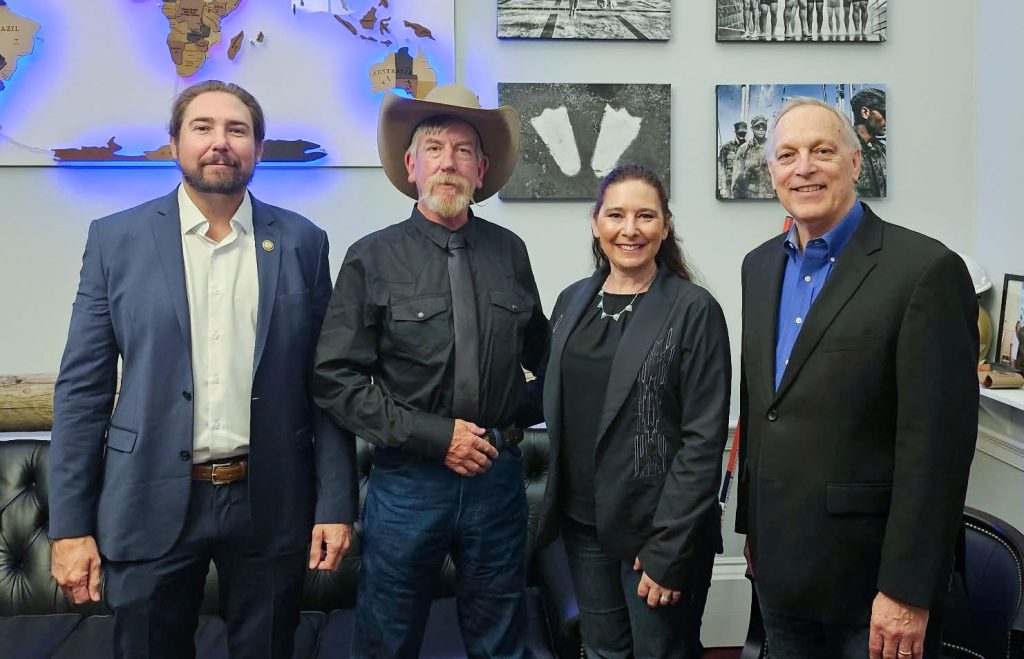
So Murph took the case to Washington. Three years of posting into the void until one post caught, then a room with Agriculture Secretary Brooke Rollins, Rep. Eli Crane, who represents this district, Rep. Andy Biggs and the administrator of the Small Business Administration. All of whom said they would use their power and sway to try and make sure that the state does not give this land to the Ørsted.
While driving on a certain portion of Murph’s state land, on the horizon sits a white shape easy to mistake for a bare rock face on a mountain. It’s panels, an array large enough to read as geology. Murph points at the solar array on an adjacent property owned by the Jeffers Cattle Company. “It shows you what we’re looking at,” Murph said. “They want to put one of those here.”
At the corner of the pasture is a well his great-uncle put in. It had a windmill; Murph replaced it with a solar pump. Everything else is the way his uncle built it. The trough was overflowing, which pleased him. It meant he was keeping up. All of it sits on state land, along with the effort of a few generations of Murph men and all of that may soon be gone.
Murph’s retirement is in this ranch. He says his deeded ground today wouldn’t fetch enough to buy a comparable outfit. Lose the state sections and there is no old-age income and nothing to hand down. The reason this is landing here, Murph told the Board of Supervisors at the first meeting held on the subject, is the transmission lines and the infrastructure at Cholla and also the fact that there aren’t enough people out here to form an effective resistance against this. “Other parts of the state consider this part of the state to be throwaway land,” he said. “And the people who live on it, we’re throwaway people.”
For now, he’s still watering cows on it, waiting for the fight to finish.



