

A long-vacant downtown building that has lived a dozen different lives over the past century is about to start another one, this time as a space built around art, community and a little bit of Holbrook history layered into every corner.
Aaron and Becki Colon are preparing to open The Gandy Dancer Gallery around the beginning of May inside a 1916 building that has served as everything from Holbrook’s first telephone exchange to a barbershop, confectionary and a string of bars over the decades, with each use leaving behind pieces of its identity that still show through today. The building, located at 121 Bucket of Blood St., is perhaps best remembered as the Arizona Tavern, after William Baldwin purchased and restored it in 1970, but even that chapter is just one piece of a much longer story that stretches back more than a century.
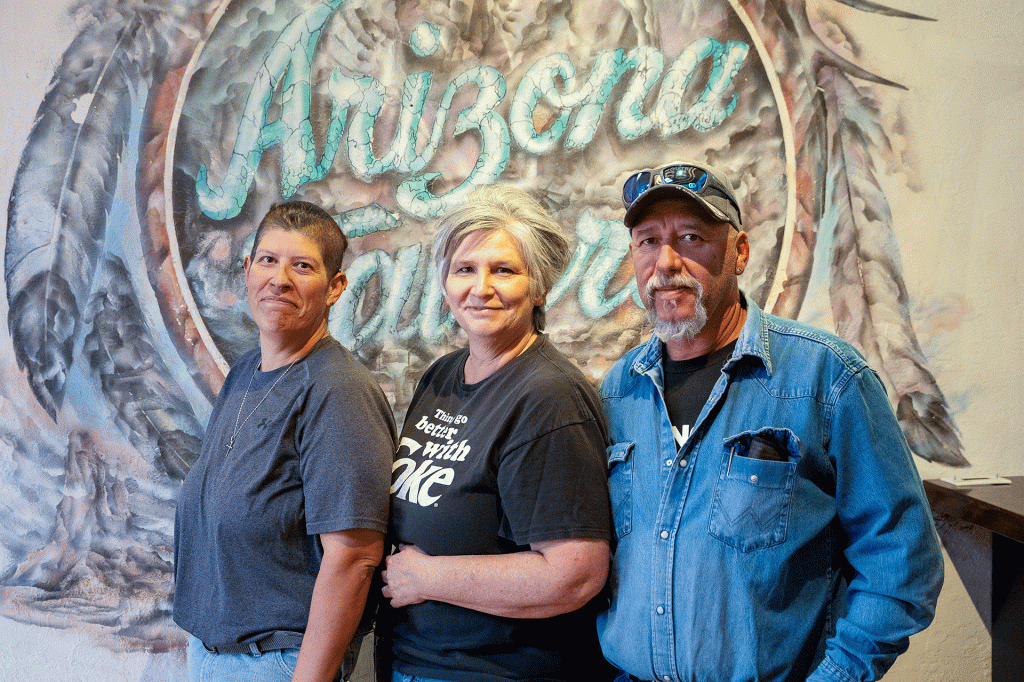
Rather than erase that past, the Colons leaned into it during renovations that began in January 2025. Becki’s sister, Andrea Romo, also helping to bring the space back to life while preserving details tied to its history, including signage connected to its time as the Arizona Tavern. An old A-1 sign remains in place as a nod to the first brewery in Arizona, once located in Phoenix, something they said was intentionally left as part of the building’s character rather than removed or replaced. It also contains a mural that says Arizona Tavern that is in the main gallery.
Even the gallery’s name is rooted in local identity, drawing from the term “gandy dancer,” which is a slang for the rail workers who laid and maintained railroad tracks in the years before the work was done by machines. Becki said this connects directly not only to the community but to her own family history since her grandfather worked on the railroad starting at just 15 years old. The name, she said, serves as both a personal tribute and a reflection of the broader railroad history that defines Holbrook’s past.
The gallery will occupy the front portion of the building, while a second space in the back, called the Three Sisters Studio, will serve as a dedicated area for classes and events, creating a space for hands-on, community-focused activities. The studio, decorated with hummingbird motifs inspired by Becki’s grandmother, is expected to host much of the interactive programming the Colons hope will draw people into the space on a regular basis.
The Colons say they want the gallery to be flexible and welcoming, with an emphasis on accessibility for all types of art, and they are intentionally avoiding setting strict expectations on what qualifies as art or who qualifies as an artist. Artists of all kinds, not just traditional painters, are encouraged to participate, with work ranging from jewelry and pottery to metal art and other mediums that might not typically have a place in a more formal gallery setting.
“There’s no preconceived notion as far as what level the artists need to be at or whatever scope or specific medium,” Becki said. “It can be a ton of different things.”
That same open approach extends to the public, with plans to open the studio at least twice a week. Ideas already in the works include “sip and paint” nights, mother-daughter events, date nights and hands-on classes such as stained glass, sand art and other types of art classes, all aimed at creating a space where people can participate rather than just observe.
“It’s really about having a space for the community,” Becki said. “If someone wanted to do a team-building day or something.”
An apartment located behind the building could eventually be used as part of a rotating resident artist program, allowing artists to stay for a month at a time while creating and showcasing their work on-site, something the Colons see as a way to both support artists and bring new energy into the space on a consistent basis. The broader goal, Becki said, is to create opportunities for local artists who might not otherwise have a place to start or a platform to share their work with the community.
“I think it’s important to represent the local art community,” she said. “Who knows, maybe a young kid will get discovered and become a famous artist and come back and say ‘This was the first gallery that held my art.’”
As the doors prepare to open on yet another chapter, the building is once again becoming something shaped by the people who pass through it, not just those who own it. This time, instead of telephones, haircuts or drinks, it will be filled with paint, conversation and the kind of small moments that turn into something lasting, adding a new layer to a place that has been quietly collecting stories and conversation from locals for over a century.



