/wp:paragraph
wp:paragraph
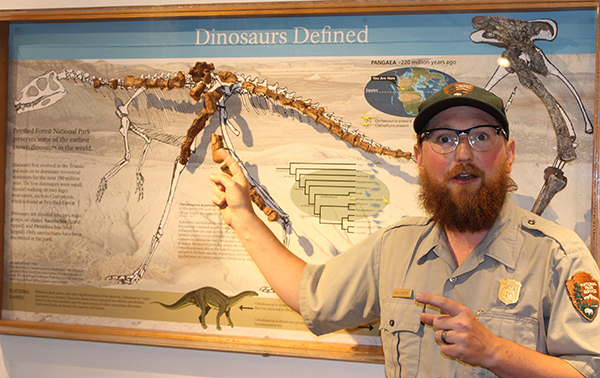
Thirty-four years ago, Paleontologist Bryan Small discovered the remains of a brand-new dinosaur at the Petrified Forest National Park. In the tradition of paleontology, the dinosaur was named Chindesaurus Bryansmalli and on June 6, 1985, amid international media attention, the fossil was airlifted out of the park’s wilderness.
/wp:paragraph
wp:paragraph
The remains of the dinosaur were carefully cataloged, with the bones on display at the Rainbow Forest Museum. Over time, the dinosaur was nicknamed Gertie and now June 6 is celebrated as being Dino Day at the Park.
/wp:paragraph
wp:paragraph
As a roving paleontologist, Chuck Beightol presented an overview of the geological structure of the park, as well as the more common creatures found within the fossiled remains that fill the landscape.
/wp:paragraph
wp:paragraph
“How can you tell what is related to a crocodile versus a dinosaur?” Beightol asked. “Dinosaurs have certain nobs and bumps on the bones and they also have a hole in the hip socket. Another characteristic of a dinosaur is the ankle bone which looks very much like bird ankle bone.”
/wp:paragraph
wp:paragraph
Because the dinosaur/bird ankle bone only allows the animal to lift their legs up and down, it enables them to move fast without risk of tripping or falling.
/wp:paragraph
wp:paragraph
Dinosaurs are divided into two main groups: Saurischia (lizard hipped) and Ornithischia (bird hipped). Only the first group has been discovered at the park, among which was Gertie.
/wp:paragraph
wp:paragraph
Gertie is known mainly from a partially preserved, single skeleton, that provided just enough clues for scientists to determine that it was a saurischian dinosaur.
/wp:paragraph
wp:paragraph
While Gertie’s exact relationship within the saurischian remains a mystery due to the lack of a preserved skull and pelvis, it is hoped that one day a more complete skeleton will be found.
/wp:paragraph
wp:paragraph
Paleontology field work has been going on in the park for over a hundred years and it is not uncommon to have a new animal or plant known to the park discovered every year.
/wp:paragraph
wp:paragraph
From the more commonly found Metoposaurus, a giant salamander type creature, to the more recent find in 2016 of Scutarx Deltatylus, a reptile version of an armadillo, the Park remains a treasure trove for those who want to study and touch the far distant past of the planet.
/wp:paragraph
wp:paragraph
From 9 a.m. to 3 p.m., every Wednesday and Sunday, the paleontology lab is open to the public for free demonstrations as well as question and answer sessions.
/wp:paragraph
wp:paragraph
For folks that just want to enjoy the outdoors, at 3 p.m. on Tuesdays, there are free Birder Walks at the Painted Desert Inn. There are free Wildflower Walks, with park admission, at 10:30 a.m. on Thursdays.
/wp:paragraph