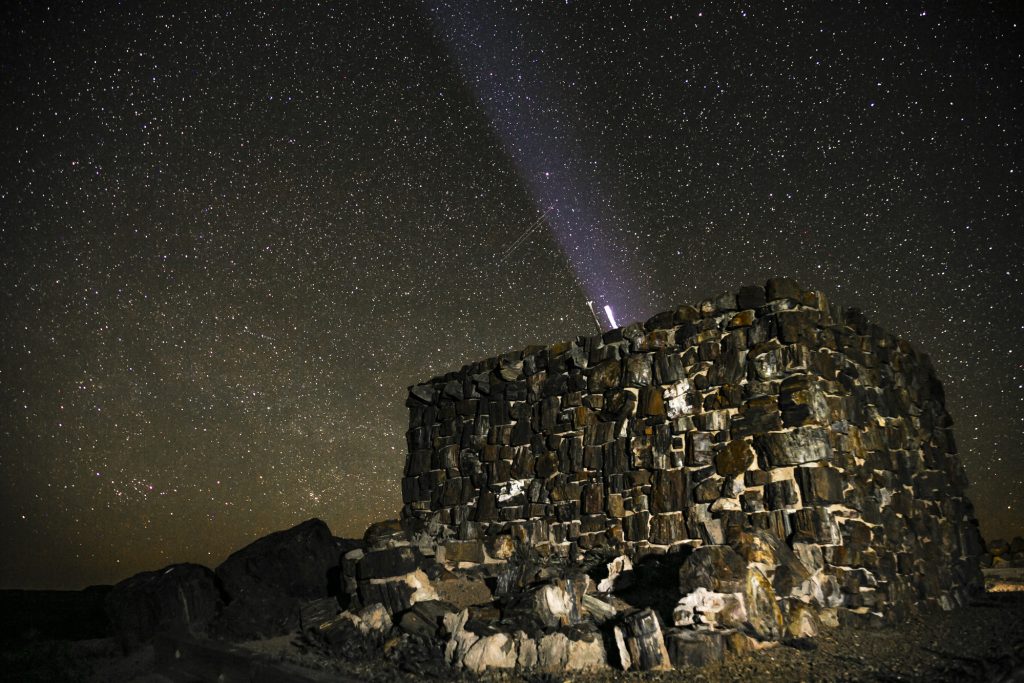
In 2018 the Petrified Forest National Park (PFNP) received their International Dark Sky Park designation from the International Dark Sky Association (IDSA). During the Feb. 19 Holbrook Chamber of Commerce meeting, PFNP’s Visual Information Specialist Jacob Holgerson and Executive Director of the Petrified Forest Museum Association Tara Young offered some information about communities that are also making the dark sky commitment. Young and Holgerson explained what it means to become a dark sky community and how Holbrook could benefit by becoming one.
The IDSA’s mission since it was founded in 2001 is to help protect and preserve areas from light pollution through responsible lighting. According to Holgerson, Arizona is ahead of the curve when it comes to dark sky designation. “I was intrigued to find that Arizona has more designated dark sky communities than anywhere else in the world with six out of the 23 official dark sky communities. Arizona also has the 11 dark sky parks found in the state and is currently the home of the International Dark Sky Association in Tucson,” said Holgerson.
For a community to receive a dark sky designation there are certain requirements that must be met and that would require changes to be made with a level of commitment from the community. Holgerson offered, “It’s not just being as completely dark as possible, it’s using light smartly. It’s using it only where you need it and not shooting it up into the sky or glaring into our eyes because that’s as much of a safety issue.” Saying that rather than making it easier to see at night, adding more of what he called blue-shifted light would actually cause the pupils to dilate making it harder to see at night.
Holgerson explained that more orange lights can be seen around dark sky communities like Flagstaff, which was designated in October of 2001 and was the world’s first International Dark Sky City. “That actually helps your night vision, which is a little bit safer,” said Holgerson.
Young shared some of the information she was given during her recent meeting with the Utah Office of Tourism regarding the economic benefits a community like Holbrook could have from becoming a dark sky community. “Dark sky astro-tourism is the fastest growing reason for people visiting the western national parks. A lot of our visitors have never seen a starry sky. They never even knew it was possible because it’s not visible in these urban areas. It’s the fastest growing reason for people to be visiting the west and we as a community can really start to embrace it,” said Young.
Holgerson said that there are a number of reasons, aside from economical change, that he believes dark sky designation can have a positive effect on the safety and health of the community, “These initiatives are backed by well-researched studies that show that blue-shifted light may have harmful effects on our health. They promote natural habitats that our local flora and fauna require to survive. While it seems counter-intuitive, proper lighting may improve safety by maintaining our natural night vision and reducing glare. Dark sky initiatives may also reduce our monthly energy costs.
Young offered some clarification for those who may have safety concerns, “Dark sky is a scary word because people associate safety issues with dark sky. But it doesn’t mean dark, it means night sky. Night sky is a very natural thing. So, they’re (International Dark Sky Association) working on changing some of the terminology so that it doesn’t bring that negative connotation.”
Holgerson said that his experience of seeing the PFNP through their dark sky designation has made him aware that the application process can be intimidating after making the smaller initial changes. Holgerson offered, “Implementation of dark sky initiatives at the household or local business level can be quite simple. It can be as easy as changing a lighting fixture, checking the packaging when purchasing light bulbs, or simply turning off a light when not in use. But I’ve come to realize that the process to becoming a dark sky community may seem daunting and complicated.” Holgerson even offered his assistance in offering his knowledge on dark sky lighting ordinances if Holbrook should be interested. But noted that the IDSA emphasizes the point that anyone considering applying for a dark sky designation should have robust community support.
Young stated that she believes this could be an opportunity to not only embrace the many benefits listed by Holgerson but for Holbrook to thrive on something that is already relative to the community, “In terms of tourism and economic development, it’s something I think that the City of Holbrook should consider. We’re in a dark sky corridor anyways. If we’re looking for things to embrace this is one of them and it’s very up and coming,” said Young.