/wp:image
wp:image {“id”:60875}

/wp:image
wp:paragraph
/wp:paragraph
wp:paragraph
On Sep. 24, the University of Arizona Cooperative Extension in Holbrook welcomed members of the community for a free gardening workshops they offer throughout the year. Master Gardener Sterling Hancock was there to answer questions about the basics and the importance when maintaining a garden in the Arizona’s high desert.
/wp:paragraph
wp:paragraph
Just in time for the first expected frost, Hancock gave attendees what could be considered game changing advice when it comes to protecting their plants and prolonging their lives through the drastically changing weather in the area.
/wp:paragraph
wp:paragraph
Hancock has been gardening for most of his life but made it part of his career when he provided professional volunteer services to the university’s instruction program through Americorps just over five years ago. After a year he boarded as a full-time employee and has since been teaching the gardening workshops as the instructional specialist for the Supplement Nutrition Assistance Program (SNAP) with the University of Arizona.
/wp:paragraph
wp:paragraph
Part of Hancock’s job has given him a first-hand look into the deficiency of fresh produce in the area. When asked why he felt so strongly about providing this form of education he said, “There has been a push for it.” Hancock acknowledged the steady rising cost of food and said, “I want more people to be self-reliant.” Explaining that he’d like to provide as many avenues as possible for those who wish to grow their own produce.
/wp:paragraph
wp:paragraph
While the workshop touched on other subjects like integrated pest management and organic and inorganic comparisons, the weather quickly became the center of the discussion. “This is not a good climate for gardening, mother nature is a major challenge,” said Sterling who hosts the workshops around the region. As part of his workshop, Hancock gave attendees some useful tools and techniques they can use to battle the fluctuating weather in the area.
/wp:paragraph
wp:paragraph
Some of the most common challenges gardeners face in this part of Arizona are the irregular cold fronts, killing frosts and sudden rise in temperature which can result in the demise of one’s plants.
/wp:paragraph
wp:paragraph
Hancock dispersed handouts containing average timelines for when frosts have occurred but stated that although it is a helpful tool, the timelines are broad, some spanning over a month so they may not be as effective as monitoring the weather.
/wp:paragraph
wp:paragraph
He suggested anyone who genuinely wishes to preserve their crop learn about weather watching to get ahead of the unexpected rise and fall of the temperatures saying, “We actually are very lucky so far in our advances with weather and climate watching.” By doing so, gardeners have a better chance at saving their plants through the first frost and avoid losing plants from planting too early.
/wp:paragraph
wp:paragraph
The average killing frosts are said to take place in mid to late Oct. and end in late Spring according to Sterling. One gardener’s documented account of an early frost in Sept. of 2013, which sterling called “a crazy early frost,” was a prime example of why it is still important to monitor the weather.
/wp:paragraph
wp:paragraph
According to Sterling, an effective technique that gardeners can use is to cover the plants with a sheet or shade cover of some sort. This method can be used to combat both extreme heat and abrupt cold which the high desert is notorious for. He explained that while the more delicate plants such as herbs will likely not survive using this method, the larger plants such as tomatoes have a better success rate after being covered in colder circumstances if gardeners can prepare for it.
/wp:paragraph
wp:paragraph
Covering plants in hotter conditions can also effectively protect most plant varieties. Sterling explained that in extremely high temperatures, a plant’s ability to produce viable pollen decreases, which can be why some plants may grow but never produce.
/wp:paragraph
wp:paragraph
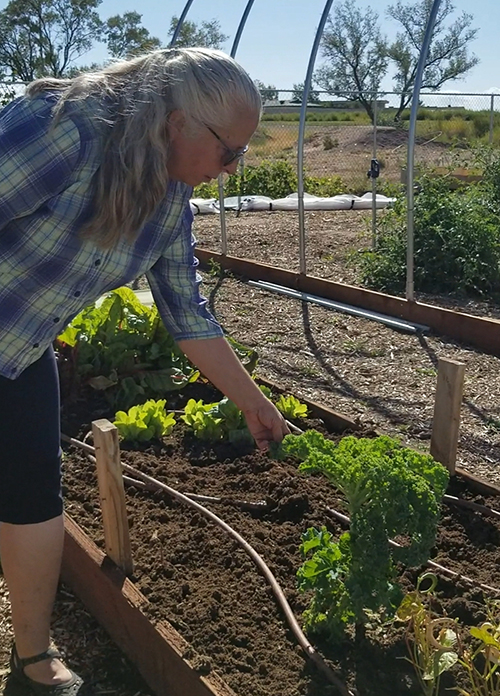
Bawden, who primarily looks after the Holbrook garden at the extension office with the assistance of her colleagues, shared a helpful booklet called “High Country Vegetable Gardening” published by the UA Cooperative Extension Navajo County Office and written using information provided by local gardeners from Heber, Holbrook, Joseph City, Kayenta, Keams Canyon, Lakeside, Pinetop, Show Low, Shumway, Snowflake, Taylor, Whiteriver, Winslow and Woodruff. The booklet features area specific charts that indicate what and when to plant.
/wp:paragraph
wp:paragraph
To gain a better understanding of why UofA continues to host these workshops, Bawden quoted the UA Dean of Agriculture and Life Sciences Shane Burgess, “We take science and research produced by the university and bring it to communities throughout the state for everyday application that improves living.”
/wp:paragraph
wp:paragraph
Bawden said that anyone who would like a copy of the “High Country Vegetable Gardening” booklet can contact her at cbawden@email.arizona.edu and request one free of charge. Bawden also said that not only is the community encouraged to visit the garden but they are always hoping for volunteers to join them on the gardening adventure. The garden is located behind the UofA Extension Office and the office is open from 8 a.m. To 4 p.m., Monday through Thursday and is located at 748 N. Third St.
/wp:paragraph