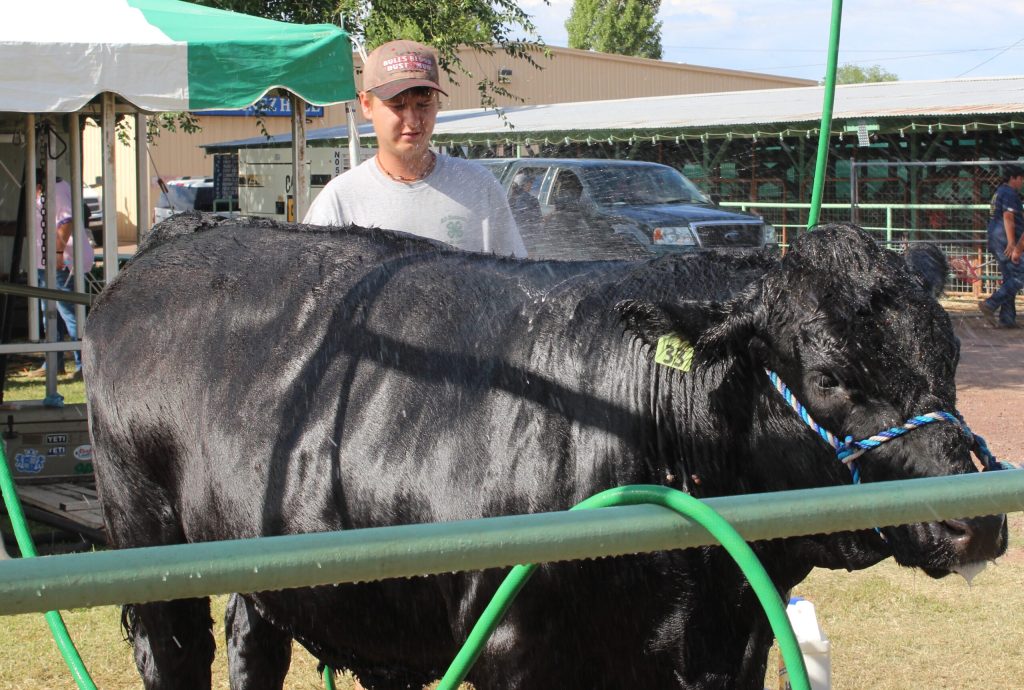
The Arizona Livestock Camp 2018 was in full swing from July 17-20 at the Navajo County Fairgrounds, promoting, “Where Champions Begin”, for 250 kids from Arizona, California, Texas, Colorado and New Mexico.
What used to cost $300 per kid, is now a free event to help kids understand the complexities of feeding, daily care, clipping, fitting, showmanship and nutrition for cattle, sheep, goats and hogs. Open for anyone under the age of 21, who wants to learn about livestock, the camp has participants as young as four this year.
Dallon Laird, a Holbrook High School student, has been attending the camp for several years and has showed the last four. This year he brought his steer, Gunther, an Angus-Simmental cross-born in March 2017. “We are the future of American agriculture,” said Laird. “While most teenagers are playing video games, we are out working with our animals. It’s the best thing America has to offer its youth.”
As Laird washed Gunther in prep for show practice, he went on to say, “Through the camp I have learned how to handle a 1,500-pound animal, but more importantly, I have learned how to handle myself. When I am calm, my steer is calm. Even a small animal can teach us so much.”
Shelby Prenovost, a 13-year-old from the Phoenix area, said last year was her first year at the camp. “Maricopa County started a beef outreach program where they gave teenagers interested in raising livestock, a free steer with everything we needed to take care of the animal. I wanted to do the program, but I came to the camp first to learn everything I could.”
Prenovost said she is hooked on raising cows. “I couldn’t imagine anything else.” When asked what she had learned from the camp, she said, “The instructors really stress that you might not have the best looking animal, but if you put 100 percent into it, it will turn out well. It’s what we put into the animal that makes the difference.”
Started by Jimmy Crosby eight years ago, Steven Lackey from Yuma and Rusty DeSpain of Joseph City are the coordinators that have been pushing for the last three years to get more funding for the camp, along with corporate sponsorships. This year there were a total of 21 sponsors for the camp and 78 sponsors for the Jackpot Show, with three being corporate sponsors, including Sullivan’s Supply Inc., Sunglo-Cargill and Stand Alone Feeds, LLC.
The three and a half day camp ended with the Route 66 Classic Jackpot Show last Saturday. While the camp is free, the cost to enter the show is $40 per entry and is limited to ages 21 and under. Lackey said the entire event, including camp and show, costs between $30,000 to $35,000 to put on.
This year there are 512 entries for the Jackpot Show, up more than 25 percent from last year’s entries of 378. Lackey added that he was able to get half the funding this year from the entries. “Every kid that enters will get at least a part of their entry back through prizes.”
The prizes include everything from show boxes and fans to hats, banners, T-shirts, buckles and buckets. Every kid has a chance to not only show, but to walk away with great prizes.
Lackey said, “People in the communities around here probably don’t realize that we have three times as many animals on site right now as during the fair. We wouldn’t make it without our sponsors and all the volunteers.” He also wanted to thank the Navajo County Sheriff’s Office for the use of their command center and two generators. “The Navajo County Fair has been amazing to work with,” said Lackey. “They gave us the keys and the use of the facility at no charge.”
A free lunch is cooked at the fairground’s kitchen during the camp and some of the sponsors brought in pastries and snacks for the participants to have something for breakfast.
For 20-year-old Noah Barela, a firefighter with Joseph City Volunteer Fire Department, this was his first time at the camp. “My chief (Randy DeSpain) asked for help, so I came,” said Barela. “I like the food and learning about the animals. It feels good to help out around here.”
One of the clinicians, Matt Denetclaw from Ship Rock, N.M., shared that one of the things he was hoping to bring to the kids “was the confidence to tackle the task of caring for and competing with animals on their own. A lot of kids get left on the sidelines and I just want to take each one by the hand and help them believe in themselves.”
Denetclaw said he came from a rodeo family but it was his friends in third grade who were involved in 4-H that had the biggest impact on him. “When my mom and dad told me to choose rodeo or 4-H, I chose 4-H.”
Another clinician was Steve Gouker from Lakeside, who works as Director of 4-H Youth Development with University of Arizona Cooperative Extension Program in Navajo County. Gouker said he grew up on a polled Hereford ranch in Wisconsin and believes, “What life is about is the more work you put into something, the greater chances of success.” He stresses the principals of 4-H that are contained in the BIG M: a sense of Belonging; Independence; Generosity; and Mastery.
Kiley Elder, an intern with Sullivan’s Supply, said she has been spending the past two years traveling the country working with the stock show universities that Sullivan’s puts on. For her it was about seeing the passion of the kids toward the animals. “It is amazing to watch these kids work so hard and improve so much.”