

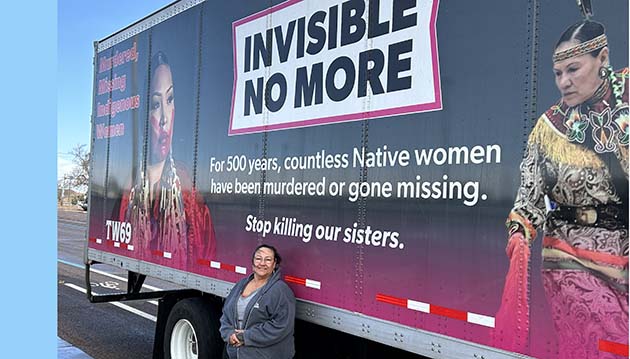
Elizabeth Johnson owns and operates a semi-truck and has been driving her trailer around the country for the past two years using it as a mobile billboard spreading awareness about missing and murdered indigenous women. Johnson was driving her truck along I-40 last Wednesday when the roads closed due to the weather and forced truckers to pull off the interstate and on to the streets of Winslow.
The trailer is accented with an eye-catching pink that draws the viewers’ attention to the boldened words “Invisible No More.” Johnson explained, “You don’t see a lot of coverage about this issue, in all my time driving I have only seen one billboard about it and it was in Oklahoma and you never see it on the news.”
The statistics surrounding murdered and missing indigenous women in the United States are alarming and indicative of a systemic problem. Indigenous women are murdered at a rate that is ten times higher than all other ethnicities, and murder is the third leading cause of death for them. These women are also more likely to experience violence and sexual assault, with more than four out of five indigenous women having experienced violence and over half experiencing sexual violence. These numbers are staggering and highlight the need for more policies and initiatives to address the issue.
However, data collection remains a challenge due to underreporting, poor record-keeping, and racial misclassification, which leads to inaccurate reporting and an incomplete understanding of the issue. This lack of consistent and current data limits the depth of these reports, and the statistics are most likely an undercount.
In recent years, there have been significant policy initiatives to address the issue of murdered and missing indigenous women. May 5 was officially designated at the National Day of Awareness for Missing and Murdered Native Women and Girls was officially designated by the White House in 2019 and in the same year Executive Order 13898, also known as Operation Lady Justice, created a task force to address the concerns of indigenous communities in the U.S. These initiatives aim to improve data collection, establish cold-case teams, and improve investigative responses to better address MMIP cases but there is still much work to be done.
These are the kinds of statistics that Johnson was talking about when she stated that there is a big problem with violence against indigenous women and it’s something that does not get much play in the media. She says she loves being able to spread the message and operating her own truck allows her the flexibility to choose where she drives, so she takes jobs that allow her to be in cities during certain tribal events and parades because sharing her message not only informs people who were not aware but also brings joy to victims who know their story is being told.



