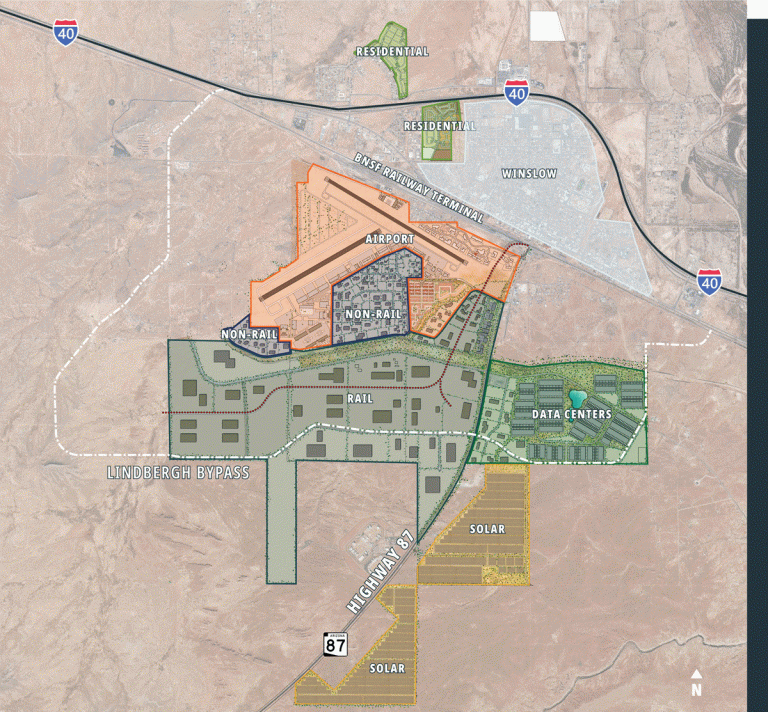
During a recent Winslow City Council meeting, a significant number of residents, mainly from the Southside and Coopertown neighborhoods, expressed their deep concerns regarding Atlas Global Development’s plan for an I-40 tradeport within the city.
The council’s meeting room was packed with residents, which prompted Mayor Birdie Cano to ask the room how many people were there to speak about the Atlas Global deal. After a significant number of hands were raised, Cano suggested restricting the amount of time each resident is given to speak to get through comments more efficiently. This, however, did not happen, and residents were given the full three minutes to speak.
Holly Wagner opened the discussion, advocating for the reinstatement of the Planning and Zoning Commission, a sentiment echoed by Ann Schmidt. Schmidt emphatically stated, “if what people are saying means anything to any of you then show that by reinstating the planning and zoning commission so citizens have a say and decisions about property aren’t just made by one person.”
Debra Lopez, a resident of Southside, stressed the importance of her neighborhood, arguing against its potential industrialization. “This is not just land to be put in the hands of an outside developer,” she declared, also expressing concerns about environmental factors and law enforcement readiness in the face of rapid growth.
Anna Dewitt, while supportive of Winslow’s growth, questioned the wisdom of surrounding her neighborhood with an industrial zone. She referenced Flagstaff’s water scarcity issues as a warning for Winslow.
A resident who identified herself as Patil raised concerns about the impact of rapid development on local schools and the town’s ability to manage such growth. Arthur Gonzales, another Southside resident, questioned why industrial buildings couldn’t be located further from residential areas to mitigate residents’ suffering.
Sandra Vasquez, from Coopertown, spoke about her attachment to her neighborhood and the difficulties residents might face in affording new homes if displaced by development. Similarly, Enrique Pacheco emphasized the importance of growth that does not compromise the character of Southside and Coopertown.
Marianne Moody voiced her concerns about a neglected old sawmill near Southside and the potential of her neighborhood becoming part of the industrial park. “Southside and Coopertown are neighborhoods of culture and family, and it would be so sad to lose any of that,” she commented.
Other residents, including Tony Park and Daisy Caldera, highlighted issues ranging from property values to infrastructure needs and the impact on local emergency services and schools resulting from this kind of growth. Carol Dawn stressed the importance of fact-based information in future meetings, particularly regarding crime rates.
Melcor Salazar called for empathy from the council towards residents who might face displacement due to the industrial park. Kathy Patton noted to her fellow speakers that better communication and attendance at public meetings organized by Atlas Global could have prevented some of their concerns.
In response to these heartfelt concerns, Mayor Cano suggested several actions: a special election to vote on the Atlas Global project, consideration of reinstating the Planning and Zoning Commission and a commitment to hold a detailed public meeting or council work session to thoroughly explain the development plan.
After leaving the meeting, residents Dewitt and Schmidt shared their post-meeting reflections. They felt somewhat reassured by Mayor Cano’s initiatives, like the reinstatement of the Planning and Zoning Commission, but remained disappointed with the city’s communication with residents. They emphasized the urgent need for more effective communication in the future to ensure residents are well-informed about community developments.