Plans for a sprawling energy and data center complex west of Holbrook are advancing, with developers eyeing a construction start this summer.
Gordon Baier, CEO of Go Solar Energy, says he spent almost a decade narrowing down potential sites across the country for what he calls “Gigawatt.Land,” a co-located system combining power generation, long-duration energy storage and industrial development. After evaluating roughly 30 locations nationwide he says one rose to the top. “We broke them down to 10 and guess which one was number one,” Baier said. “Right here in Holbrook.”
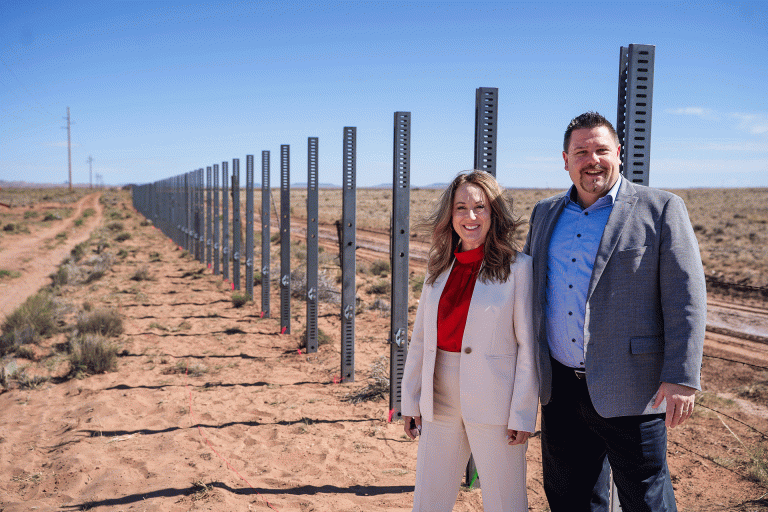
The proposed site sits roughly six miles northwest of Holbrook and about seven miles north of Joseph City, primarily on privately owned and leased land across a large plateau Baier calls Marcou Mesa. The initial phase would cover more than 5,000 acres, with further expansion planned.
At its core, the project would use what Baier describes as a hybrid energy model. “It’s on-site power generation, on-site storage and a bi-directional charging and discharging from and to APS’s (Arizona Public Service) grid,” he said. “That serves the entire system stability with APS as well as it serves our on-site clients.” According to Baier, the initial buildout would include approximately 1.5 gigawatts of generation capacity and an equal amount of storage, though output to the grid would be capped to avoid straining the utility. “We limited ourselves to 500 megawatts in and out constantly to help them balance their grid without peaking them,” he said.
One of the more ambitious elements is an electrothermal storage system that, according to Baier, uses volcanic rock as a medium. “You heat lava rocks up to more than 2,000 degrees and store that energy not just for hours or days, but potentially for a month,” he said. The rocks are stored in a concrete tomb underground where they are able to retain their heat. The stored heat could later drive steam turbines, only heating the rocks when the grid can’t accept any more load and then using them to generate electricity at a more opportune time. Baier said that 40% of the infrastructure of the recently closed Cholla Power Plant could be repurposed for this feat. The project would also incorporate traditional batteries to smooth out the variability of solar and wind generation. “Long-duration energy storage is the key to all of our concepts,” Baier said.
On the industrial side, data centers are expected to anchor the development. Baier estimates the solar and data centers facilities would bring around 500 permanent jobs and expects additional employment tied to fertilizer manufacturing and chemical processing and thousands of short-term construction positions. Rather than treating the heat produced by data centers as a byproduct, Baier says the project plans to put it to use. “One man’s waste is the other man’s treasure,” he said. “Data centers have a certain waste product and that is heat. We take that heat and use it for chemical processing,” including, he said, fertilizer production.
Water use, always a flashpoint for large industrial projects in the Southwest, would be managed through a closed-loop geothermal cooling system that Baier says would eliminate evaporative loss. “You pump the water out, run it through a (underground) heat exchanger and put it back,” he said. “There’s no evaporation and nothing gets lost.” The system would also do away with the large cooling fans common in conventional data centers and drastically reduce noise made by fan cooled data centers.
Baier has sought to frame the project as compatible with existing land uses rather than disruptive to them. Solar panels, he says, would be elevated high enough for cattle to graze beneath them and infrastructure like water systems and communication networks could be shared with neighboring ranchers. “We are for integration instead of pushing things out,” he said.
Standing at the edge of town, Baier pointed toward Marco Mesa and outlined what he says will be a deliberately low-profile development. The solar arrays, he said, would sit on top of the mesa and be largely invisible from the road. Data centers would be tucked into the area’s natural valleys and coves, painted to blend with the surrounding Painted Desert landscape. Gesturing toward the open land, he said that when the project is complete, the view from the highway will look much the same as it does today and not disturb the area’s beauty.
The project’s economic structure is still being developed. Baier says the company is working with Navajo County on a tax framework tied to energy production rather than depreciating asset values. “It’s not about the asset itself, it’s about the energy that’s produced,” he said. “We have a counter-mechanism where we distribute value based on the energy.” He says the goal is to agree on a fair tax that does depreciate but is tied to the output so that the community can benefit even as facilities age. Specific financial details have not been made public. The project must still clear the county permitting process and receive approval from the Navajo County Board of Supervisors.
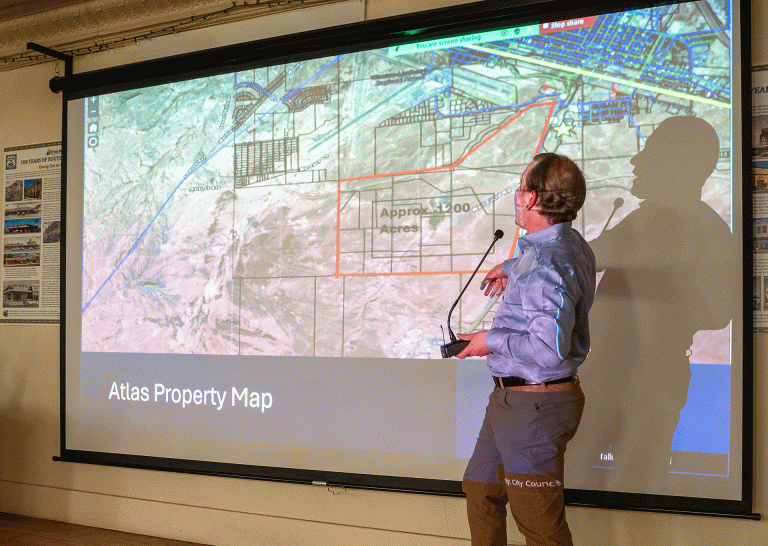
On the infrastructure side, the proposal includes a new 345-kilovolt transmission line connecting the project area to Winslow and Flagstaff, which Baier says would address a longstanding gap in regional capacity. “It’s like a new high-voltage highway,” he said, adding that the I-40 corridor is currently “energy deficient” and that the added capacity could benefit communities across the region. Baier has worked with Daniel Lupien of Atlas Global Development to work together to share infrastructure in resources to make both projects more durable.
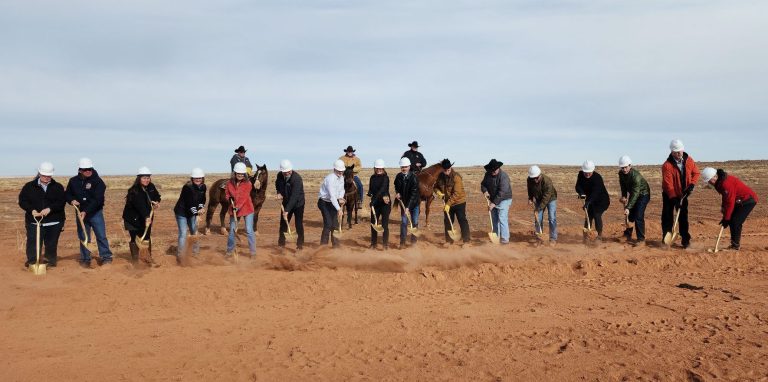
The timeline is pressing, at least according to Baier. He says construction needs to begin before early July to qualify for certain federal tax credits, though he maintains the project would remain viable regardless. Data center development is expected to follow within 12 to 24 months, he said.
For communities like Joseph City still absorbing the economic impact of the Cholla Power Plant closure, the proposal arrives at a difficult moment. Baier argues the window of opportunity is narrow. “If we don’t act now, these industries will go somewhere else,” he said. “And once they make a decision, they’re not moving. They put billions into their infrastructure and they stay there for decades.”
As the project moves toward public hearings, residents will get their first formal chance to weigh in on a proposal that remains, in many respects, still on paper. “It’s basically energy creates jobs, jobs create lifestyle,” Baier said. “And that’s what we want to bring here and revitalize the cities with this type of industry.”