Some people are born tinkerers, never quite satisfied with the mysterious engineering that powers the world the rest of us take for granted. Dan Lutzick was one of them. He likes to say he was “the type of kid who would take over his parents’ basement with a geology lab,” though that hardly captures the whole picture. In truth, as a kid he descended into that New England basement like an explorer, spending long hours under the warm light of an incandescent bulb surrounded by whatever grand project had captured his imagination that month. A stack of science-fiction paperbacks was never far from reach and together these things—light, solitude, experimentation, wonder—became the building blocks of the artist he would eventually become.
For a while, art wasn’t even on the horizon. Lutzick started college as a physics major while working for Pfizer, which footed the tuition bill and, he was told, would continue paying no matter which field he pursued. It was a safety net he didn’t know he needed until he realized the physics track wasn’t feeding him in the way disciplined curiosity should. A coworker’s offhand remark about Pfizer’s generous tuition policy opened the door: he could study anything. So he pivoted, an abrupt, liberating turn into fine art at UC Irvine, graduating in 1994 with an emphasis in ceramics.
Ceramics at Irvine was, at the time, the unwanted stepchild of the art department. Pottery wheels smashed in the parking lot. Dismissive attitudes from faculty. A sense that clay was old-fashioned and unworthy of serious artistic pursuit. But being treated like an outsider suited Lutzick. While others wrote ceramics off, he was handed the keys—literally—to the ceramics building and spent countless hours next to roaring kilns, experimenting, learning, making. That period cracked something open in him. He met artists whose work spilled into public spaces. He made pieces for anyone to take home. And he found a strange, unexpected community in a nearby trailer park, where he first resisted and then embraced the idea of living in a mobile home.
It was on the porch of that trailer, tinkering as always, that a young architect wandered over. Allan Affeldt lived in the park with his wife, the artist Tina Mion and the shared language of art created an instant connection. The friendship that began there—three young creatives drawn together by chance geography and mutual curiosity—would pull Lutzick toward a place he had barely heard of: Winslow, Arizona.
After graduation, the trio began pursuing ownership of La Posada, the once-grand Fred Harvey hotel that had fallen into disrepair. The negotiations stretched on for years. When the deal finally closed, they secured a $700,000 grant for restoration. Lutzick was the first to move, settling into another crumbling downtown building he repaired and lived in until the hotel was habitable. For years he lived at La Posada with Affeldt and Mion, working alongside them to rebuild what is now the crown jewel of Winslow.
Eventually, he bought the Snowdrift building—22,000 square feet of collapsing former department store in historic downtown Winslow, its best days behind it. He paid two dollars for the place.
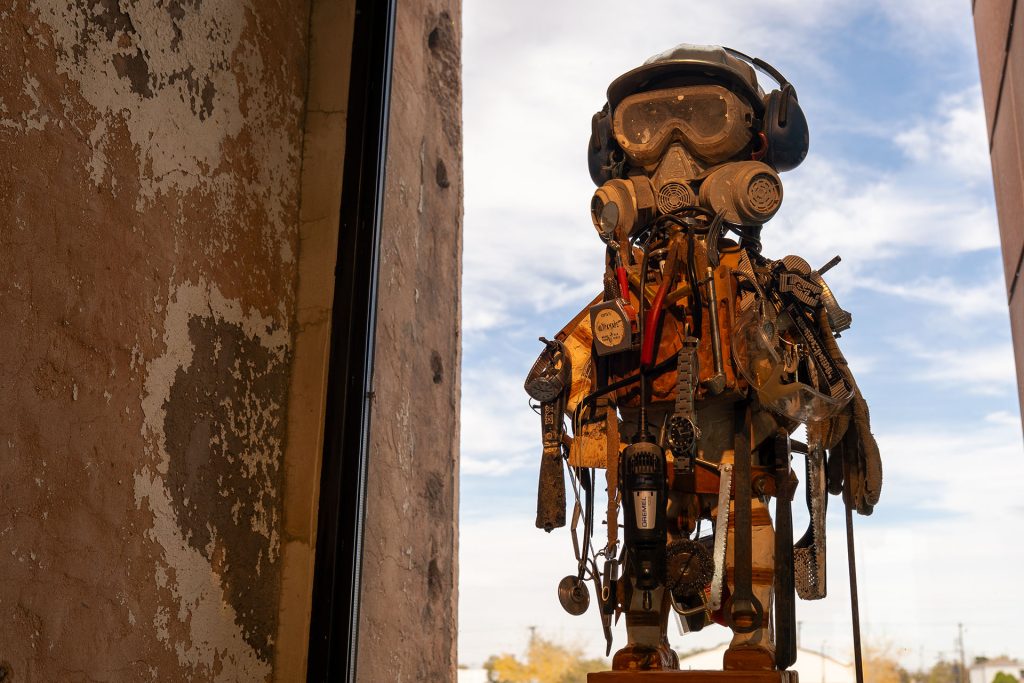
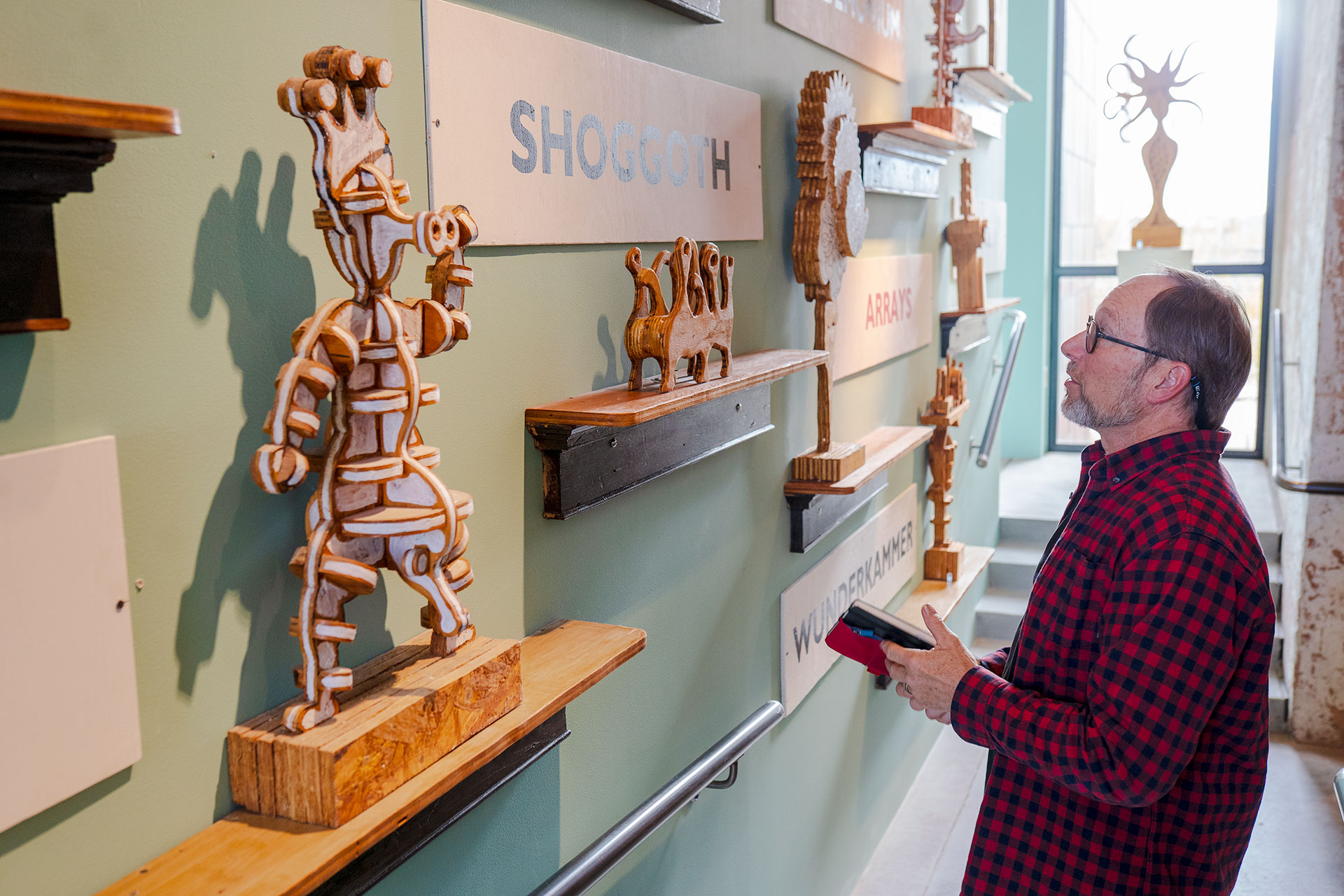
Early on, its vast basement and storefront became a repository for leftover parts from restoration projects around town. Old beams, discarded ductwork, broken furniture, misfit hardware—what others considered trash, he saw as possibility. Over time, that clutter shifted. It morphed from salvage to material, from material to sculpture, from sculpture to something like a living organism. Today, Snowdrift is less a studio than a cosmos: room after room filled with work, hundreds of objects evolving into a dozen or more galleries defined by what Lutzick calls “arrays.” And now, those arrays have stepped into the spotlight.
Lutzick’s new exhibition, Arrays, at the Affeldt Mion Museum at La Posada, distills more than two decades of the Snowdrift project into a single moment. The museum show is not a static retrospective—nothing in Lutzick’s world would ever allow that—but a curated constellation of his sculptures, arranged specifically for this space and this year.
The story of Snowdrift itself helps explain the show’s shape. When Lutzick moved there in 2002, the building was abandoned and broken, but that only meant there was room for possibility. As he filled it with work he began grouping his sculptures into clusters that spoke to one another. Arrays. Configurations. Ecosystems. In 2006, his future wife Ann-Mary walked into the building on a tour, unaware that this place, overflowing with objects, would soon become her home. Together they continued shaping it, rearranging its interiors into galleries defined by patterns, rhythms and dialogues between objects.
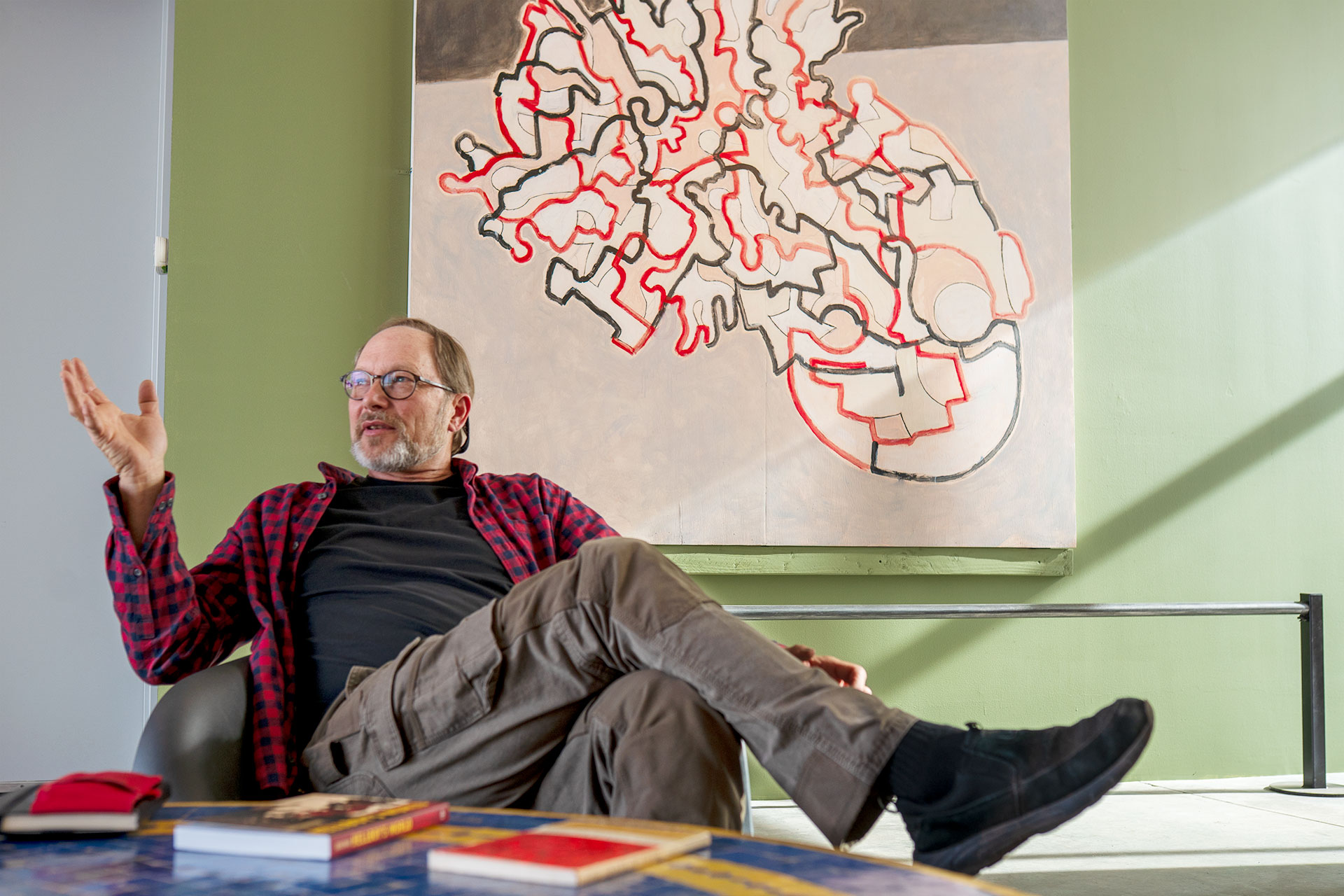
The museum show reflects this evolution. Instead of presenting singular, iconic pieces placed reverently on pedestals, Lutzick has assembled groupings that lean into the energy of interaction. As he puts it, “When you have a thing by itself, it is ‘on a pedestal,’ perhaps monumental, perhaps iconic… When you have a group of things… many of these ideas about the object fall away.” Completion becomes relative. Boundaries blur. Meaning shifts depending on where the viewer stands.
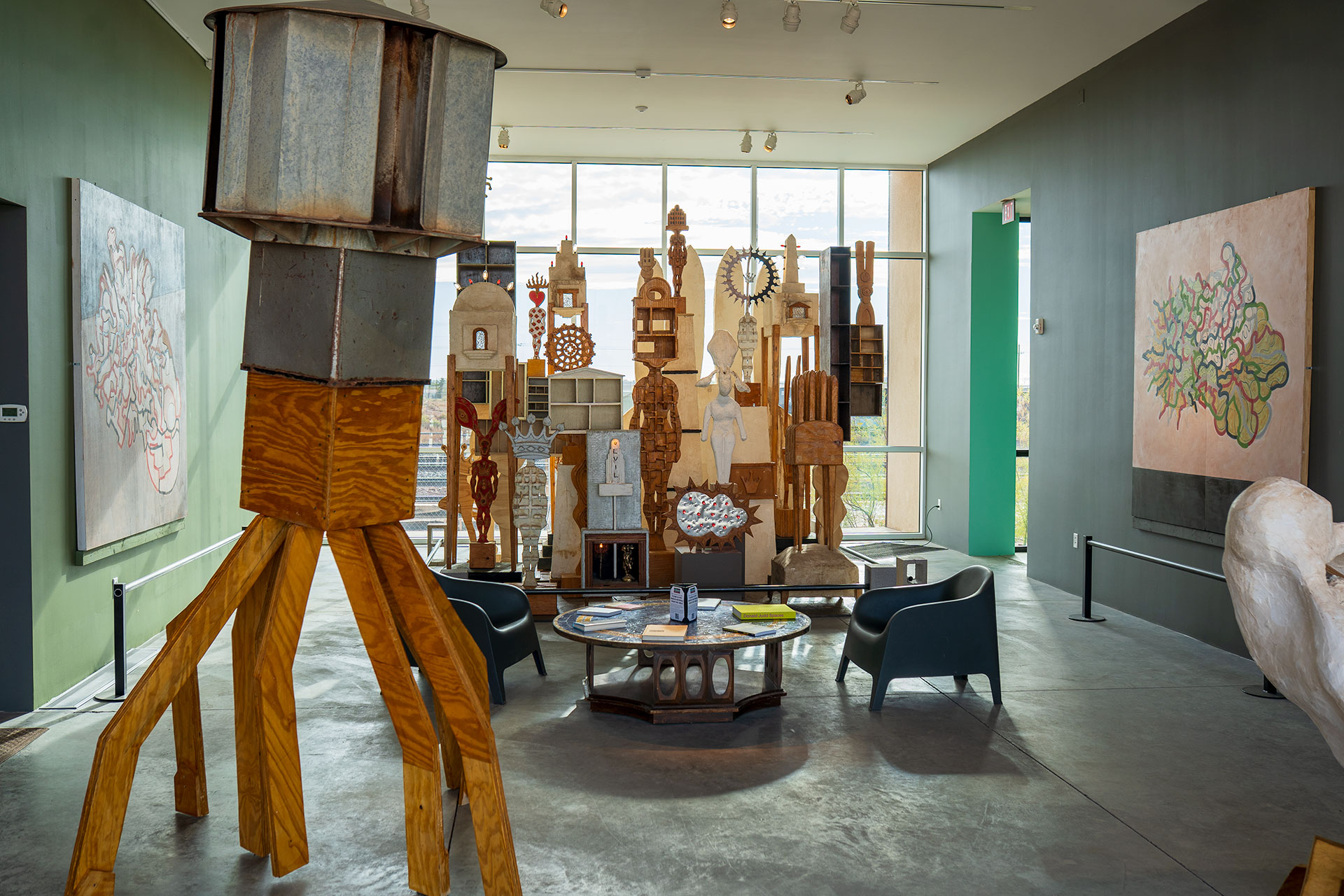
The installation Accretion embodies this idea. Named for the gravitational process that pulls matter together to form larger bodies, the piece includes eight floating painted wood panels and a central multimedia sculpture. At the center sits a serene figure, radiating calm amid deliberate chaos. Lutzick points to a jester-like character inside the work—its mandalas spiraling outward—as a stand-in for the creative mind navigating turbulence. The chaos swirling around him is not decoration; it’s expression. Nearby, towering “predators” stalk the gallery floor. These giant sculptural beasts appear to walk; their legs poised in mid-stride. The larger one was fashioned from an old HVAC component salvaged from La Posada, a piece of metal that sat waiting for more than a decade before becoming a creature. The piece was born during the pandemic, shaped by the idea of a virus roaming freely—another echo of the sci-fi novels that have been a spark of inspiration since day one for Lutzick.
Another anchor of the show is The Huddle, a dense cluster of sculptures arranged so that no single vantage point reveals the whole. To see it properly requires movement, curiosity, patience, which are qualities Lutzick often builds into his work. The sculptures’ relationship to one another, and to the space they occupy, becomes part of the piece itself. Meaning emerges not just from the objects but from the empty air between them, from the angles, shadows and overlaps.
Visitors will be able to watch the exhibit change throughout the year. Lutzick has said he plans to make both minor and sometimes major adjustments to the pieces and their arrangement, a natural extension of his belief that art is never truly static. Arrays is the next chapter in a series of yearlong exhibitions at the museum, following Paul Ruschá’s year in the gallery. When this show ends in 2026, the work will shift again and the following year will spotlight Tina Mion’s art.
But for now, the space belongs to Lutzick, to his Snowdrift universe distilled and reimagined. Walking into the gallery, you can feel echoes of the basement where he once spent hours tinkering. The incandescent glow may be different, the tools more refined, the projects larger and more complex, but the impulse is the same: to gather the stray materials of the world, dismantle their hidden engineering, and rearrange them until they reveal something new. And in this exhibit—this shifting constellation of arrays—he’s still that kid in the basement, assembling a universe out of whatever he can find, inviting the rest of us to wander and wonder.