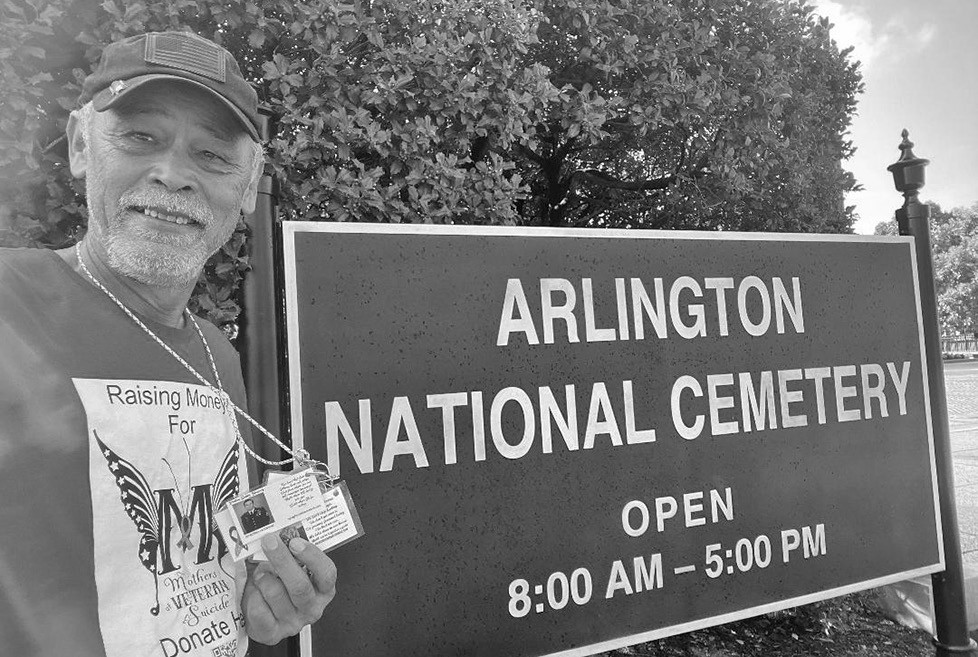
In Key West, Florida, author Hogan Hilling went on a 49-state journey to spread awareness and raise money for Moms Against Veteran Suicide (MAVS). He toured Elks Lodges in all states except Hawaii to spread empathy for this cause, which all began with Winslow resident Bridget Bagley, who began making charms for her son, a veteran who died from a drunk driver. A story on Bagley’s work was published in an August edition of The Tribune. Although her son did not die of suicide, her path of grief led her to start MAVS to connect with other grieving mothers. However, Hilling’s narrative offers a unique glimpse into a journey that’s more than just mileage – it’s about connection, resilience, and the power of a purposedriven life.
Hilling’s mission, fueled by a blend of personal aspiration and altruistic vision, lost a son himself although also not to veteran suicide but the loss brought him to Bridget, and his journey has finally led him to raise money for the grieving parents, not only as a way to honor the dead but to comfort those they left behind.
Hilling’s journey is tied to a significant fundraising component, a purpose that adds depth and meaning to every mile traveled. The funds raised are not merely a byproduct of his travels but a core objective, driving him to each new destination with a sense of mission. Initially, his fundraising efforts were centered around visits to Elks Lodges across the states, leveraging these stops as opportunities to gather support and resources. At every lodge he visited, he would sign the names of himself and the people he was spreading awareness for: Preston (Bridget’s son), Richard, Christian and Matthew, the last three having died by suicide, all of them veterans and in their 20s.
Reflecting on his journey, Hilling candidly acknowledged the ambitious nature of his initial fundraising goals. Starting with a target of $50,000 in just three months, he soon realized the enormity of this challenge. This acknowledgment was not marked by discouragement but rather an insightful understanding of the journey’s complexity. His journey, much like any venture of such magnitude, was bound to encounter unforeseen obstacles and learning curves, each requiring a nimble and responsive approach.
Although there were challenges, Hilling found himself not only meeting other parents who had lost their children and showing them empathy but also receiving empathy in return. He drove the interstates from lodge to lodge in an RV with a banner promoting the MAVS organization.
He ended up in Arkansas, sitting at the bar of one of the lodges, when according to Hilling, a man approached him, put a hand on his shoulder and said, “I just wanted to say I love what you’re doing. I have put a gun to my head two times but never pulled the trigger.”
Hilling said that the man, despite being a “man’s man,” almost began to tear up as he poured out his story to Hilling about how grateful he was to be alive and to have a wife who knows when his depression is bad enough to need extra care. Hilling, before embarking on this journey, had a son with severe disabilities who he had recently lost, which prompted him to start a support group for fathers of children with disabilities. He said that his experience with that organization allowed him to connect with other men and make them feel safe being vulnerable with him. The man at the bar took one of the charms that Hilling had as a remembrance for the people who were fatal victims of depression.
He said that this was far from the only time that men, who otherwise kept their feelings close to their chest, opened up to him on this trip. He offered empathy, not sympathy, in their time of need. He was able to offer them what his father’s group offered him: a caring ear to listen when the rest of the world was tired of hearing about those people’s grief.
“I think that’s a big problem with the world,” says Hilling. “Most people don’t want to hear about someone’s grief after the initial period of time. We have a ‘get over it’ culture.” However, grief, especially grieving over a child, lasts a lifetime, and empathy to that situation should last just as long, says Hilling.
He said that he’s met so many people all across the country who all were in similar predicaments: they were missing a child and felt they were bothering those close to them by discussing it as much as they wanted to. Hilling wanted to be the person who could teach them that the grief was not only acceptable but natural and necessary, and has fostered a community around them that shares that grief with him, but also in a community on Facebook. He mentioned that the best part of the trip, the thing that kept him going, was knowing that a random conversation with an Elk’s member or a random conversation at a gas station could leave a lasting impression on someone.
From all his travels, Hilling distributed more than 350 charms, which are laminated, business card-sized paper with descriptions of the ones who are missing, with beads and jewelry attached, to people all across the country. He wanted people to carry these with them as a reminder of those who are lost but not forgotten and for people to leave them for others to find so that perhaps they could find peace from the charms as well. He knew his cause was working when he was in an Elks Lodge and before he could go and sign the names of the men on his charm, he found Preston’s charm sitting right on the sign-in sheet. Someone had taken it from another state and continued Hilling’s mission. “It was just one of the many divine intervention moments from the trip,” says Hilling.
Of the $50,000 he set out to raise, he raised almost $2,400 from a Kickstarter campaign he started before leaving on the 49-state journey. The fundraiser can be found here: https:// www.gofundme.com/ f/ PrestonsCharm for anyone who is willing to donate to Hilling and the mission of MAVS.
Hilling is starting his journey again, this time he is going to take it a little slower, visiting American Legions this time. He will go to several legions in a single city and states and ask each club to donate what he can. He thinks that this will be able to get the money the organization deserves in a more realistic timeframe. He also plans to write a book, his 12th book, all about the journey, and all the mothers will have a chapter to talk about how their path to grief has led them to Hilling.
He doesn’t know where the journey will lead him, what twists and turns it might take, but to him, it’s not about the journey or even the money; it’s about teaching people there are better ways to grieve and that there is no time limit on caring about someone you’ve lost. He urges anyone who has stories similar to these to please reach out, and he will even make charms for others and send them to them free of charge in the hopes that it eases the pain just a little bit.
Hilling says, “I did not find the charms; the charms found me.” He has been able to work through the loss of his own son by way of helping others and hopes to extend empathy, not sympathy, to anyone who might need it.