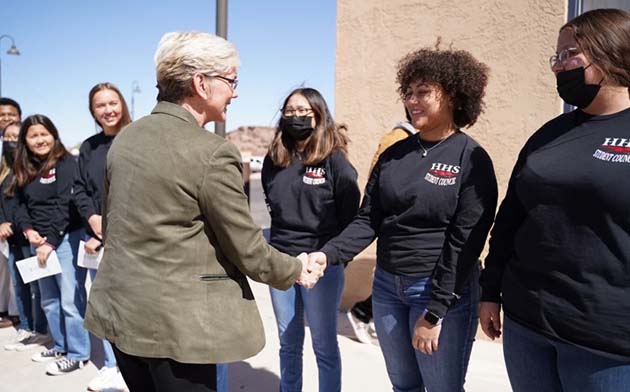
Government officials, city administrators, and college and school officials met last week at Holbrook High School at the invitation of US Secretary of Energy Jennifer M. Granholm and Congressman Tom O’Halleran to discuss the impact and opportunities with the closure of area coal fired power plants.
There are three plants scheduled to close, along with the Navajo Generating Station owned by SRP that closed in 2019. Those scheduled to close next are Cholla Power Plant in Joseph City owned by APS and PacifiCorp by 2025, the Coronado Generating Station in St. Johns owned by SRP no later than 2032, and the Springerville Generating Station owned by TEP no later than 2032, with the shutdown phases to begin prior to those dates.
Those who spoke at the round table discussion included Winslow Vice Mayor Samantha Crisp, Joseph City Unified School District Superintendent Bryan Fields, Navajo County Supervisor District I Jason Whiting, St. Johns City Manager Paul Ramsey, Springerville Town Manager Chris Collopy, Eagar Town Manager Matt Mears, Northland Pioneer College President Dr. Chato Hazelbaker, the Economic Collaborative of Northern Arizona President and CEO Gail Jackson, Salt River Project (SRP) Plant Director Craig Larson, Arizona Public Service (APS) Community Affairs Director of the Northeast Division Janet Dean and Tucson Electric Power (TEP) Engineering Superintendent Cris Patterson.
The discussion began with Secretary Granholm stating that she was in attendance to listen to community representatives and to, as she said, “be most helpful from the Federal Government side.”
Whiting spoke regarding the RealAZ organization that addresses economic development in Navajo and Apache counties. “We did a study looking at those two counties, looking at some of the impacts as a result of the loss of these power plants.
“By way of property tax alone, in Navajo County you’re looking at (a loss of) almost $3 million. This is the money that comes in and goes back out to our schools, and the employment is pretty significant. When you look at the average median income it’s around $30,000 and these jobs on average with benefits are around $90,000. These are our highest paying jobs, so it’s a pretty significant hit in that regard. In Navajo County you’re looking at about 520 jobs and in Apache County about 650 jobs. We were doing a comparison between our self and the Valley, and that would be like losing Intel and Boeing.”
Whiting added that his interest is in utilizing the existing infrastructure including rail and interstate and work with the federal government to facilitate a transition into other economic opportunities and jobs with the loss of the power plants.
As far as industry, he addressed the issue of biomass as a result of forest thinning. Whiting noted that in the Northwest, the biomass degrades rapidly and becomes compost but in this region that’s not the case, it does not decompose and that byproduct needs to be managed and utilized. “A potential solution would be to burn some of that. It’s expensive but it’s a way to help our forests and it’s another way to produce energy,” he said.
Raban addressed the Secretary and Congressman stating that the concerns of his community are like those of other communities. “To say it’s going to be a struggle when (the power plants) leaves, is an understatement. In Apache County, a greater majority of our property tax comes from these power plants. Losing the jobs, for us to match the pay of those jobs, it’s just not going to happen. What is going happen is that these folks are going to have to go where the work is and that’s going to devastate not only our county but our schools. We’d not only like to provide jobs so that our people can stay, we want to generate energy.”
He noted that he has been working with alternative waste companies that see an opportunity to work with the power plants and tie into the existing infrastructure. “We have enough waste regionally to easily fuel one of these power plants that could turn around and provide energy for Catron County in New Mexico, Apache County and Navajo County.”
Fields explained that in Joseph City the impact will be significant to both school enrollment and the lack of jobs, as well as the assessed valuation of property. “One thing that is different for us is that we’re unincorporated. Our schools were built in the 1970s when the plant was in full operation and back then schools were funded a bit differently. It was prior to equalization so our district was flush with money. Things changed around 1980, since then our school has operated on overrides and bonds to operate our track, swimming pool and a nice auditorium with a district of about 400 students. Our capacity to out to bond and override is going to be diminished when the power plant goes away.”
Other concerns addressed included the need for broadband in both counties and a better highway system to the southern regions of Apache County in order to entice industry.
Hazelbaker spoke of how Northland Pioneer College is looking at the issue of closures. “When I go to my district board meeting next week, I’m going to be asking them to pass a budget that includes a $750,000 decrease from the prior year partially from the assets coming offline. At the same time, I don’t go visit with one of these folks from these communities that don’t want us to increase our services in their communities because they’re trying to train workers or remote work or there’s IT jobs, or many healthcare jobs, there are jobs that we can train them for right now.”
He also talked of how the campuses are also providing opportunities to high school students to earn college credits while in school. “What it’s going to require is to get some investment early so we can build some things that aren’t here yet. New employers aren’t going to come without a trained workforce and we are so ready to do that but when we see that decline in investment it just gets harder to do that, but I am very hopeful for a couple of reasons. One is that you would not believe the quality of students in schools in this region. In an area in the country that has been in the one percent of the poorest counties in the nation, the schools have fantastic graduation rates. The students in this region are incredibly hard working. They really have a great value set for future employers. The second is that there is not a community that I go into that isn’t trying to come up with a plan.”
Dean stated that APS is very sensitive to the communities and the impact as the power plants in the region close. She explained that as APS is regulated it works through the Arizona Corporation Commission and anything they do needs to meet their approval because they are looking out for the rate payers. “We’re also the utility provider in this area so we are very, very committed and will continue to be so. We want to work with the community and to support what the community decides is best for the region.”
As a discussion of opportunities for industry was presented, Granholm stated that the Bipartisan Infrastructure Law passed by the Biden administration includes $7.5 billion for an electric vehicle charging network across the country. A portion of that is delivered through formula to states and a portion of that is competitive. “All of that is to go to put EV charging in areas it does not already exist. So, it’s not supposed to go to urban areas where you already have the EV charging infrastructure.” She explained that Arizona is going to get $76 million in the first round and there will be a competitive component for the second round, which is to go more into rural and underserved areas. That will not require a funding match.
She related the challenges of the power plant closures to what she experienced as the former Governor of Michigan with the closure of the auto manufacturing and the transition into electric vehicle manufacturing. “We were on our knees. We were the state with the most outward migration with jobs because of the challenges. We wanted to keep our young people there. You want to do the same. You want these young people to not have to go to these big cities. You were born here; you were raised here. You want to make sure you have community and opportunity.
“I love to hear your analysis of the opportunities here in solar. I’d like to know from the energy companies what they see are the opportunities. Because you have got so many resources in sun. We’ve tried sun in Michigan and we didn’t have so many resources. The amount of sun, the amount of land and the amount of space that you have, and the fact that you are all partnering together. It’s just such a huge opportunity.”
Granholm went on to say that as an example, in Wyoming, coal plants left and TerraPower came in and put a small modular nuclear reactor on an abandoned coal mine because of the infrastructure that already existed and the ability to train those workers.
“The next technology that is in huge demand is clean hydrogen. There’s a huge among of money in that Bipartisan Infrastructure Law in hydrogen, about $8 billion. We’re encouraging those to be located, yes you do have to have a match for that, so you do need a big partner on that, but we want to be able to do some matchmaking and place them where there is mass amount of resources like solar to be able to deliver clean hydrogen. That is a game changer for some people.”
She noted that pre-permitting areas for solar development would be a good start. “I know that we’d be interested in a conversation like that to pre-approve, so that it makes a development ready if there were an interest in really working on something like solar.”
Granholm also added that there are billions of dollars for advance nuclear reactors and next generation modular reactors, with the consideration of utilizing coal plant infrastructure. “We are all in on keeping the existing plants open as well as investing and expanding new.” But added that solar is much less expensive than nuclear and that storage of solar would also offset the use of power after the sun sets and that there is funding for that as well.
The transmission grid is another opportunity for development. “We need to add capacity to the transmission grid so that we get power from places that generate it to places that use it. So, building the grid as well as generating the power are all jobs and they are all in that Bipartisan Infrastructure Law. Billions of dollars to add capacity to the grid, as well as make it more resilient against some of these climate impacts as well as cyberattacks. It’s not one solution. It’s not a silver bullet, it’s silver buckshot. Communities that are eager to raise their hand, they are all kinds of jobs for all kinds of people in all pockets of America in this space. It’s for those who generate the power, those who build the products, those who install products to maintain the products. It’s just very big,” stated Granholm.
O’Halleran concluded, “The key for us at this time is that the people are listening to how this transition is taking place and there’s opportunities now that may not be there later, or there may be more opportunities because of success. But we have to drive the process and part of that is your unity, your regionalism, your ability to work together is key to doing that. The same with Congress. We have to learn to work together because we’re going to be faster in that process and moving it along for everybody. We cannot go backwards; we have to go forwards and this is the way to do it, working with one another.”