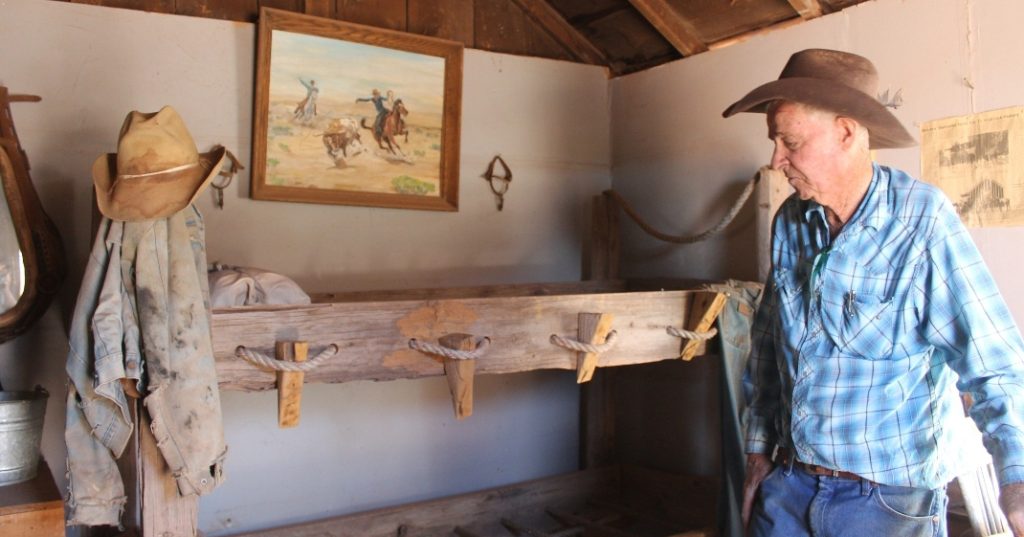
By China Cassidy Central to Holbrook, Joseph City and Winslow, Rock Art Ranch is a great place to learn about more of the area’s diverse history. From Anasazi pottery and Old West bunkhouses, to displays of how pioneers of the area lived, there is much to be seen at the ranch. Rock Art Ranch is a 25-minute dusty drive west of Holbrook off Interstate 40. Cattle surrounds the dirt roads leading up to the ranch and the family dogs run up to greet visitors as they enter. When at the ranch, visitors will typically have a tour led by owner Brantley Baird’s granddaughter Tori Baird-Rice. Most prominent on the property are an old 1800’s chuck wagon, a large lodge-style building that holds a museum full of Anasazi and pioneer history, and an original Hashknife cowboy’s bunkhouse, the last of many that once were located on the property used by the men that worked for the Aztec Cattle Co., according to Baird. Inside the old bunkhouse, visitors catch a glimpse of the cowboy life. In the late 1800s, these cowboys passing through Holbrook to ship cattle were accommodated for one month out of the year as they rounded up cattle. Baird has items in the room including old cooking utensils, a wash area and an old rope bed. Baird explained that the ropes that run across the bed frame were what the cowboys laid their bedrolls on instead of bars or wood. Pulling on the ropes to demonstrate how to tighten them ensuring that they would not sink too much. Baird said, “You heard the old saying, sleep tight and hope that the bed bugs don’t bite? That’s where that came from.” Just outside the Hashknife bunkhouse is an old restored chuck wagon. The wagons would essentially house all of their cargo while the cowboys slept outside on the ground with a horsehair rope barrier around their bed rolls to steer the snakes away. They continued this way for many years according to Baird who recalled witnessing it as a young boy, “They had stockyards there in Holbrook when I was a kid. So, they would ship the cattle and stay in them 11 months.” Inside the museum building, the walls are covered with decades upon decades of memorabilia and photos from the area’s history. To the back of the building, Baird has set up two displays, one with items from his wife’s family and one with items from his own. The pioneer display is only a small portion of his collection. The rest of his collection such as old tractors, well drills and corn wagons can be found at his Pioneer Museum on Main Street in Joseph City. In a private room inside the museum, Baird has a collection of delicate pottery, water ollas, jewelry, baskets and other items believed to be anywhere from 1,000 to 1,200 years old. The baskets, according to Baird, were used by the Navajo for transferring water, contrary to the common belief that they used pottery. Many of the pots and baskets are intact but secured inside glass cases for extra protection. Baird told of how the larger pots were used to fend off dehydration during long travels. Baird explained, “On the trail, the Hopi’s told me every five miles they would bury these about halfway in the sand and it was somebody’s job to keep them full of water. They couldn’t just head out because they would be choking. So, they had to know that every five miles they had one of those.” Just another short drive through a bumpy dirt road are Anasazi pueblos, which were excavated over the course of five years by archeologists and field students who would stay at the ranch for five weeks at a time while working to reveal the structures. The trail leading up to the pueblos has pottery and arrowheads scattered on both sides. Inside the building that protects the old structures are living quarters where three families stayed. Baird offered, “This is the actual footing of their houses. They figured these were two story buildings.” It is obvious that each room had its own function and what that function was. A charcoal pile sits in the corner where they were believed to do their cooking. Holes in the ground show where pots were put to store water or food such as grain of rice. After visiting the pueblos, there are also two hogans, a sacred home of the Navajo people, on the property for viewing. What the locals call the “swimming hole” can be found further down the canyon where the walls that line the water are covered in old petroglyphs. Baird said he would love to see more people visit the ranch saying, “This is not my museum, this is our museum, and if there’s any time that anybody feels that we can upgrade it by doing something that they have, they’re welcome.” Rock Art Ranch is open at 10 a.m. Monday through Saturday and is located off Territorial Road between Joseph City and Winslow. For tours and to schedule reservations, visit rockartranch.com or call (928) 386-5047. Admission is $35 per person.