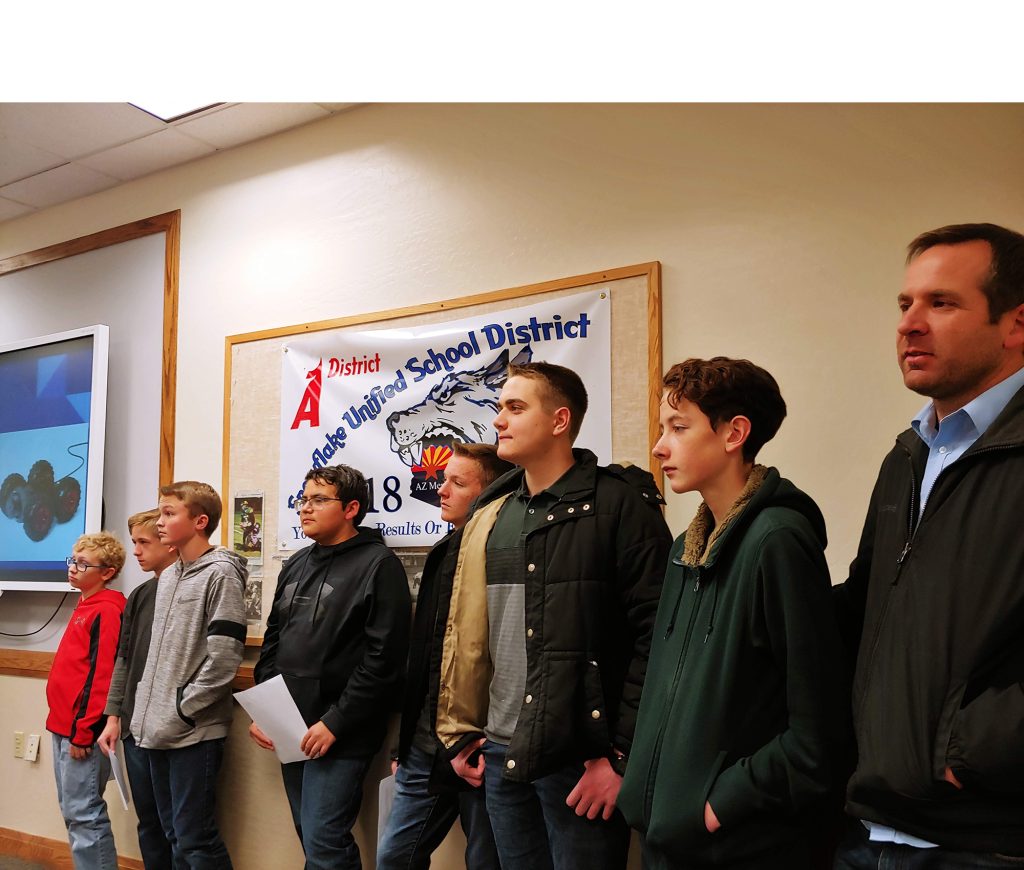
Snowflake Junior High School and Blue Ridge Junior High School in Lakeside were both named state winners for the Samsung’s Solve for Tomorrow Challenge. The contest tasks students to think of a way to solve an issue in their community using STEM (Science, Technology, Engineering, and Mathematics). 100 state winners are chosen after students in grades 6-12 work with their STEM teachers to submit an idea for a project that would use STEM to address an issue in their community. The contest consists of four rounds, with the selection of 100 state winners being the second round. The state winners will receive $15,000 worth of technology for the school and a video kit to advance to the next round.
For the next round, students will submit a three-minute video showcasing their project and how it addresses their community’s issue. The issue proposed by Michael Eilertsen’s students at the SJHS was the formation of sinkholes and fissures caused by decreasing groundwater. The students proposed a device that could go into these fissures and safely investigate previously unexplored geographic features and give insight to preventing further sinkholes.
For their video, the students plan to create a system of pulleys that will lower a robotic vehicle, which they have built and programmed with coding, with a camera down into a subterranean location and pilot the robot with a remote control or an app. It will be corded and able to be pulled out if it were to lose connection and powered with a generator up on top of the place their rover is exploring.
The video voting contest will run from Dec. 23 to Feb. 20. From there, 20 national finalists will be chosen to have their videos put on social media where the public can place their votes from March 5 to March 30.
“Samsung is extremely proud of the evolution of the Solve for Tomorrow platform over the past 10 years: fueling students’ passion and curiosity to tackle issues that affect their communities in unexpected and creative ways,” said Ann Woo, Senior Director of Corporate Citizenship at Samsung Electronics America. “Reading the innovative proposals students and teachers have put forth this year exemplifies what we know to be true for every student – that young minds have just as much to teach as they do to learn. Our guiding citizenship vision is ‘Enabling People,’ and we are thrilled to celebrate another year of empowering future innovators to achieve their full potential through STEM learning.”
This is a second state win for Eilertsen and his students as they were chosen as national and state winners in 2017.