/wp:paragraph
wp:paragraph
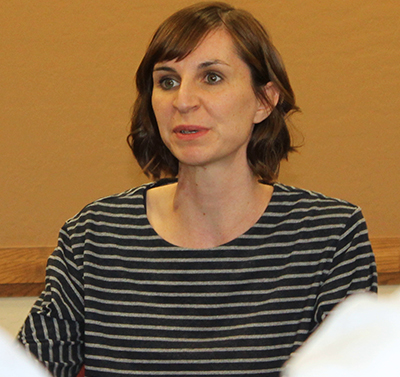
Principals, teachers and staff at the Snowflake Unified School District (SUSD) had a rare opportunity to meet with the newly-elected Superintendent of Public Instruction for the Arizona Department of Education (ADE) Kathy Hoffman on April 24, who not only welcomed questions and comments at a round-table type discussion, but also took time to visit classrooms at the Highland Primary School.
/wp:paragraph
wp:paragraph
Hoffman said as the discussion opened, “This is your chance to share your ideas and concerns as I am always trying to bring your voices to the table.”
/wp:paragraph
wp:paragraph
Questions were raised from how to pay for the minimum wage increases to creating testing standards that are meaningful and timely, with an emphasis on third grade and high school testing.
/wp:paragraph
wp:paragraph
SUSD Business Manager Mark Ollerton shared his concerns of the minimum wage going to $12 an hour in January of 2020. “We are having to pull funds from other areas in order to meet this and that creates a lot of struggle.”
/wp:paragraph
wp:paragraph
Superintendent Hollis Merrell said that the minimum wage increase will cost the district an additional $185,000 for next year’s raises.
/wp:paragraph
wp:paragraph
Hoffman said, “Schools need to be funded to afford the minimum wage increase. There needs to be more awareness around the impacts this is causing.”
/wp:paragraph
wp:paragraph
Earlier this year, the U.S. Department of Education threatened to withhold nearly $300 million of Arizona’s school funding if the ADE continued to allow their schools to choose their own standardized tests for students.
/wp:paragraph
wp:paragraph
Relating to this, Hoffman said she predicts that the current AZMerit test will be renewed. “Over the next two years it will pretty much be what you, as educators, are used to.”
/wp:paragraph
wp:paragraph
Hoffman also noted that a year from now there will be field testing on a new standard test for third to eighth grades.
/wp:paragraph
wp:paragraph
Regarding high school assessment testing, Hoffman said, “There are a lot of questions as to what the test should be and to what grades it should be administered. It will all have to go through the approval process of the U.S. Department of Education.”
/wp:paragraph
wp:paragraph
“Theoretically, the state should pay for whatever is designated as the state assessment,” continued Hoffman. “I feel it is the state’s responsibility to pay for it.”
/wp:paragraph
wp:paragraph
Some concerns were shared regarding the current testing for third graders that focused on the length of the writing test, as well as the fairness in evaluating the writing when students were receiving different prompts rather than just one prompt for everyone.
/wp:paragraph
wp:paragraph
Federal Programs and Curriculum Director Jason Owen said, “The third grade reading and math tests are smaller and can have a break in between, but when our third graders are taking the writing tests, some of those kids were sitting for six hours without being able to take the breaks that were needed; these third graders are trying to do their best and working as hard as they can.”
/wp:paragraph
wp:paragraph
Taylor Intermediate School Principal Debbie Muder asked, “How can they evaluate a child when there are different prompts that provide different writing genres. If one prompt is talking about the favorite pet and another prompt is talking about recycling, I can tell you which student wrote the better paper.”
/wp:paragraph
wp:paragraph
Also brought into the conversation was the effectiveness of the Move on When Reading law, which effectively requires the passing of the AZMerit in order for the student to transition from third grade into fourth grade. Hoffman said she feels that the data needs to be evaluated to see if that law is really helping kids, or if there is a better solution.
/wp:paragraph
wp:paragraph
Highland Primary Reading Specialist Jennifer Rose said that while the teachers are not to teach to the test, the reality remains that the kids have to pass the test in order to pass third grade. She further noted that the test is done on the computer, which also tests the student’s ability to type as well as their computer knowledge.
/wp:paragraph
wp:paragraph
As the conversation wound down, Hoffman shared that the ADE financial audit would be completed soon to make sure all the funding formulas are working and that the schools are getting the funds they need.
/wp:paragraph
wp:paragraph
Hoffman also noted, “We are looking at special education cost studies to see how much we are really spending and how to make it more equitable. Looking to make sure the money is appropriately distributed. We know it is not enough money, but the end goal is to increase special education money.”
/wp:paragraph
wp:paragraph
Merrell thanked Hoffman for coming, “We sure appreciate you taking time to come to our school. This is unprecedented and says a lot about you and what you are trying to accomplish.”
/wp:paragraph