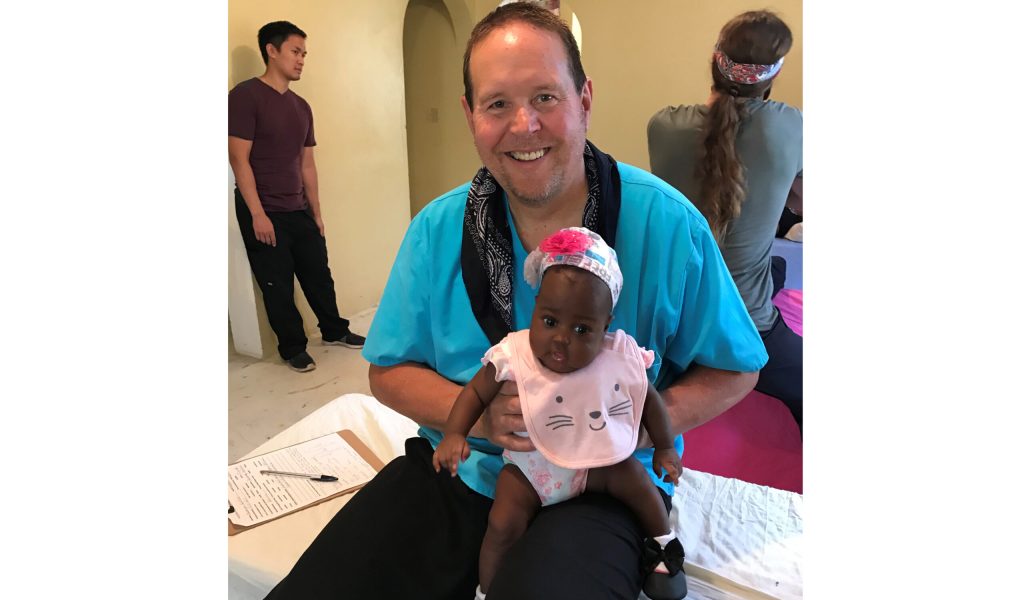
A recent trip to Haiti as a physical therapist with Phoenix Rising for Haiti (PHR), gave Snowflake Mayor Lynn Johnson a chance to not only experience the joy of helping people, but also his first earthquake and his first run in with typhoid fever.
Three years ago Johnson took his first trip to Haiti with PHR and last month he went back again. “The kids melt your heart. The needs of the people are so great,” shared Johnson. “We take so much for granted in this country.”
Born and raised in Snowflake, Johnson graduated Snowflake High School in 1980, and went on to become a physical therapist beginning practice in 1993. Today, he works as a partner at White Mountain Physical Therapy in Taylor.
With his kids getting older, Johnson found himself drawn to helping people in poorer countries. “An orthopedic surgeon and I had been planning a trip to the Dominican Republic, but it never worked out,” noted Johnson. So when he learned of the PRH group three years ago, he signed up to go.
Twice a year PRH takes in groups of medical professionals to help the residents of Port-de-Paix, which is in northern Haiti, where they now have an established medical clinic.
Johnson shared, “After the earthquake in 2010, most of the areas that were serviced were right around Port-au-Prince. Haiti is one of the poorest nations in the western hemisphere and Port-de-Paix is one of the poorest cities.”
Driving north out of Port-au-Prince, Johnson said the pavement ends and the remainder of the three-and-a-half hour drive is over terrible dirt roads.
Just as the group was boarding the bus, another earthquake struck, with Port-de-Paix being the epicenter. Driving into the city, Johnson said they could see the fallen walls of the homes and buildings. “Construction is pretty poor and families are afraid to sleep in their homes because of the risk of collapse.”
Arriving at the two-story facility, the group set up camp. “We slept on twin bed mattresses that either had a bug net or a tent to cover it. The mosquitoes are pretty fierce,” continued Johnson.
The next morning the group went on an excursion around the city, but Johnson opted to stay behind and read. “In the afternoon I was taking a break, the streets are just buzzing the whole time. The noise is constant: honking, talking, traffic,” said Johnson. “I was on the upstairs terrace, watching the people, when all of a sudden, I heard a rumble. At first I thought it was a truck coming down the road, and then realized it was a deeper rumble. That’s when I saw my feet bouncing. The floor was waving. People were screaming, yelling and flooding into the street. I looked across the street and there was a solar panel on a tall pole, waving back and forth.”
At that point, Johnson realized he was in an earthquake that was later reported as 5.6 on the Richter scale. “I am watching all these people and the fear. After it stopped, one of the security officers got to me.”
The next day when the clinic opened, the PRH began working with the people injured in the quake. One was a 20-year-old boy who had jumped from a two-story building and couldn’t walk. Carried in by his friends, the PRH doctor tried to get x-rays done at the hospital, but there were no x-ray plates available. “The best we could do was to give him a wheelchair and bandage his feet,” said Johnson, who suspected that the boy had broken his heels.
Johnson said that at the local hospital “if you can’t pay, you can’t get seen”, which forces people to go the local “leaf” doctors, who are the local herbalists, or a voodoo doctor, because with those doctors the locals can do barter and trade for their medical care.
Whether the surgeries and initial care are good or bad, the aftercare and follow through is often the place where the things break down. The PRH clinic will pay for x-rays for patients who need that care. “These people that I work with over there are some of the cream of the earth to me, because they are taking out of their pockets to help these people,” said Johnson, who recounted the worst case he saw was from a man in his 60s who had fallen off his horse and broken his leg. Eight weeks prior, the leaf doctor had set what turned out to be a compound fracture with a knee immobilizer and an ankle brace.
“Considering what the leaf doctor had available, she probably did a pretty good job,” recounted Johnson. “I took off the braces, did a few preliminary tests on the leg, which was pretty dirty, but I knew there was a real problem when I picked up the leg and it bent.”
With the hospital out of x-ray plates and the surgeon not due in the area for two more weeks, Johnson could not put the leg back into the braces. “I looked around, found some casting plaster and made a posterior splint with a sugar tong so it could be removable. When I secured it on his leg, the man’s whole countenance changed. I begged him to come back as this was just a temporary fix. He had come in on a motorcycle and might not make it back. I see stuff like that all the time. The people we see are so grateful for the help.”
In his previous trip, the PRH coordinators were concerned about the safety of the medical staff, but this time Johnson said the group wanted to explore, so with three Haitians as interpreters, the visiting staff walked around the town, played basketball with some of the locals and just experienced what life was like there.
“The living conditions are pretty crazy,” said Johnson. “There is no sense of trash pickup, most of it is tossed into the little creeks that flood and carry it out to the ocean. The amount of trash is stunning. There are skinny dogs everywhere; no one pets them. A little girl that was homeless was given a small bag of Cheetos every day for her food. We have no concept of what it is like to live in those conditions.”
On Thursday night, Johnson began to feel ill. His fever shot up to 104 degrees and the dysentery began. “My stomach was in knots and it felt like someone was ripping my insides out,” he shared. “By 4 a.m. that morning, I couldn’t take it anymore and had someone wake up the doctor.”
It took four bags of intravenous fluid to bring Johnson out of the dehydration. But the pain and sickness continued all the way through the bus ride back to the airport. “I was terrified of that bus ride back, but somehow I made it,” said Johnson, who has fully recovered.
As he concluded his story, Johnson shared a final scene from his return trip three years ago. “On my first trip I came home on the flight from Miami to Phoenix, and ended up seated with two doctors,” said Johnson. “One was an emergency room doctor, who had been on several humanitarian trips as well, and he looked at me, after I shared my story, saying, ‘You didn’t change anything. As soon as you leave they are in the same problem that you came to them with; the health care is terrible and the government is corrupt.’”
Johnson said those words hurt, but they also made him think. “For a moment I was silent. Finally, it just came to me, and I turned and looked at the doctor, saying, ‘You are right. I didn’t change Haiti. I didn’t change the politics or the health care system. But I promise you this; I made a difference to at least one person.’”
Johnson continued, “I know I made a difference to the guy I helped with the broken leg. I helped another man start a business when I first went. I will go back. I like that type of work; I like seeing humanity. The people I worked with are the most caring, compassionate people you can imagine. They come from all walks of life. We have so much here, it is good to share; even if it only helps one person.”
For more information on PFH, visit www.phoenixrisingforhaiti.org.