https://www.youtube.com/watch?v=mVug5g3ZIGc
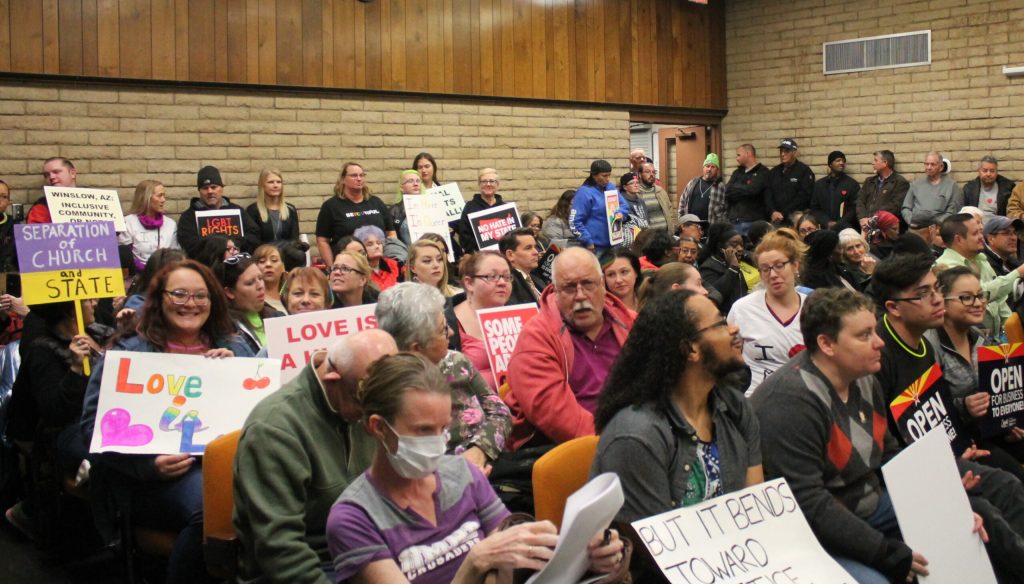
A large group of citizens attended the Nov. 13 Winslow City Council meeting in order to address an ordinance entitled the Human Rights Ordinance, which has become controversial amongst the city’s residents. Members of the community, local clergy and members of Christian faith have come forward during call to the public at the last two meetings, and again at the Nov. 13 meeting to express their concerns.
The intent behind the ordinance is to insure that members of the lesbian, gay, bisexual, transgender and queer (LGBTQ) community are provided equal rights when it comes to employment and treatment within the city. It requires that all businesses have a proclamation stating that they will not discriminate to those who identify as LGBTQ in order to do business with the City of Winslow and potentially face fines. While many spoke to the need for such an ordinance, others viewed it as preferential treatment and spoke out not only against the ordinance but also against the LGBTQ community in general.
Before the meeting, a large group of individuals gathered at the entrance of City Hall in a prayer circle and singing religious hymns. They were soon met with another large group of individuals in support of the ordinance and LGBTQ equality who had paraded down Second Street carrying signs to city hall. Although the difference of opinion was apparent, the overall mood was polite and even affectionate as members from one group reached out to members from the other.
Approximately 40 people addressed the council during call to the public for nearly two hours. Among those who spoke during the meeting was First Baptist Church member Lou Slonczewsk. “I was thinking, these are either a lot of concerned citizens or a very divided town.” He continued, “I feel like what people do in their own home is their business, but when the City of Winslow brings it out in to a public domain, it becomes my business. I don’t agree with this ordinance I believe in the long run, it will hurt the church.”
Conversely, Dr. Gregory Jarron spoke in favor of the ordinance. He said, “I agree with the mayor that civility and unity are the two most important things we can learn from today. I fully support this ordinance. There is clearly a religious exemption, which people are not reading. This ordinance allows people to not be discriminated against in our city. So that we can attract businesses to our city so that they can be sure that their employees will not be discriminated against.”
Church leaders also took the podium both in support of and in opposition to the ordinance. Pastor Fred Harris of the First Baptist Church said, “I don’t really want to talk about the ordinance, I gave it my best shot. I do want to remind the city council of what First Baptist has to offer. If there is anyone there who doesn’t want to live the lifestyle, I am inviting you to a place where we don’t attack each other. We want to help. I offer my services to you.” Harris had previously spoken out against the ordinance in previous meetings.
Deacon Ursula Baker, of St. Paul’s Episcopal Church also addressed the council. “I have been a citizen of Winslow for over 30 years and I have come to love this town. I am here to speak in favor of this ordinance. We human beings are the stubbornest and most arrogant of all God’s creatures. We are all human and this is an ordinance about accepting humanity.”
Other comments included those from resident Kody Cavin who is five months pregnant and stated that she and her wife were not there to change anyone’s opinions regarding their lifestyle. “All I’m asking is that you give me the same rights that you have in your workplace and in asking for a house. I want to be able to feed and house my baby.”
Becky Kolomitz, who has lived in Winslow her entire life, noted that she never felt discriminated as a Hispanic woman and that she had “all colors of friends, every religion, every sex, every sexual orientation” and had always been proud to share that while talking with others about Winslow. “I thought that’s what Winslow was about. And now, because of a simple ordinance, that is not a religious matter, it is a civil matter, all of a sudden all this dark hatred is coming out.”
Another speaker was Mary Alice Hayes. “I am against the ordinance. We, as black folks, have been discriminated against forever. If I had known that half the majority of this council brought this ordinance together, I don’t think we wouldn’t have voted for you; most of us wouldn’t have. I am so glad there is a thing called recall. If you approve this ordinance, you are asking for trouble. You’re going to have more ordinances coming in here that you’ll have to approve.”
Later in the meeting, City of Winslow Attorney Nicholle Harris presented the motion to adopt the ordinance and addressed questions and concerns from the council.
Councilman Bob Schlesinger, who ultimately voted against the ordinance said, “I see a lot of loopholes in this and it seems it would be going to the city manager and we don’t have an employee to do that. In my opinion, this is a state issue that needs to be dealt with by the state.” He added, “I hate seeing ordinances dictating to our businesses on what they have to do.” He then made a motion to table the issue indefinitely. It was seconded by Councilwoman Judy Howell but the motion failed to move forward.
Councilman Robin Boyd, who also voted no said, “To me, this got to be too complex and I just felt that the main problem with this ordinance is the main people threatened is the religious community. I am not opposed to this ordinance, I feel like people should have the right to do whatever they want. I do have problems with the ordinance though. One is the religious inclusion and one is the penalty. I really don’t want penalties for civil rights problems.”
Those who voted in favor were council members Marshal Losey, Samantha Crisp and Rickey Jackson, as well as Mayor McCauley, with Howell, Boyd and Schlesinger voting against. The adoption does include an amendment excluding religious organizations from adhering to the ordinance. Further discussion will be had regarding the penalties for violating the ordinance. However, as explained by Attorney Harris, complaints will be reported to the city manager’s office and the matter reviewed by legal council before action is taken against business owners.
McCauley said, “I would like to say thank you all for being civil to each other tonight. We are a very inclusive community, we always have been but now we have it in writing. Continue to support and to love each other. I hope that everyone continues to do that in your own faith, in your own homes, and in public.”
The ordinance in its entirety can be viewed on the city’s website at www.winslowaz.gov.