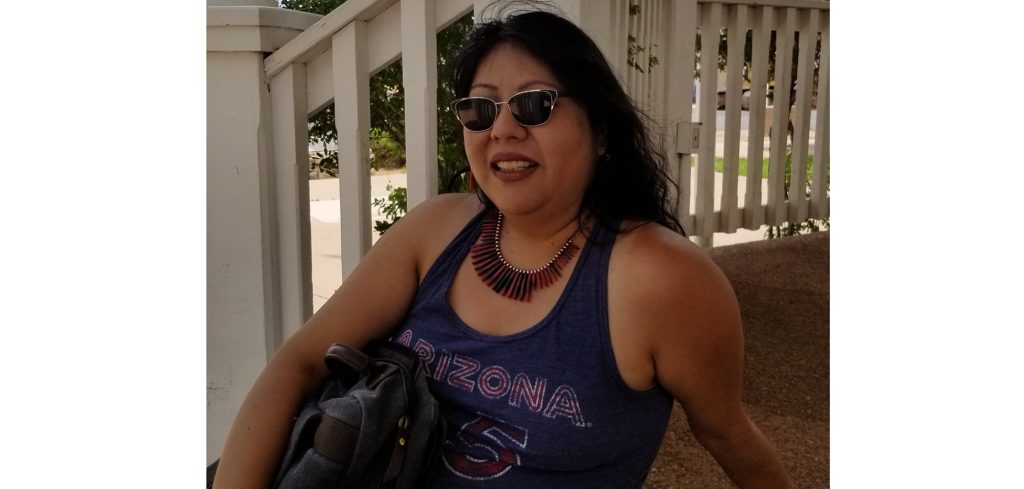
By L. Parsons Larrilynn Oso was an otherwise healthy 35-year-old when she contracted the coronavirus last April, an event that changed her life in many ways. “I started feeling not well about two weeks before I went to the hospital. At first I thought I had a head cold, you know, a sinus infection because I felt so much pressure in my head,” said Oso. She lives with her 72-year-old mother in a small apartment in Winslow and at the time she fell ill, maintained an administrative career at the Winslow Indian Health Care Center (WIHCC). She continued to work, despite the risks because her job was to procure personal protective equipment for the entire medical center. “I felt honored to be able to provide equipment these medical professionals needed to do their jobs safely. I would come into work and see them coming in for their shifts and see how exhausted they were, but they were walking into battle every day, so I felt like at least I could be doing a little bit to help.” The number of COVID cases continue to decline county, state and nationwide. However, 542 Navajo County residents lost their lives to the virus. That number does not reflect those affected on the Navajo Nation, which was one of the hardest hit areas in the country. The WIHCC serves a large percentage of the Navajo Nation. While those around her were displaying obvious signs of COVID-19, Oso said she gradually began to feel worse every day. “First there was pressure in my head, then the body aches, then I got to the point where I couldn’t even shower myself. During all of that, Winslow lost the pharmacist from Safeway, Patty Wilke. Her death was a real catalyst for me along with seeing how many people in our community were getting seriously ill. Not to mention I was in a very stressful job and going to college full time. Honestly, I thought I was just stressed, you know, exhausted. I had done that before, worked myself to exhaustion. “I went into full panic mode and I think that is part of what saved the rest of my family. I left all the doors and windows open and vented air from the back to the front of my apartment. I stayed away from my mom and made sure everything was cleaned. My biggest fear is that I would pass it to someone that couldn’t fight it like I could. By the time April came, I was terrified.” She was tested for COVID-19 at work around that time and her test reported a negative result. “At that time, the testing wasn’t perfect. When I got the false negative, I called the hospital and asked if there was any way they could have made a mistake, because I’m dying.” Four days later, she drove through a rapid test site and was told they wouldn’t swab her for COVID-19 because she had just been tested, that she probably just had the stomach flu and sent her home. “I went home and cried for days. The rate at which it went from a gunky nose and lungs, to being the hospital, it was like being knocked off your feet. The body aches were excruciating. I was praying because I didn’t know what else to do. This was a pain I had never experienced before in my life. Worse than broken bones, torn ligaments all of that. My body felt foreign. I looked in the mirror and I didn’t even look like myself, and it was only two weeks into being sick.” The last Sunday of April 2020, she made a phone call to a friend asking her to “Look after my mom if anything happens to me.” Soon after, she dressed herself, put on her trademark matching necklace, earrings and bracelet, and decided to drive herself to the urgent care clinic at WIHCC. “I told my mom it was a sinus infection and that I would be right back. I knew that was a lie and it hurt me so much to lie to her, but I didn’t want to be a burden.” She made it as far as the admissions desk at the clinic with a 104-degree temperature. “The person at the admissions desk took one look at me and sent me to the respiratory clinic that was set up specifically for COVID patients. That walk, which is not very far, felt like the longest walk of my life. I got to the respiratory clinic and I just collapsed.” Within two hours of driving herself to the clinic, Oso was admitted to Little Colorado Medical Center with COVID-19. “I heard a doctor or a nurse or someone say to me, you have COVID and you are deteriorating quickly.” Osos said that the next eight days were a blur. “I do remember waking up because a nurse was literally slapping me, not you know, hard, just enough to wake me up because at that point, if I had gone to sleep, I would not have woken up.” Several times she woke to nurses and doctors surrounding her, placing lines for intravenous medications, a full dose of potassium that had Oso believing she had lost her arm due to the cold, fluids and nutrients. “So many blood draws,” she said. “I have never in my life been poked and prodded so much. But the entire time, even when I was combative, I was grateful.” Oso said that she came to a point that she made peace with the fact that she may not leave the hospital. “I wasn’t afraid, I thought about my family and I thought about a package I was expecting. But I wasn’t afraid even though I felt like I was breathing through Jello. Every breath out was one I wasn’t getting back in. It was getting progressively harder to breathe, I knew there was oxygen in the air, but it wasn’t for me. So I said thank you to God and looked around and thought, ‘this is the room, this is what I’m wearing, this is it.’ And it was the most freeing feeling, to just let go.” She didn’t stop breathing though. She got better. While being treated for COVID, she was also diagnosed with double pneumonia and had excessive fluid in one of her lungs, a common occurrence in COVID patients. “Every doctor and nurse and hospital worker I came in contact with treated me so kindly. I cannot stress enough how grateful I am for all of those people who couldn’t even go home and care for their own families but they were there doing everything they could for me.” Oso said that during her eight days in the hospital, she did what doctors suggested in order to fight the disease. “I took my breathing treatments, I moved my body, and I tried to stay hydrated. I did my daily devotionals and I made my bed as soon as I could get out of my bed. It seems mundane, but it was one of those things that brought me back to earth, so to speak. It grounded me.” After her release from the ICU, she learned that several people had been admitted at the same time as she had been and she was the only patient to leave the hospital. “Some were transferred to other facilities and I don’t know what happened to them. And some, I know for a fact, didn’t make it.” She has survivor’s guilt, she said. “Even now, a year later, it hits me. I do think, why isn’t my cousin here? Why did this person have to lose their dad? Why am I here when they are not? It’s kind of like, trying to find out the message, what am I supposed to do with my life if I was spared? “The person you were before COVID is not the same person you are now. I learned how stupidly human I am. I learned that this community is so full of people who extend kindness in small but important ways. I told myself I would learn to take time off and enjoy meals. I understand now, that if you aren’t going to take care of yourself, the universe, or God or whomever will open your eyes and make you do it.” She said what has come out of it is a renewed sense of hope. Oso’s mother never contracted the illness, despite close living quarters. “I have to thank my family. I attribute my recovery and will to keep fighting to them. The nurses, the doctors, they deserve the credit as well.” Oso made a plea for people to get vaccinated. “People are still dying from it, the pandemic is not over.”