Alicia Stoffers, project manager with Ardurra Group, Inc., stood before the Winslow City Council last week to unveil four interlocking master plans covering potable water, wastewater collection, stormwater management and reclaimed water use. She began by recalling a frustrating visit several years ago when her team, armed with paper plans, searched in vain for a buried water line in Winslow, only to have to find a retired employee who set the record straight. “That’s why we want to build a robust and accurate map of all existing infrastructure,” she told council members.
She said the second phase of the plan drills into system performance, analyzing flow rates and billing data, while the final phase lays out recommendations and simulates how the system would operate once those upgrades are in place. “The good news is you guys meet most of the required flows in town, you have good pressure, your system is perfectly adequate for what you’re serving today,” Stoffers reported.
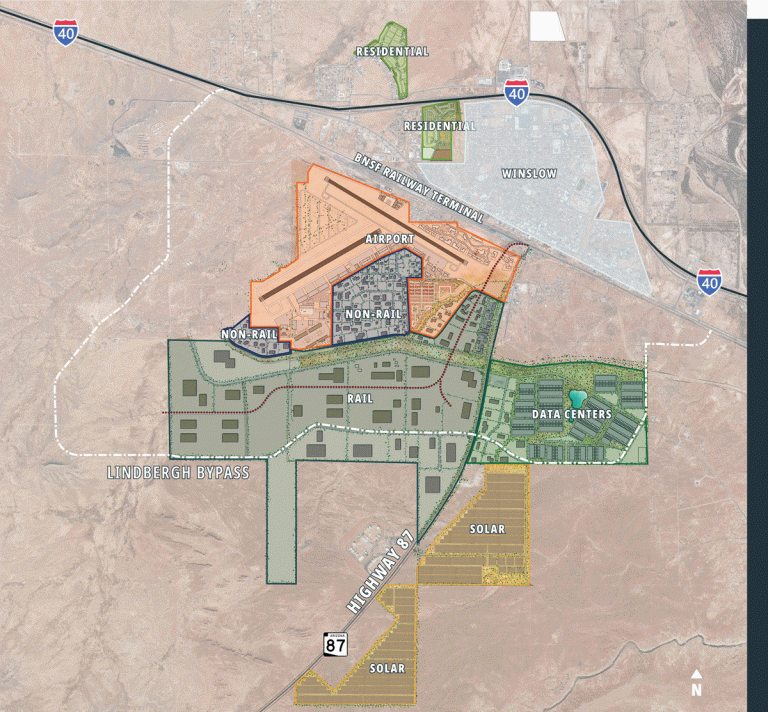
Looking ahead, Stoffers urged the city to build a new water tank— something the city has already been working towards, even receiving a $3 million grant appropriated to them by the federal government for the project in late 2024 — and to reconsider the layout of its seven wells, all clustered together and tied into just two pipelines. “A new well site is definitely something that’s worth a lot of attention,” she said. She also recommended installing booster pumps in higher-elevation neighborhoods that currently rely only on gravity for pressure and upgrading the mains servicing Winslow-Lindbergh Regional Airport and Transcon Lane before any major developments move forward. Stoffers warned that nearly 70% of the water drawn from the wells doesn’t show up on customer bills and advised investing in a leak detection survey.
On the wastewater side, Stoffers noted the treatment plant is running at half its capacity and suggested minor upgrades and a regular preventative-maintenance schedule to keep things running smoothly. The stormwater network, she said, is small but would benefit from routine care.
Finally, Stoffers described how the city could turn treated effluent into a revenue stream. “The water coming out of the treatment plant is quality enough to sell to local farms for irrigation or use it to water the city parks,” she said. While that reclaimed-water infrastructure would require a substantial upfront investment, she added, it would ultimately cut the cost of maintaining parks and other city landscapes.
Navajo County Emergency Management Director Catrina Jenkins presented an extensive update on local emergency preparedness efforts at the council meeting. Jenkins highlighted recent accomplishments, including the completion and FEMA submission of a critical five-year Multi-Jurisdiction Hazard Mitigation Plan, essential for maintaining eligibility for federal funds.
She discussed the installation and successful testing of a new flood-warning siren in the Bushman Acres neighborhood, designed specifically to alert residents in historically flood-prone areas. “This is primarily for the Bushman Acres area, which has seen significant catastrophic flooding in the past,” Jenkins explained, noting the siren is stationed at the intersection of Shattuck and Sunset.
Jenkins strongly emphasized public preparedness through Navajo County’s “Ready, Set, Go” program, encouraging residents to register for county and city emergency alert systems, maintain emergency kits with vital documents and medications, and establish clear evacuation and communication plans within families. She underscored that residents should only trust official information from city or county sources during emergencies to avoid confusion and misinformation.
The presentation also covered Winslow’s unique risks, including severe windstorms, dust storms, flooding from the Little Colorado River, wildfire risks due to dense tamarisk growth in the riverbed, potential hazardous material incidents along Interstate 40, and railway safety concerns.
Jenkins mentioned collaborative preparedness efforts with neighboring jurisdictions, such as ongoing wildfire prevention strategies and active engagement with Navajo Nation Emergency Management officials to enhance regional response capacities.
Jenkins concluded her remarks by urging residents to heed evacuation warnings promptly during emergencies. “If we call for an evacuation, please go,” she stressed. “You’re not going to stop water, you’re not going to stop fire—leave it to the professionals.”
In other business, the council:
* Approved the reappointment of Kenn Evans and Heather Pruett to the Board of Adjustment.
* Approved the reappointment of Kenn Evans and Stacey Emigh to the Historical Preservation Committee.
* Approved the notice of intent to adopt new building permit fees, community services fees, development services fees and public works fees. The council will discuss new fees and fee increases at the council meeting on June 10.
* Approved an ordinance authorizing the acquisition of two adjacent properties located in Coconino County near the intersection of Coopertown Road and Desert Hills Drive and directing city staff to acquire the title by donation from the Frank Lewis Family Trust.
*Approved an ordinance authorizing the sale of real property on the corner of First Street and Kinsley Avenue to Dixon Oates at a cost of $30,000.
The next meeting of the Winslow City Council will be held at 6:30 p.m. on Tuesday, May 13, in the meeting room located at 523 W. Second St.