/wp:paragraph
wp:paragraph
In a world where a light switch is simply a part of life, it is hard to imagine the darkness that 15,000 families, living on the rugged, remote, ancestral lands of the Navajo Nation, have experienced for decades with no power available to them.
/wp:paragraph
wp:paragraph
It is a world that Navajo Tribal Utility Authority (NTUA) General Manager Walter Haase, with the mutual support of the American Public Power Association (APPA) as well as public utilities across the United States, wants to ‘Light Up.’
/wp:paragraph
wp:paragraph
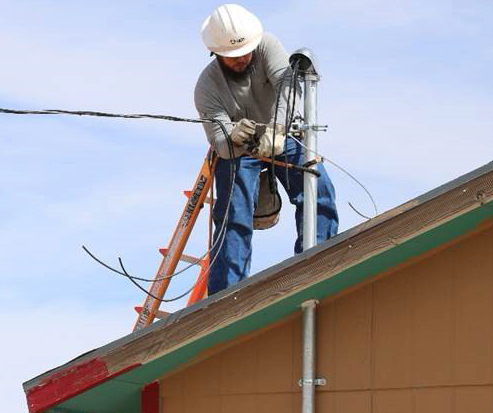
Launched as Light Up Navajo, the unprecedented pilot project saw 28 utility companies, including Arizona Public Service (APS) and Salt River Project, from Arizona, Arkansas, California, Delaware, Illinois, Indiana, Massachusetts, New Mexico, Ohio, Oklahoma, Texas and Utah, converge on the Navajo Nation with crews who strung up more than 50 miles of line, bringing power to 233 families in an expedited six-week period of time during April and May.
/wp:paragraph
wp:paragraph
“It is shocking that in this day and age there are still so many homes in the U.S. without electricity,” said Mike Hyland, senior vice president of engineering and operations at the APPA. “We are touched by the support being offered from so many of our member utilities.”
/wp:paragraph
wp:paragraph
APS sent a crew of five linemen, including Roman Middleton, who grew up in Holbrook, for their two-week portion of the project. Working from dawn to dusk putting in 12-hour days, the APS crew was able to string up 39,800 feet of line, digging 108 holes and connecting 12 families.
/wp:paragraph
wp:paragraph
As was noted by APS staff, “Our guys were from Flagstaff and the Pine-Strawberry area, so they were used to working in the rough, unforgiving terrain in the middle of nowhere. NTUA was impressed at the quickness, safety and efficiency of our workers.”
/wp:paragraph
wp:paragraph
Starting near Tuba City, the APS crew strung nearly 7.5 miles of line as connections were made in Tonalea, Chinle and Teec Nos Pos.
/wp:paragraph
wp:paragraph
Fannie Shorthair, an elderly woman who received electricity near Teec Nos Pos, shared her excitement when she said, “It comes from my heart. People from all different states are here to help me. That is so neat. It makes me want to scream with happiness.”
/wp:paragraph
wp:paragraph
The NTUA along with the Navajo people put on dinners for the linemen and the families that had been connected or were about to be connected. Emotions ran high as the Navajo people shared their stories and their gratitude.
/wp:paragraph
wp:paragraph
One mom said she was so excited that her boys were now able to do their homework past sunset and not having to work by candlelight or flashlights.
/wp:paragraph
wp:paragraph
Lillie Wilson of Kayenta, simply said, “I went over and turned a switch on and the lights came on.” Her voice choked as her eyes filled with tears.
/wp:paragraph
wp:paragraph
For men and women who were used to working with power outages from major storms and catastrophes, watching people who had never had power finally be able to turn on a light or plug in an appliance, put this project at the top of their list.
/wp:paragraph
wp:paragraph
“It is a relentless pursuit to survive,” shared Middleton, as he put words to what he had seen and heard from the two weeks on the Navajo Nation. “It is never-ending for them, whether it is just food or water, just everyday things. None of us realize how spoiled we are to flip a switch or turn a faucet on. It brings a whole new perspective and respect to their way of life.”
/wp:paragraph
wp:paragraph
While only 233 homes received power, instead of the 300 initially hoped for due to the spring rainstorms that deluged some of the areas making the rugged roads impassable, NTUA deemed the project a success.
/wp:paragraph
wp:paragraph
“We are grateful that these electric utility teams have volunteered to travel here to help us with our challenge to extend electric services to homes without,” said Haase. “We are equally appreciative to their communities that supported this effort to help dramatically raise the standard of life for our families who have been waiting years for electricity.”
/wp:paragraph
wp:paragraph
Since 2008, NTUA has expended over $170 million to bring power to more than 5,000 families at the average rate of 474 families per year, while employing 91 workers. NTUA also contributed $1,500 for each home totaling $7.8 million.
/wp:paragraph
wp:paragraph
Deenise Becenti with NTUA said that for the last three years the overall average cost of bringing electricity to a single family is about $40,000. Multiply that by 15,000 residents to equal $600 million and add another $350 million for transmission lines and substations and the cost soars to nearly $1 billion dollars. Money that neither NTUA nor the Navajo Nation has.
/wp:paragraph
wp:paragraph
“In 2017, our residential customers paid an average of $630 per year for electricity. If we were to self-fund the electric build to 15,000 families at a zero percent interest rate – our rates would not be affordable,” Becenti said. “The average annual bill would go from $630 to over $6,000. There’s no way our customers would be able to afford it.”
/wp:paragraph
wp:paragraph
By using workers from other utility companies to help with the installation, NTUA is hoping to bring costs down and make the goal of lighting up the nation more achievable.
/wp:paragraph
wp:paragraph
Haase is the immediate past chairman of the APPA. During his year-long tenure, Haase traveled to various public power conferences to speak and he was given time to talk about NTUA and the number of families without electricity.
/wp:paragraph
wp:paragraph
“After each session, people would come up and tell me they didn’t know that thousands of families in a given region do not have electric power,” Haase said. “This was unreal to them and, as public power entities, they felt they could do something.”
/wp:paragraph
wp:paragraph
Every year, public power communities dispatch their electric crews to restore electricity to regions hit with hard weather storms like hurricanes and tornadoes. This is part of the APPA mutual aid program.
/wp:paragraph
wp:paragraph
“People would ask, ‘If we help cities and communities, why can’t we help the Navajo people?’” Haase said. “These types of questions became part of a bigger conversation that created Light Up Navajo.”
/wp:paragraph
wp:paragraph
It took NTUA over a year to set up the project as they coordinated with the Navajo chapters to make sure the homes were ready for electricity as well as secured rights of way for the electric lines.
/wp:paragraph
wp:paragraph
“This project is a goodwill effort to bring reliable lighting, heating, refrigeration and make way for other services such as running water and cellular/internet communications,” Haase said. “Navajo families will witness that other parts of America do care and have sent their teams to help us.”
/wp:paragraph
wp:paragraph
Middleton shared that one of the stories that forever changed his life, was from a family at the end of nearly six miles of overhead lines. “The homeowner’s family was the first to settle in that area. Speaking in Navajo, he shared how he raised his kids and grandkids with no power for most of their lives until recently, when the family got a generator and a mobile solar panel trailer for limited use.
/wp:paragraph
wp:paragraph
“To see their excitement, their smiles and tears; makes me thankful for the opportunity to go and help them. It was an awesome experience,” added Middleton.
/wp:paragraph
wp:paragraph
Before World War II, the federal government established the Rural Electrification Act that provided loans to utility companies to connect rural and remote areas to the grid.
/wp:paragraph
wp:paragraph
Unfortunately, the Navajo Nation, like many of the reservations, was bypassed as utilities opted not to service or expand into the reservation lands.
/wp:paragraph
wp:paragraph
Perhaps the greatest irony is that the Navajo Generating Station, while being the largest employer on the Navajo Nation and the biggest exporter of electricity west of the Mississippi, sends its power hundreds of miles away to millions of customers in Arizona, Nevada and California.
/wp:paragraph