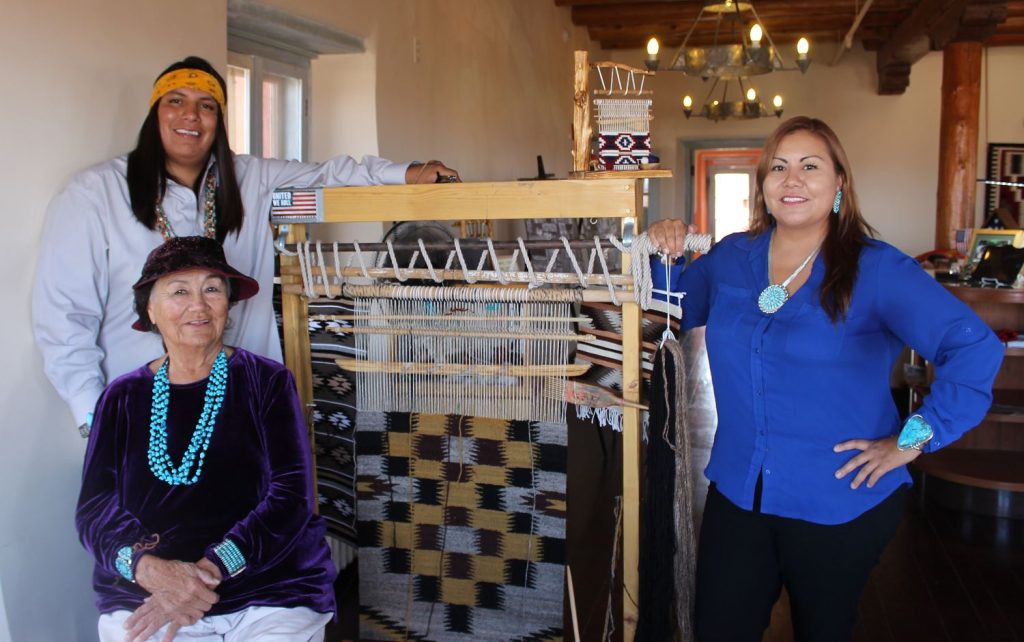
By Toni Gibbons “The story that my grandmother told me,” began Lucille Smith, a Navajo master weaver, in a clear voice that defied her 88 year walk on this earth, “was when women were created at the beginning of time, Spider Woman came to them and said the women needed to weave and make dresses. Spider Woman taught us the sacredness of the weaving.” Lucille started weaving when she was seven years old, learning the tradition from her grandmother. As she and her grandchildren, Shannon and Jacob Smith talked about the complexity of weaving, Lucille’s fingers never stopped moving through the wool threaded across the homemade loom that sat in the corner of the Painted Desert Inn at the Petrified Forest National Park (PEFO). Lucille, Shannon and Jacob are part of the cultural demonstrators the PEFO hires to give the visitors a chance to engage with the local culture. As visitors stepped into the room, Jacob was quick to greet them with a smile as he introduced Lucille with the pride of a young man who loves his grandmother and his heritage, saying, “My grandma is a national treasure. To this day, she does everything from start to finish. She raises the sheep, shears the wool, combs, spins, creates the colors from the natural wool and natural dyes. And then she sets up the loom from start to finish. From the mind to the eyes to the hands, she weaves the stories of our people into her rugs.” While the words that describe her work can be said in less than a minute, the weaving of a mid-size tapestry can take up to three months, with larger ones taking even more time. “It is quite calming,” noted Shannon, who began weaving at the age of eight. “It keeps your mind busy with the patterns and the counting. It keeps your mind and fingers strong as you age.” Jacob admitted that while he has never woven, as the Navajo tradition maintains that it is taboo for the men to weave, he has seen the effects of it. “Grandma is very in tune with everything around when she is weaving. It clears the mind,” shared Jacob. “Grandma has a great way of integrating her stories into her weavings. Each tapestry has a beautiful story woven into its fabric, whether it be of the horned toad, the four sacred mountains or another story.” The Smith family weaving tradition goes back to Great Lady Blacksheep and it is a tradition that includes not only the carding, spinning and weaving of the wool, but also the raising and sheering the sheep that produce the wool. The Navajo tradition of raising sheep is still prevalent among many of the tribal members. “To my knowledge, we are the only Native American culture to still have sheep,” said Jacob. “The Navajo live among the sheep. It is a way of life for us.” When she was a young child in the 1930s, Lucille’s family ran a flock of a 1,000 sheep near the New Lands area. Sadly, because of certain events that happened, her family had to move to Allentown where their flock was reduced to less than 30 sheep. Today she lives near Lupton on the family farm where she and her late husband, Raymond Smith Sr., raised their four children along with a herd of sheep. Jacob noted that his grandfather was a Code Talker who passed in early 2000. Raymond was part of the Fifth Marine Division that served and fought on Iwo Jima. Before his death, Raymond recalled seeing the raising of the flag on Mount Suribachi. As a politician and advocate for the Navajo Nation, Raymond helped to develop roads and bridges throughout the Arizona portion of the reservation. He was also the general manager of the Navajo Arts and Crafts in Window Rock, Chinle and Kayenta.” Today the Smith family maintains a herd of more than 35 sheep. “We have Churro, Rambouillet, Suffolk and Blackface sheep,” said Jacob. Lucille was quick to add that the Churro are the best tasting for eating and that their heavy wool was good for making rugs. Jacob and Shannon are both facing a world where the crafting is going away. “Many of the Navajo women still weave, but they no longer weave with the yarn they have made,” Jacob said. “It’s not just my culture that this is happening to, it’s everyone’s culture.” Shannon shared how when she was a young girl learning the art of weaving, her loom was set up opposite of Lucille’s. “There would be times I would mess up the pattern and grandma would come over and take a look,” said Shannon. “It never took her long to figure out what had gone wrong and she made the correction look easy.” “This is very important for the legacy of the Navajo women,” said Lucille, as she stopped weaving for a moment to join the conversation. Jacob continued her thought, “The Navajo culture is beautiful. There is an ordinance for everything. The way to the heart of the Navajo is through the language. When there is instruction to be given the Navajo elders prefer to speak in their native tongue because it is more meaningful and personal.” In the 1800s, the Navajo blankets, rugs and saddle blankets were highly sought after by the men who ran the trading post. The regional rugs that carry the Tree of Life, Ganado, Two Grey Hills and Storm patterns were the designs requested by the traders. But what is truly special to the Navajo are the story rugs that carry their family stories within the complex patterns and the chief blankets that were made for the ruling male members of the tribes. The earliest of the chief blankets contained the indigo blue color, a European dye made from a plant base, with later ones having both red and blue in the pattern. Living in the modern world, where new colors are almost a daily occurrence, the simplicity of the colors used by the Navajo weavers creates a web of life that has spanned the ages. Using the same plants and methods that were passed down to her from her mother and grandmother, Lucille dyes the yarn into four colors. From the wild dandelion, known as Navajo tea, comes the sage green color. While the deep yellow is derived from the roots of the holly bush called Woozhii in Navajo. The blood red color is created by harvesting the cochineal insect that lives on the pads of the prickly pear cactus. Indigo blue is the only color that comes from a dye that has been used for centuries. The remaining colors of black, white, grey, tan and brown are the natural colors from the sheep. Among the Navajo, the women are the weavers; the men make the looms, as well as the shuttle and the comb. And while the women are weaving the men of the Smith family are the silversmiths. Jacob said he comes from generations of silversmiths in his family. “The way I was taught to work with the silver and stones are sacred and special. My shop is my sanctuary.” When asked if women were allowed to be silversmiths, Jacob laughed and said, “The women can be whatever they want, and yes there are women silversmiths in my family.” For more information on the Smith family artwork folks are welcome to call or text Jacob at (928) 864-9099.