

What started as a way to teach basic life skills, like cooking, laundry and budgeting, to at-risk youth in Navajo County, has turned into the H.U.B. (Hope, Unity, Belief) Center for Success, a program where the goal is to keep at risk youth out of detention. “There is nothing exactly like what we are doing,” said Navajo County Chief Probation Officer Jason Cash, who came from the adult side of probation a year ago. “The kids don’t need to be locked up, but they do need more supervision, which got me thinking how that would look.”
The result was a strength-based approach created through the combined efforts of the Navajo County Juvenile Probation Department and the Navajo County Instruction for Success High School (NCIS). “What we are doing is looking for the strengths and passions of the students,” shared Cash. “We want to give them opportunities to build on their strengths. More success can be developed by focusing on strengths, and success is contagious. Some of these kids need to be able to accept success in their lives.”
Taking four empty classrooms located in the Navajo County Probation Services Office in Holbrook, Cash and his staff worked hard to transform them into rooms that invite the students to pursue life skills and the arts, with one room being a library with a computer lab.
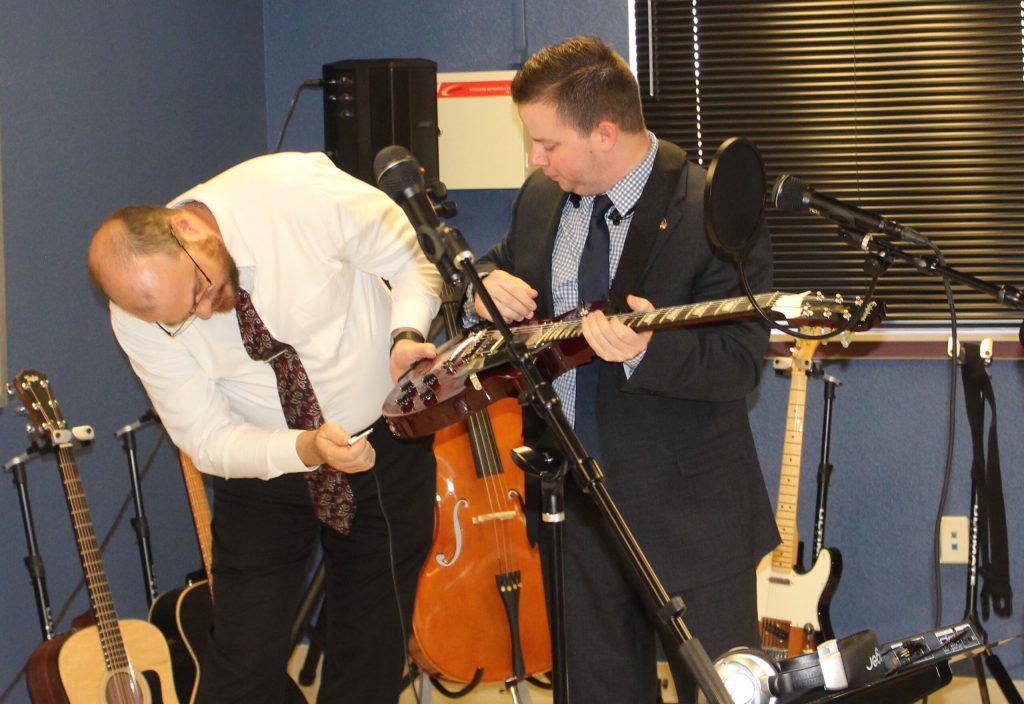
“The favorite room is the music room,” said Cash. Filled with acoustical and electric guitars, a full set of drums, an electric piano, microphones and a sound room, the room is the dream of any budding musician or a student who just wants to see what it is like to create music. Also included are other arts including photography.
Cooking is another hit among the students. From baking cookies to make a bad day better or just learning to make a basic meal, Cash said that learning life skills is a big part of their lives. “They definitely like cooking. You can really see the changes in the kids. We have rules and boundaries, but we don’t spend the day nagging on them,” Cash continued. “We have a dress code, but if we see a violation, we talk with the kids and tell them why it is not appropriate; we take a different approach. Sometimes it is the only clothes they had to wear that day.”
Credit recovery is done at NCIS from 9 a.m. until 2 p.m. on a typical day during the school year. “At 2 p.m. the students come to the H.U.B. Center until 5 p.m. Eventually, I would like to have them until 7 p.m.,” said Cash, who noted that the times most kids get into trouble are between the hours of 3 and 6 p.m. when the parents or guardians are still at work.
When the H.U.B. day ends, the students are bussed back home with a bus provided by the NCIS. The bus route during the school year goes from Dilkon to Show Low, with the ability to expand to Pinetop, if needed.
The H.U.B. Center can accommodate up to 25 students and Cash said that right now they have approximately 16, with numbers as high as 20 in the summer program. While the program is not open to the general public, kids who are struggling in school or have gotten too far behind to gain credits can sign up. “They don’t have to be on probation. If a kid has been suspended or expelled, they can be a part of this program,” shared Cash. “As well as any student that attends NCIS.”
“Between seven to 11 kids are in detention at any time,” said Cash and with the closure of the Navajo County Juvenile Detention Center in June of last year those juveniles are now taken to Pinal County Youth Justice Center in Florence, Arizona, where it is tougher for the families to stay in touch. Cash would like to see the number of kids in detention drop significantly.
The juvenile detention center had a yearly budget of $1.2 million from the county general fund, while the H.U.B. Center has an annual budget of approximately $200,000 in salary and operating expenses, which is split between the county and state funds. The initial cost to set up the H.U.B. was approximately $120,000, which was funded by the state.
Cash also noted that for each child that is diverted away from detention in Pinal County to the H.U.B. Center, the county will see an estimated savings of $145 per day.
Most recently, the H.U.B. Center was able to hire Mike Koenig, a clinician, who will be setting the curriculum based on the top four risk factors that tend to push kids toward crime and drugs. The first is attitude, how they think and what they believe; second, personality and behaviors; third, peer relations; and fourth, family circumstances.
“These are not the only risk factors that we will assess and address, but these are the four that truly drive all the other factors,” said Cash. “Our clinician will be working to ensure that any activity is tied to lowering one or more of these risk factors.”
Cash also wants the communities to know that they welcome volunteers at the H.U.B. Center. As Navajo County Government Relations Director Adam Wolfe said, “The volunteers do not necessarily have to be proficient at what is already in place. If you have an idea for a positive, life-changing activity, by all means reach out and let us know.”
Volunteers will need to get fingerprinted, but that can be done at no charge at the probation office. For more information, contact the probation office at (928) 524-4197.




