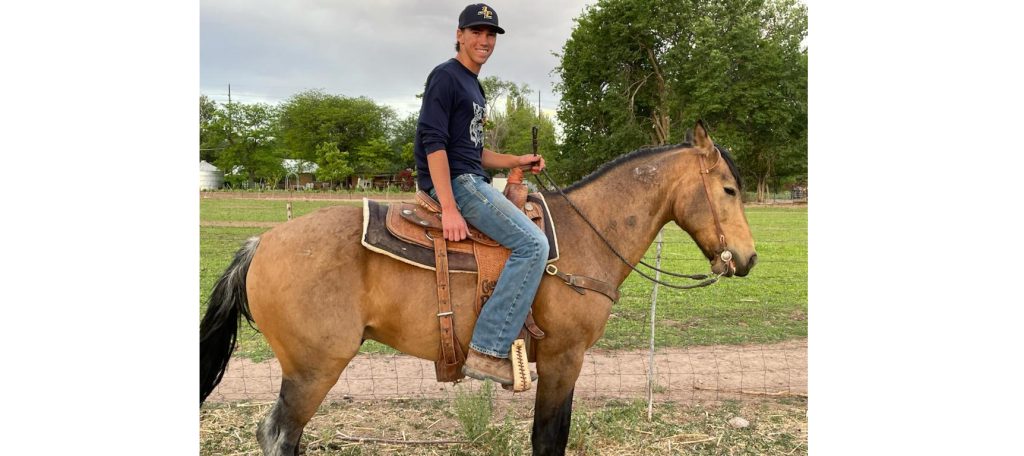
By Tammy Gray “We like to share the fun,” said Alan Palmer of The Farm on Route 66 about the success he and his family have found on social media. “It’s about sharing who we are and promoting goodness.” What started out with small animals like goats and chickens, as well as a handful of their own horses being shared through videos on social media has now turned into a full-blown equine rehabilitation and rehoming project with approximately 20,000 followers on YouTube. The Farm on Route 66 is also gaining traction on other sites like Facebook and Instagram. “Horses are kind of our biggest thing,” Palmer said. “A lot of followers seem to like the horses and horse rescue stuff.” Currently Palmer has about 30 horses on his farm in Joseph City, of which only five were his own personal horses. The rest of the horses are being brought back to health and given enough training to be able to find a good home. The rescue effort includes properly feeding emaciated horses to bring them back to health as well as providing basic regular care like de-worming and hoof trimming or shoeing as needed. According to Palmer, most of the horses being prepared for new homes come from the Navajo Reservation. Some are sold by families who can no longer afford to feed them, while others were rounded up after having either escaped or turned loose. “It seems like with this drought a lot of people on the reservation are selling their livestock, so I’m buying a lot of wild horses from families that can’t afford to feed or water them,” he said. “But then we just try to get them to a better spot.” He noted that a lot of the male horses are not gelded (castrated), which perpetuates the current problem of there being too many horses without enough grazing land to support them all. The dry conditions mean that the grasses that fed horse, cattle, sheep and goats have become sparse. Palmer has the horses gelded, both to help alleviate the overpopulation problem if the horses happen to return to the reservation and to make them suitable for a wider variety of potential new homes since intact stud horses require considerable skill and experience to handle safely. “We get the males castrated, start training, and get them to better homes,” he noted. “It’s hard to get a home if it’s just a wild horse.” In that regard, Palmer along with his son Blake and other family members spend considerable time teaching the horses some of the basic skills they need in order to go to a new home, such as accepting handling and touching, wearing a halter, getting in and out of a trailer, standing tied, and behaving in a safe manner so they don’t accidentally injure anyone. The rehabilitation process can’t be rushed and normally takes months rather than weeks. For example, starved horses must be brought back to a healthy weight in a slow and purposeful manner over time to avoid the risk of metabolic problems that could be caused by quickly fattening them up. Training also takes time and patience. Palmer noted that the difficulty with the amount of time it takes to properly rehabilitate and rehome a horse is the high cost of feeding it. To that end, he has gained some sponsors, formed relationships with other local vloggers, and monetized the farm’s YouTube channel. “I’ve got about 30 horses and donkeys right now. That’s a lot of feed and it’s expensive,” he noted. “A lot of people think that if you have YouTube you’re making a lot of money or it’s a way to get rich quick, but it took a year just to get monetized. That’s a year of work with nothing. Then we made 21 cents on our first day of being monetized.” Palmer explained, however, that the channel is growing and he remains hopeful that it will eventually help offset the cost of feeding and caring for the horses. Money isn’t the only goal though. Palmer and his family truly enjoy sharing their animals and adventures with others. “I have fun sharing it,” he said. “I’ve made friends all over the country and all over the world.” The family’s vlog, or video blog, also features other animals around the farm as well as the family’s adventures and accomplishments. Palmer explained that in addition to the animals, the farm’s videos focus on faith, family, friends, and fun. “It kinda started out by loving having people over to the farm. We wanted to share it, but there’s liability with having people on the property so we thought, ‘Let’s share the farm virtually,'” he said. With help from fellow vloggers, or video bloggers, Kyle and Alli Gardner of Holbrook, who vlog under the moniker K and A Crew, Palmer got a channel up and running. Eventually a small group of local YouTubers began working to help each other achieve success, including Painted Desert Ranch, The Tin Barn Farm, and RodeoReed. Most of the channels are focused on animals or the western lifestyle. Painted Desert Ranch, for example, follows the ins and outs of life on a cattle ranch as well as the process of training young horses with the Winn family. “You build a community of people all around the world, but then build a community of local YouTubers,” Palmer noted. Palmer plans to continue rehabilitating horses, sharing his family’s adventures, and building the YouTube channel to help support the farm. “It’s pretty fun,” he said. “We just like to share the fun.” To learn more about the Palmer’s farm subscribe to The Farm on Route 66 on YouTube.