

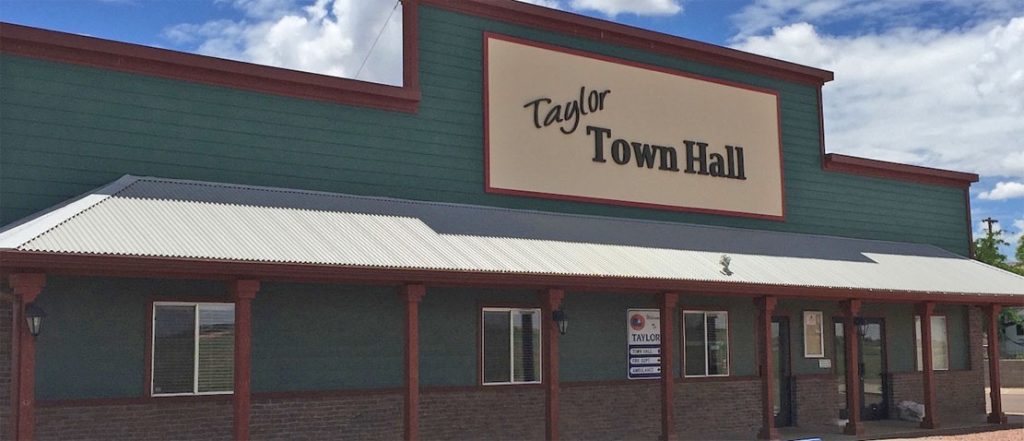
The Town of Taylor entered into an agreement with Central Navajo County Wildfire Protection Plans (CWPP) at the Thursday, Sept. 8, Taylor Town Council meeting.
Chief Clint Burden explained that they had entered into an agreement with Navajo County in 2009 and that areas within Navajo County had been recognized as Wildfire Hazard Zones.
Mary Springer, the Director of Navajo County Emergency Management, was present and explained that the Navajo County CWPP working group collaborated with community members, forestry specialists from the State Forestry, the Bureau of Land Management, the cooperative extension office, and representatives from city fire departments, and fire districts in order to map the wildland urban interface boundary within the county’s geographical area.
The CWPP core teams identified 10 communities for potential risk within the wildland urban interface boundary in the Sitgreaves Community Wildfire Protection Plan, and nine communities in the Central Navajo County Wildfire Protection Plan.
The Central Navajo County CWPP wildland fire hazards are cedar trees and grasses, while the Sitgreaves Community Wildfire deals more with ponderosa pines explained Springer. “When looking for grant money we have to have a current plan, so that’s why we’re here today,” said Springer, noting that they will be looking hard for grant money. “We’re going to go actively looking for funding to help homeowners clean up their property.”
Springer explained that what the State of Arizona doesn’t spend in suppression efforts they spend on mitigation, so they are looking at grants from the state and federal government, and the University of Arizona Cooperative Extension offers a 50-50 matching grant they will apply for.
The council unanimously approved a resolution adopting the Navajo County Community Wildfire Protection Plan, as well as the Arizona State Forestry Intergovernmental Agreement, which contracts Taylor-Snowflake Fire and Medical to send a crew and truck to fight wildland fires. Chief Burden said that they then invoice the cost to the state. “Right now we have a truck in California with this agreement. We’ve had a pretty good season getting the trucks out and helping.” Currently they have grossed $166,000 for having vehicles at wildland fires the chief said, adding that approximately one-third of that money will go to paying wages. “The council has been good letting us keep wildland funds and update our equipment with it. Without it we’d be in sorry shape,” said Chief Burden.
The council also approved the purchase of an EVG-wheeled ambulance in the amount of $152,968. With the purchase of this ambulance they will retire the 1998 Type II wheeled coach. Chief Burden explained that firefighters are all certified EMT’s so when they have an ambulance call they take their firefighting gear, and the van type ambulances do not have room for firefighting gear. He said this ambulance will be customized so it can carry firefighter gear. The ambulance will be purchased with a large down payment and a loan. The down payment will come from the Wildland Fire funds.
The purchase of a 2017 F150 4×4 super crew pickup was also approved that will serve as the chief’s truck, and will have the capability to carry a crew. Three bids were received, which are Show Low Ford $32,195.21; Winslow Ford $32,945.42; and Tate Ford $33,211.11. The truck Burden has been using has 155,000 miles on it and will be used as a secondary truck. Wildland funds will be used for this purchase. Council approved the purchase of a pickup from Show Low Ford in the amount of $32,195.21.




