

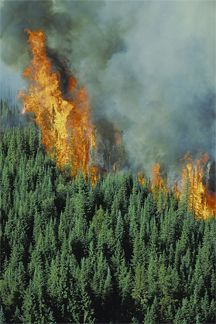
US Forest Service Supervisor Steve Best addressed concerns regarding smoke throughout the county and the efforts being taken to reduce wildfires at the Dec. 12 meeting of the Navajo County Board of Supervisors.
Best began his presentation on the prescribed burn activities on the Apache-Sitgreaves National Forest by sharing, “Researchers have found that more than a 100 years ago small fires would break out every five, 10 or 15 years maintaining the forest through nature.” He went on to say that with the migration of the European settlers and the introduction of livestock into Arizona, the ecosystem was changed and with it the nature of fire.
Then the Forest Service came along with the Smokey the Bear program in an effort to prevent fires. “Back then, everybody thought fires were bad things,” said Best. “The consequence was the forest was allowed to get thicker and denser and the fuels built up.”
Since then the area has experienced two catastrophic fires, the Rodeo-Chediski Fire in 2002 and the Wallow Fire in 2011. Those high intensity fires together burned approximately a million acres, which did a lot of damage to the forest and surrounding communities.
Best said the goal is to bring back the natural fire system by reducing the vegetation through mechanical operation, which includes logging and timber sales and controlled-burns. “When it comes to controlled burns, we have a window in the fall and the spring and so far this year, we have burned 8,500 acres. The White Mountain Apache Tribe has burned 38,000 acres.”
There is a focus on controlling and maintaining the forest in what is known as the wildland-urban interface (WUI) areas; places were structures and human lives intersect with the forest and can be affected by wildfires. By reducing the fuel, Best said that the wildfires are easier to control and maintain. “I think last year we had 167 wildfire starts and they were easy for us to control.”
Navajo County Supervisor Jason Whiting asked if most of what is being burned is biomass or timbers and what would drive the raw timber being burned versus being sold.
Best replied stating, “It depends on the timber sales. Some contractors take the biomass, others will pile it and we will come back and burn it. There are areas in the forest that are not easily accessible, either because of lack of roads or the terrain. The cost then becomes prohibitive for the timber contractors. Sometimes a fire starts in an area where raw timber will be impacted and we let it burn.”
Every prescribed burn is regulated through Arizona Department of Environmental Quality (ADEQ), based on weather, humidity, wind speeds and even the transport winds as well as how many other prescribed burns are happening in the area.
“Coming from the tribe, where we have thousands and thousands of acres of healthy forest due to the White Mountain Apache prescribed burning program, we are a national example of healthy forests,” said Supervisor Dawnafe Whitesinger.
Navajo County Emergency Managment Director Mary Springer said, “The Forest Service and state forestry both print out public information, and they go to the local radio stations and newspapers.
“We have our 311 information line where folks can dial in. It is a recorded line that the forest service uses to keep the public updated. We also have our Facebook pages. So in advance of the prescribed burnings, we get the information out as much as possible so the public does know what is going on.”
Best summed it up when he said, “Even though I’ve been told not to say this, the smoke is a necessary evil. We are going to have smoke one way or the other in Arizona, whether it is from wildfires or from controlled burns.”




